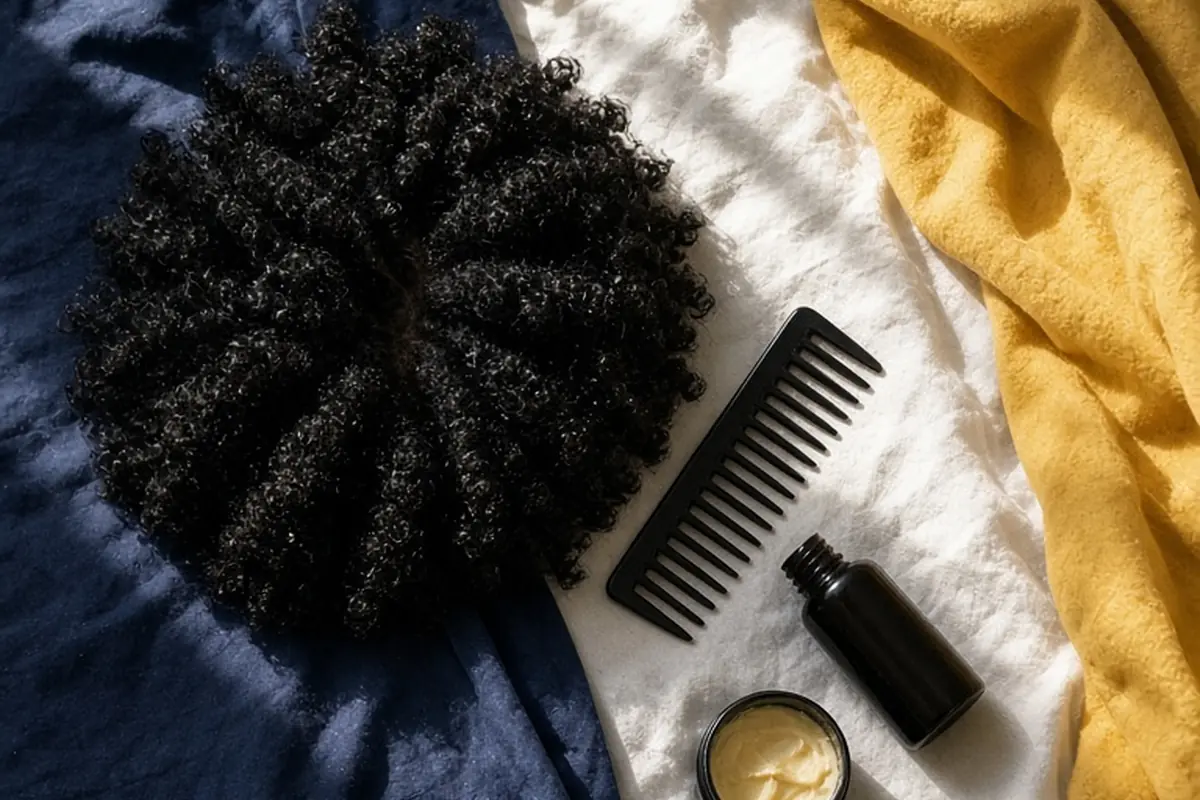
Caring for 4C textured hair centers on preserving natural moisture, minimizing mechanical tension, and protecting tight coil patterns from breakage. Effective maintenance requires gentle cleansing with sulfate-free formulas, methodical wet detangling using high-slip conditioners, and sealing hydration through the Liquid-Oil-Cream (LOC) or Liquid-Cream-Oil (LCO) method. Prioritizing low-manipulation styles, satin or silk night protection, and consistent deep conditioning ensures coils remain elastic, defined, and structurally resilient against environmental dryness and daily friction.
While 4C coils possess natural volume and intricate curl architecture, their tightly packed zig-zag pattern makes it difficult for natural scalp oils to travel down the hair shaft. Understanding how to support this unique structure allows you to build a low-stress routine that fosters long-term moisture retention and structural strength.
Cleansing Tight Coils Without Stripping Essential Lipids
A healthy 4C hair regimen begins at the scalp. Because tight coils bend sharply, the natural sebum generated by the sebaceous glands struggles to travel from the roots to the ends. Traditional clarifying shampoos formulated with harsh sulfates can strip these already scarce lipids, leading to immediate brittleness, dullness, and tangling. When selecting a cleanser, look for sulfate-free moisturizing shampoos or cleansing conditioners formulated with humectants such as glycerin, aloe vera, and gentle surfactants like decyl glucoside or cocamidopropyl betaine.
Establishing a wash frequency depends heavily on your lifestyle, product usage, and scalp physiology. For most individuals with 4C textured hair, washing once every seven to ten days strikes an effective balance between removing environmental debris and preserving vital hydration. If you exercise heavily or use heavy butters that accumulate along the hair shaft, incorporate a dedicated clarifying wash once or twice a month to clear product buildup. Cleansing in four to six distinct sections significantly reduces the risk of matting during the wash process, allowing water and lather to reach the scalp directly without disturbing your coil pattern.
Detangling Strategies to Minimize Breakage and Mechanical Stress
Detangling 4C hair requires patience, adequate slip, and deliberate mechanical handling. Attempting to comb through dry 4C strands is one of the fastest routes to breakage, as dry coils lack the elasticity needed to yield under tension. Always detangle on damp or thoroughly wet hair that has been saturated with a slippery rinse-out conditioner, leave-in detangler, or rich oil-infused mask. The water and conditioner coat the cuticles, lowering friction and allowing tangled strands to glide past one another smoothly.
Begin the detangling process using your fingers first. Finger detangling allows you to feel individual knots, shed hairs, and tangled clusters that a brush might tear through. Once larger tangles are separated, follow with a wide-tooth comb or a flexible-bristle detangling brush, always working upward from the ends toward the roots. Separating hair into small, manageable twists or clips before detangling ensures you do not inadvertently pull on adjacent sections. If you encounter a stubborn knot, apply extra conditioner and gently separate the strands horizontally rather than pulling downward.
Choosing Between the LOC and LCO Methods for 4C Hair
Hydration for 4C textured hair is a multi-step process involving water absorption followed by lipid sealing. The Liquid-Oil-Cream (LOC) and Liquid-Cream-Oil (LCO) methods are two foundational frameworks designed to trap moisture inside the hair shaft. In both methods, the liquid layer should consist of water, a water-based leave-in conditioner, or an aloe vera mist. True hydration comes exclusively from water-based products; oils and butters do not hydrate on their own, but rather act as sealants to prevent that water from evaporating into the surrounding air.
The choice between LOC and LCO largely hinges on your hair's porosity. If you have high porosity 4C hair, your cuticles remain open, absorbing water rapidly but losing it just as quickly. The LOC method often works well here, as applying a lightweight penetrating oil immediately after water helps slow down moisture loss before a thick butter or cream creates an occlusive outer barrier. Conversely, if you have low porosity hair with tightly sealed cuticles, the LCO method is typically superior. Applying your cream directly after the liquid allows moisture to absorb without being blocked by an oil barrier, with a light oil applied last to seal the cuticle surface without heavy residue.
Deep Conditioning and Maintaining Protein-Moisture Balance
Deep conditioning is a non-negotiable step for maintaining coil elasticity and softness. After cleansing, applying a formulated deep treatment supplies penetrating conditioning agents that temporarily smooth rough cuticles and reinforce weakened areas along the hair shaft. To enhance absorption, especially for low-porosity coils, apply gentle indirect heat using a hooded dryer, a thermal heat cap, or a warm damp towel covered with a plastic processing cap for fifteen to twenty minutes. Heat gently lifts the hair cuticles, allowing beneficial lipids and humectants to penetrate deeply.
Maintaining structural integrity also requires monitoring the delicate balance between moisture and protein. Moisture gives 4C hair its softness and flexibility, while protein provides structural scaffolding to resist snapping. If your hair feels mushy, excessively stretchy when wet, or limp, it may suffer from moisture overload (hygral fatigue) and will benefit from a light hydrolyzed protein treatment. If your coils feel rough, brittle, stiff, and snap easily upon gentle manipulation, your hair has too much protein and requires intensive, protein-free moisturizing treatments to restore suppleness.
Managing Shrinkage, Single-Strand Knots, and Fairy Knots
Shrinkage is a natural characteristic of healthy 4C hair and a direct sign of elasticity. When well-hydrated coils dry, they can contract significantly, appearing much shorter than their actual length. However, high shrinkage can sometimes lead to single-strand knots, commonly known as fairy knots, where an individual strand loops around itself during movement and drying. While shrinkage itself is healthy, unmanaged tangling can complicate future wash days and increase mechanical damage.
To reduce fairy knots without resorting to direct heat styling, you can gently stretch your coils using heatless methods such as two-strand twists, flat twists, braids, banding, or African threading. Keeping the ends of your hair stretched and tucked helps prevent individual strands from curling back onto themselves. In addition, scheduling regular dustings or trims every three to four months prevents weathered, split ends from traveling up the shaft, where they create rough friction points that encourage knots.
Low-Tension Protective Styling and Scalp Maintenance
Protective and low-manipulation styles—such as knotless box braids, passion twists, cornrows, flat-twist crowns, and wig installs—offer a practical way to safeguard fragile ends from daily friction, dry air, and frequent styling. However, a protective style only protects if it is installed and maintained with minimal tension. Excessive pulling along the hairline and temples can cause traction alopecia, a form of hair loss triggered by chronic mechanical stress on the follicles. Always communicate with your stylist to ensure braids and perimeter edges are installed comfortably without causing throbbing or pulling bumps.
Protective styles do not eliminate the need for regular scalp maintenance. While wearing a style, keep your scalp clean by applying a diluted scalp rinse, witch hazel on a cotton pad, or a targeted water-based cleansing spray along the parts. Avoid heavily greasing your scalp with dense butters or heavy petroleum products, as these can trap dead skin cells, sebum, and sweat, creating an environment ripe for irritation and flaking. If your scalp feels dry, opt for light, non-comedogenic oils applied sparingly to calm the skin without clogging pores.
Nighttime Care and Friction Reduction Strategies
The environment in which you sleep plays a massive role in whether your 4C hair retains moisture or dries out overnight. Standard cotton pillowcases and sheets act like sponges, absorbing conditioning agents and natural oils from your strands while you sleep. Furthermore, the rough texture of cotton fibers creates constant friction against the hair cuticle as you turn, leading to frizz, split ends, and morning tangles.
To protect your coils during the night, wrap your hair in a high-grade satin or silk bonnet, or wear a secure headscarf. If head coverings tend to slip off while you sleep, using a satin or silk pillowcase provides a continuous, low-friction backup surface. Before wrapping your hair, arrange it in loose multi-section twists, pineapple puffs, or loose braids to preserve your style, minimize flattening, and prevent the delicate ends from rubbing against your bedding.
Frequently asked questions
How often should 4C hair be washed?
Most people with 4C hair benefit from washing once every 7 to 10 days using a gentle, sulfate-free cleanser. If you exercise frequently or use heavy styling products, you can rinse or co-wash between full wash days to keep the scalp fresh without drying out your strands.
Is oil a moisturizer for 4C hair?
No, pure oils do not moisturize hair because they do not contain water. Oils act as sealants or lubricants that lock in hydration previously applied from water or water-based leave-in conditioners.
Can 4C hair grow long?
Yes, 4C hair grows at a standard biological rate, but its tight coil structure makes it more prone to mechanical breakage and shrinkage. Focusing on gentle detangling, regular deep conditioning, and low-tension protective styles will help retain length over time.
What is the best way to handle fairy knots on 4C strands?
Fairy knots cannot be untied once formed and should be snipped off cleanly with sharp hair shears. You can prevent new knots by stretching your hair with heatless styles like twists or braids and keeping your ends moisturized.
Your next step
Assess your hair's porosity this week by observing how quickly it absorbs water on wash day, then adjust your routine to either the LOC or LCO method to optimize long-term moisture retention.