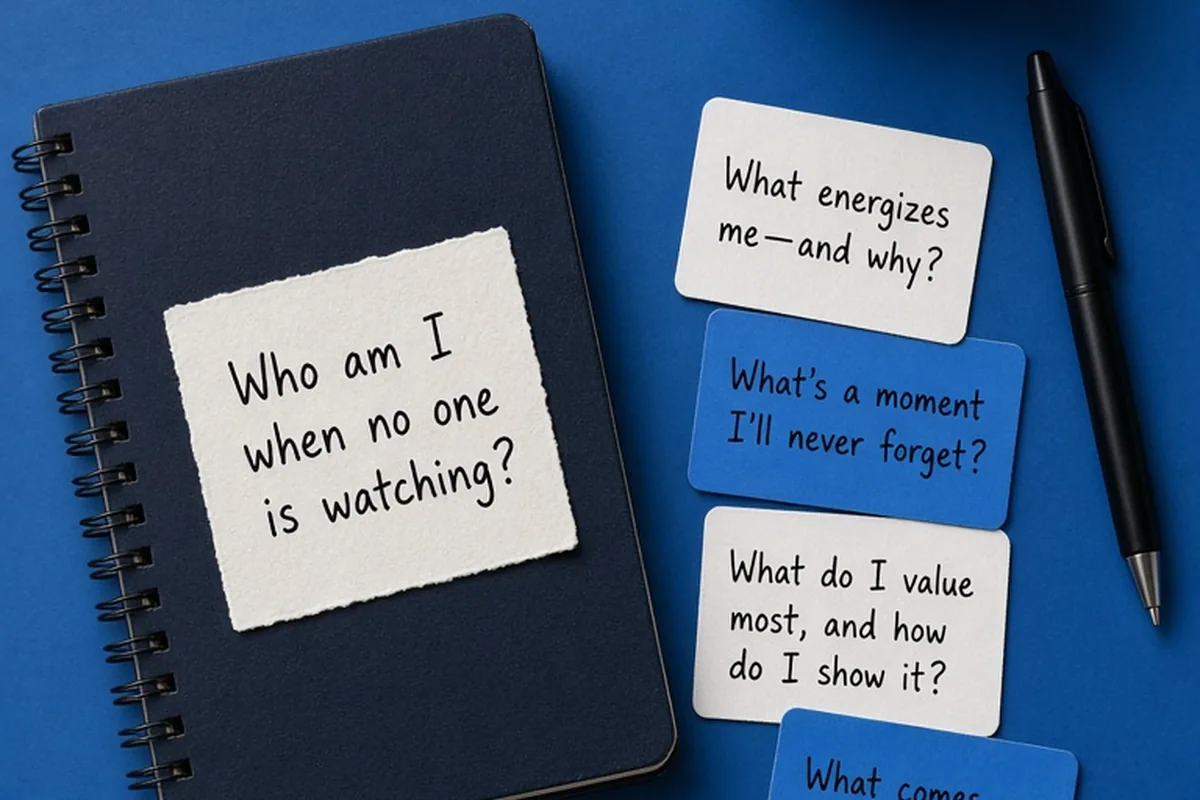
About me questions are targeted self-reflection prompts designed to help you articulate your values, career trajectory, personal passions, and working style. By answering structured inquiries about formative experiences and everyday motivations, you bypass the paralysis of the blank page, generating authentic, specific details that can be shaped into compelling bios, portfolio summaries, resume summaries, or personal introductions.
Summarizing who you are in a brief profile often feels unexpectedly difficult, even for confident communicators. Facing a blank document, many people instinctively resort to dry chronological lists of credentials or clichéd adjectives that fail to convey their distinct perspective. Working through deliberate discovery questions removes the pressure of immediate polish, giving you space to excavate meaningful details before editing them into an engaging narrative.
Uncovering Core Values and Guiding Philosophies
A compelling personal profile rarely begins with accomplishments; it begins with the foundational principles that direct your decisions. When readers understand what motivates your choices, they form an emotional connection that credentials alone cannot establish. Value-driven questions help identify the internal standards you apply to work, relationships, and problem-solving, revealing the underlying purpose behind your daily efforts.
To extract these principles, focus on questions that highlight your behavioral defaults and boundaries:
When responding to these prompts, avoid summarizing your values in single buzzwords like integrity or excellence. Instead, anchor each answer in a concrete decision where living that principle required real effort or sacrifice. For example, rather than claiming to value collaboration, describe a specific project where you slowed down delivery to ensure cross-functional input. The potential trade-off to monitor is staying too high-level; overly philosophical answers can read like an abstract manifesto unless grounded in everyday behaviors that audiences easily recognize.
- What professional or personal hill am I genuinely willing to stand on, even when it is inconvenient?
- Which single principle informs how I handle disagreements or conflicting priorities?
- What type of praise feels deeply fulfilling, and what type feels completely hollow?
- What is a standard rule in my industry or social circle that I deliberately choose to reject?
Mapping Your Professional Trajectory and Arc
Resumes document chronological employment, but an about me section should explain your trajectory. Audiences want to understand how your past experiences connect to your current capabilities and where you plan to direct your energy next. Questions that target turning points, hard-won insights, and unconventional pivots allow you to frame your career as an intentional journey rather than a random assortment of titles.
Reflect on the inflection points that reshaped how you approach your craft:
As you draft responses, focus on the tension between what was expected and what actually happened. The most interesting bios demonstrate resilience and adaptation rather than unbroken sequences of effortless triumphs. For instance, explaining how an unexpected software migration failure taught you to build user-centered testing protocols establishes both competence and humility. Be careful, however, not to over-index on past difficulties; an effective professional summary highlights lessons learned without lingering on workplace grievances.
- What was the single most informative mistake I made early in my career, and what did it teach me?
- Which project best demonstrates the unique intersection of my skills and practical interests?
- What problem do colleagues or friends constantly bring to me because they know I enjoy solving it?
- If my career had a cohesive theme over the last five years, what core curiosity drove it?
Capturing Personal Interests and Authentic Quirks
A profile composed entirely of professional milestones feels sterile and forgettable. Personal details, side fascinations, and small habits introduce texture, transforming a list of skills into a recognizable human being. When shared thoughtfully, personal quirks serve as conversational bridges, giving interviewers, clients, or new contacts an effortless entry point for meaningful dialogue.
Use these inquiries to uncover the human elements of your routine:
The secret to making personal details land effectively is rigorous specificity. Broad claims such as enjoying travel or loving coffee are so common that they register as background noise. Replace them with sensory, specific details: mention your attempt to bake the perfect loaf of sourdough, your collection of architectural field guides, or your habit of sketching vintage typewriters on weekend mornings. The trade-off lies in knowing your audience; retain sufficient boundaries so your profile remains professional and relevant without veering into oversharing.
- What subject could I speak about for twenty minutes straight without any preparation?
- How do I spend the first two unstructured hours of a free Saturday morning?
- What creative pursuit or hobby provides me deep satisfaction with zero expectation of income?
- What book, documentary, or piece of art fundamentally altered the way I view everyday life?
Tailoring Answers to Specific Formats and Audiences
An effective about me statement is never one-size-fits-all. The answers you pull from self-reflection must be filtered through the context of where the profile will live and what the reader needs from you. A personal website about page affords space for narrative depth and origin stories, while a LinkedIn summary demands rapid clarity on value proposition, and an author bio requires swift authority and thematic resonance.
Begin by identifying your primary reader's immediate question. A prospective client asks, 'Can this person solve my specific operational problem?' A potential employer asks, 'How does this person interact with a team under deadline pressure?' A social media visitor asks, 'Does this creator share perspectives I find insightful?' Once you identify the primary question, select only the answers from your reflection bank that directly address that need.
A useful technique is the modular summary: develop a single comprehensive master profile of four hundred words, then edit it down to a one-hundred-word medium bio and a twenty-five-word micro bio. The trade-off in condensing your work is that nuance inevitably diminishes in shorter formats. Accept that micro bios must focus on a single hook, trusting your portfolio or website to provide the richer context.
Synthesizing Raw Reflections into a Fluid Narrative
Having answers to multiple questions is useful, but stringing them together sequentially produces a disjointed, choppy profile. The final step involves weaving disparate answers into an organized, three-part story arc: current focus, foundational background, and forward-looking vision. This structure gives your bio rhythm and purposeful momentum.
Start with your present focus to ground the reader in your current identity and primary capabilities. Next, transition into the middle section by pulling from your trajectory answers, demonstrating how your past challenges and values shaped your distinct methodology. Finally, conclude with your forward vision, referencing the problems you are eager to tackle or the types of collaborations you welcome. This ensures the text closes with a welcoming, actionable invitation.
Consider this transformation: raw notes might say, 'I like coding, I used to be a teacher, and I value clear communication.' A synthesized narrative connects the causality: 'After five years teaching high school mathematics, I transitioned into full-stack development, bringing a teacher's clarity to complex software architecture. Today, I build intuitive educational platforms that help non-technical users navigate data.' The second version demonstrates how past experience directly enhances current value.
Avoiding Common Bio Writing Pitfalls and Traps
When writing about oneself, anxiety often leads people into predictable stylistic traps. One prevalent issue is performative humility, where writers minimize their genuine achievements out of fear of sounding arrogant. Downplaying your expertise does not make you appear modest; it makes you appear uncertain. State your contributions plainly and factually, crediting collaborators where appropriate, but without self-deprecating apologies.
The opposite error is corporate jargon overload, in which natural language is replaced by empty phrases such as 'dynamic synergist' or 'results-oriented thought leader.' These phrases act as placeholders that obscure actual competence. Test every sentence by asking whether a close friend would recognize you saying it out loud. If the phrasing feels unnaturally stiff, strip it down to direct, active verbs.
Finally, watch out for the passive observer trap. Ensure your about me text highlights your active agency. Instead of writing that you 'found yourself working in publishing,' articulate the intentional choice: 'I pursued editorial publishing to champion emerging narrative nonfiction.' Taking ownership of your choices builds authority and makes your profile substantially more engaging.
Illustrative Scenarios
Consolidating a Disconnected Portfolio Bio
A freelance visual designer and audio producer felt her online bio read like an unfocused list of unrelated gigs. She answered core value and trajectory questions, noticing an unexpected common thread: both disciplines relied heavily on pacing and narrative rhythm. She restructured her profile around this unifying concept, opening with her focus on sensory storytelling, demonstrating how her work in community radio informs her visual animations, and closing with her current client projects.
Key point: Identifying the shared methodology behind seemingly divergent skills allows multi-disciplinary professionals to present a cohesive identity without discarding valuable experience.
Frequently asked questions
Should I write my about me profile in the first or third person?
First-person perspective ('I am') is generally best for personal websites, portfolios, and platforms like LinkedIn because it establishes warmth and direct connection. Third-person phrasing ('She is' or 'Alex is') works better for conference programs, book dust jackets, formal press kits, or company executive directories where an editorial tone is customary.
How long should an about me section typically be?
A standard website about page performs best at roughly two hundred to four hundred words, giving sufficient space for story, values, and credentials. Social profiles and micro-bios should stay under fifty words, focusing strictly on your core identity and primary offering.
How frequently should I update my answers to about me questions?
Review your prompts once a year or whenever you complete a major career transition, master a new domain, or shift your creative goals. Regular audits prevent your public profiles from anchoring you to past work you no longer wish to pursue.
Your next step
Select three questions from this guide today, write unedited two-minute responses to each, and use those raw insights to draft a fresh three-paragraph bio.