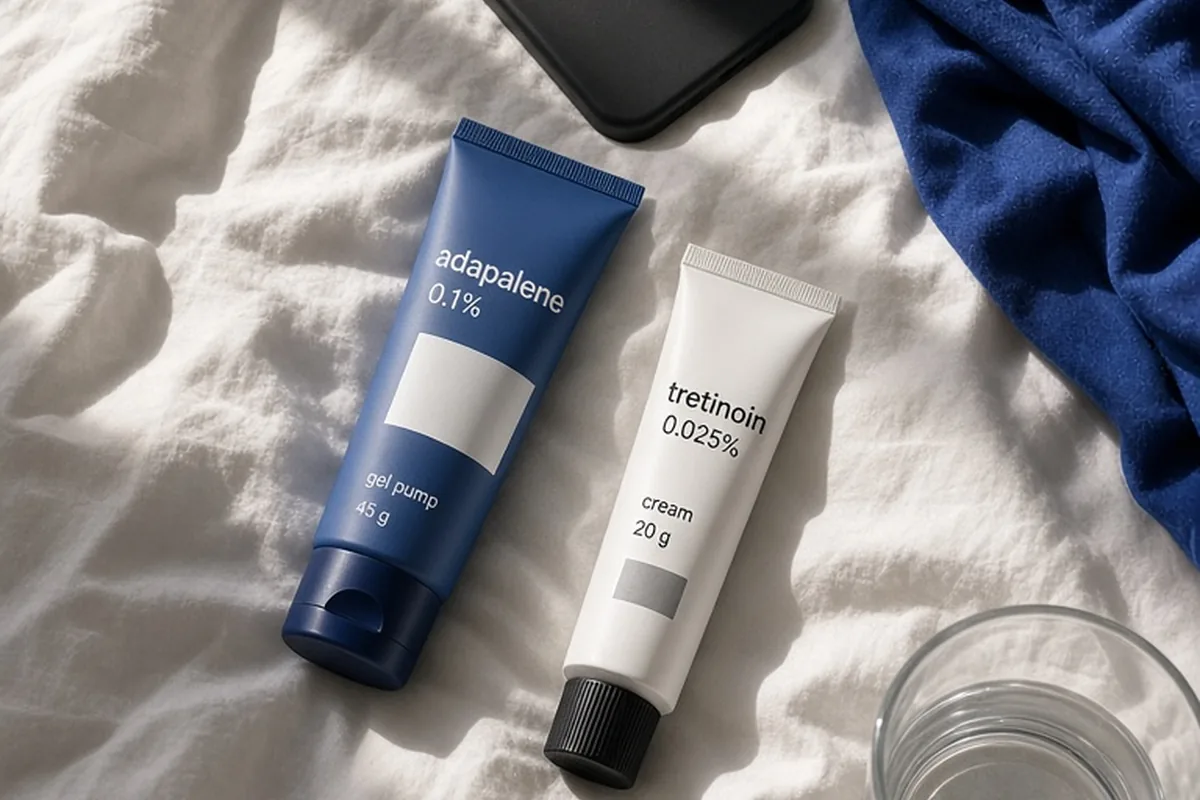
Adapalene and tretinoin are both topical retinoids, but they differ in strength, tolerability, and access. Adapalene targets acne specifically, offering high tolerability and convenient over-the-counter access in the United States. Tretinoin requires a prescription and is more potent, making it the standard choice for stubborn acne, rough texture, and visible signs of photoaging. If your primary goal is gentle acne control, start with adapalene; if you seek broader skin remodeling and anti-aging benefits under clinical guidance, choose tretinoin.
Navigating topical vitamin A derivatives can feel overwhelming when balancing breakout prevention against the risk of irritation, dryness, and barrier disruption.
Comparing Adapalene and Tretinoin: Molecular Structure and Availability
Adapalene and tretinoin belong to the retinoid family, yet their underlying chemical classifications create distinct clinical behaviors on human skin. Tretinoin, chemically known as all-trans retinoic acid, is a first-generation retinoid. Because it is bioidentical to the active retinoic acid naturally utilized by skin cells, it binds directly to multiple retinoic acid receptor subtypes, specifically RAR-alpha, RAR-beta, and RAR-gamma. This broad receptor affinity allows tretinoin to exert profound cellular effects throughout the epidermal and dermal layers, driving rapid cellular turnover, clearing clogged follicular channels, and stimulating structural proteins. However, this non-selective binding also accounts for its historical reputation for triggering noticeable flaking, redness, and initial skin discomfort.
In contrast, adapalene is a synthetic, third-generation retinoid engineered specifically to overcome some of the tolerability and stability challenges associated with earlier retinoids. It selectively targets RAR-beta and RAR-gamma receptors, which are the primary receptors located within the upper epidermis and follicular epithelial lining. By focusing its activity on these specific pathways, adapalene exerts potent comedolytic and anti-inflammatory actions while minimizing the generalized skin irritation caused by broader receptor activation. Furthermore, adapalene features a highly stable chemical backbone that makes it lipophilic, allowing it to penetrate rapidly into oil-rich sebaceous follicles where acne formation begins.
Availability also marks a major practical divide between the two compounds within the United States. While tretinoin remains strictly available by prescription only in concentrations ranging from 0.025 percent to 0.1 percent across creams, gels, and microsphere formulations, adapalene is widely accessible without a prescription at a 0.1 percent concentration. Higher strengths of adapalene, such as the 0.3 percent gel, or combination formulas containing benzoyl peroxide, still require a formal prescription from a healthcare provider. This difference in regulatory classification means that individuals seeking to establish a reliable retinoid routine can easily begin using adapalene immediately, whereas starting tretinoin requires an evaluation and ongoing guidance from a licensed prescriber.
Further reading: American Academy of Dermatology: Acne
Managing Acne Breakouts: Which Retinoid Clears Blemishes More Effectively?
Both adapalene and tretinoin are cornerstone therapies for managing mild, moderate, and persistent acne vulgaris. Their primary therapeutic mechanism is comedolytic, meaning they normalize the desquamation of follicular epithelial cells. In acne-prone skin, dead skin cells shed abnormally and clump together with excess sebum, forming microcomedones that eventually develop into visible whiteheads, blackheads, and inflamed papules. By signaling keratinocytes to shed evenly rather than adhere to the pore wall, both medications prevent new microcomedones from forming, effectively addressing the root cause of breakout cycles.
Adapalene holds a distinct advantage when treating inflammatory blemishes due to its inherent anti-inflammatory properties. Beyond regulating cell turnover, adapalene directly modulates the inflammatory cascade by inhibiting the lipoxygenase pathway and downregulating the migration of inflammatory cells into the hair follicle. This dual action makes it especially effective for individuals dealing with red, tender, inflamed pimples and surface pustules. Users frequently observe that inflamed spots calm down with less surrounding erythema compared to traditional baseline therapies.
Tretinoin, while equally powerful at preventing microcomedones, works through sheer cellular acceleration. By rapidly increasing cellular proliferation from the basal layer outward, tretinoin expedites the expulsion of existing follicular plugs and deep impactions. This aggressive unroofing of stubborn comedones makes tretinoin exceptionally effective for chronic non-inflammatory comedonal acne, including closed comedones and persistent texture irregularities across the forehead, chin, and jawline. However, because tretinoin promotes such rapid turnover, the initial clearing phase can feel more intense, occasionally leading to a temporary surge in visible blemishes as underlying impactions surface simultaneously.
Further reading: American Academy of Dermatology: Acne
Anti-Aging and Skin Texture: Weighing Tretinoin's Evidence Against Adapalene
When the primary skincare objective extends beyond blemish control to addressing the visible signs of photoaging, tretinoin remains the gold standard topical treatment. Decades of clinical literature support tretinoin's capacity to remodel the extracellular matrix of the dermis. By binding broadly to retinoic acid receptors, tretinoin directly stimulates dermal fibroblasts to synthesize new type I and type III collagen, while simultaneously inhibiting matrix metalloproteinases, the enzymes responsible for breaking down collagen fibers after ultraviolet radiation exposure. Over consistent months of use, tretinoin demonstrably improves fine lines, softens deep wrinkles, enhances dermal thickness, and disperses concentrated melanin deposits to fade sun-induced hyperpigmentation.
Adapalene, historically developed and studied almost exclusively for acne management, has a smaller body of research addressing photoaging. Because adapalene targets RAR-beta and RAR-gamma, it does enhance epidermal cell renewal and promotes a smoother, more uniform surface texture. Preliminary clinical investigations into higher-strength adapalene have indicated that it can stimulate collagen production and reduce solar lentigines over extended application periods, offering a meaningful anti-aging benefit for individuals whose skin cannot tolerate tretinoin. Nevertheless, the total depth of clinical documentation establishing long-term dermal remodeling remains far more extensive for tretinoin.
For individuals experiencing both adult acne and the early visible markers of photoaging, this distinction helps clarify expectations. If your chief priority is smoothing fine lines, improving structural elasticity, and reversing chronic sun damage, working with a prescriber to introduce tretinoin is the most supported route. If your priority is calming recurring breakouts while enjoying moderate secondary improvements in surface radiance and post-inflammatory dark marks, over-the-counter adapalene delivers dependable performance without necessitating a medical appointment.
Irritation, Peeling, and the Purge: Evaluating Tolerability Profiles
The retinization process refers to the initial period during which skin adapts to accelerated cell turnover, often accompanied by flaking, localized dryness, tightness, and heightened reactivity. The severity of this transition represents one of the most significant practical differences between adapalene and tretinoin. Because adapalene binds selectively to specific receptor sites and possesses a distinct lipophilic structure that remains concentrated within the pilosebaceous unit, it generally produces fewer disruptive side effects on the surrounding epidermal barrier. Most individuals adjusting to adapalene experience manageable flaking and mild tightness that resolve within a few weeks.
Tretinoin, by contrast, frequently induces a more pronounced retinization phase. Its non-selective binding throughout multiple epidermal layers can temporarily compromise the stratum corneum barrier, leading to noticeable peeling around the mouth, nose, and eyes, as well as stinging sensations when applying basic moisturizers or sunscreens. Furthermore, the rapid unseating of deep microcomedones often triggers what is commonly known as a retinoid purge, where pre-existing sub-surface blockages rapidly mature into visible whiteheads and inflammatory papules over the first four to eight weeks of consistent use.
Mitigating these side effects requires disciplined application strategies regardless of which molecule you select. Initiating therapy by applying the product only two or three evenings per week allows the skin barrier time to adapt without succumbing to severe moisture loss. Incorporating a bland, ceramide-rich barrier cream and strictly avoiding concurrent physical scrubs, exfoliating acids like glycolic or salicylic acid, and astringent toners during the initial adaptation period dramatically improves overall comfort and treatment adherence.
Further reading: American Academy of Dermatology: Acne
Formulation Stability, Routine Layering, and Daytime Sun Sensitivity
A critical technical distinction that influences daily application routines is the molecular photostability and chemical compatibility of each retinoid. Traditional forms of tretinoin are notoriously photolabile, meaning the active molecule degrades and loses potency when exposed to direct sunlight and ambient indoor ultraviolet rays. For this reason, conventional tretinoin must be applied strictly in the evening before bed. Additionally, conventional tretinoin degrades rapidly when applied alongside oxidizing agents like benzoyl peroxide, meaning these two active ingredients cannot be layered at the same time and must be separated into morning and evening steps.
Adapalene offers superior chemical and physical stability. Its synthetic molecular framework resists degradation under light exposure, meaning accidental light exposure after evening application does not diminish its effectiveness. Crucially, adapalene remains entirely stable in the presence of benzoyl peroxide. This compatibility allows the two powerhouse acne-fighting ingredients to be formulated together in single prescription products or applied sequentially in the same evening routine without chemical neutralization, providing a powerful dual-action defense against bacterial proliferation and follicular clogging.
Despite their differences in molecular stability, both retinoids thin the outermost compacted layer of dead stratum corneum cells during the initial months of use, which temporarily increases the skin's vulnerability to sunburn and UV-induced hyperpigmentation. A broad-spectrum sunscreen with an SPF rating of 30 or higher must be worn every morning regardless of whether you apply adapalene or tretinoin. For individuals with sensitive skin, adopting the buffering technique, which involves applying a light layer of moisturizer immediately prior to or mixed directly with the retinoid, helps slow transdermal absorption and minimizes stinging without neutralizing clinical efficacy.
Further reading: American Academy of Dermatology: Acne
Cost Breakdown, Insurance Realities, and Selecting the Right Retinoid
Financial considerations and prescription requirements play a decisive role when determining which retinoid fits your long-term skincare budget. Adapalene 0.1 percent gel is readily available over the counter across US pharmacies, grocery stores, and online retailers. A standard 45-gram tube typically lasts between two and three months when applied as a pea-sized amount across the entire face, representing a highly predictable, out-of-pocket expense that does not require medical co-pays, recurring clinic visits, or prior authorization paperwork.
Tretinoin, being an exclusively prescription medication, involves variable overall costs depending on your healthcare plan and age. Many US health insurance formularies provide robust coverage for generic tretinoin when prescribed specifically for acne vulgaris in adolescents and young adults. However, for adult patients or when prescribed primarily for photoaging, insurance providers may classify the medication as a non-covered or cosmetic expense, leaving the individual responsible for full cash pricing or requiring the use of pharmacy discount cards and specialized compounding services. Patients must factor in both the ongoing cost of the medication tube and the professional fees associated with dermatologist consultations.
To make an informed decision, assess your primary clinical objective, your baseline skin sensitivity, and your preferred access channel. Choose adapalene if your primary concern is active acne, if you have sensitive or easily irritated skin, or if you prefer an affordable, immediately accessible product that requires no prescription. Opt for tretinoin if you have persistent or severe textural issues, if your primary goal is comprehensive anti-aging and collagen remodeling, and if you are willing to consult a medical professional to establish an individualized, step-up concentration protocol.
Frequently asked questions
Can I switch from adapalene to tretinoin once my skin adapts?
Yes, many individuals begin with over-the-counter adapalene to build retinoid tolerance and clear active blemishes before transitioning to prescription tretinoin for advanced skin texture and anti-aging benefits. When making the transition, consult a healthcare provider to select an appropriate starting concentration and temporarily reduce application frequency to allow your skin to acclimate to the stronger active.
Can I use adapalene or tretinoin while pregnant or breastfeeding?
Topical retinoids, including both adapalene and tretinoin, are generally advised against during pregnancy due to theoretical risks associated with systemic vitamin A toxicity. If you are pregnant, planning to become pregnant, or nursing, discontinue retinoid use and consult your obstetrician or dermatologist for pregnancy-safe alternatives such as azelaic acid.
How long does it take to see visible results from adapalene versus tretinoin?
Both adapalene and tretinoin require consistent application over several months to demonstrate their full clinical impact. Most users notice initial improvements in acne breakouts and surface smoothness within eight to twelve weeks, while structural improvements such as collagen remodeling and wrinkle reduction from tretinoin typically require six to twelve months of steady use.
Can I use vitamin C or chemical exfoliants in the same routine as my retinoid?
It is best to separate potent active ingredients to prevent severe barrier disruption and irritation. Use vitamin C serums in the morning under broad-spectrum sunscreen, and reserve your retinoid for the evening. Avoid using exfoliating acids like AHAs and BHAs on the same nights you apply your retinoid, particularly during the first few months of treatment.
Your next step
Evaluate your primary skin goal today, and if you are managing uncomplicated breakouts, begin with a pea-sized amount of over-the-counter adapalene two nights a week alongside a gentle moisturizer and daily sunscreen.