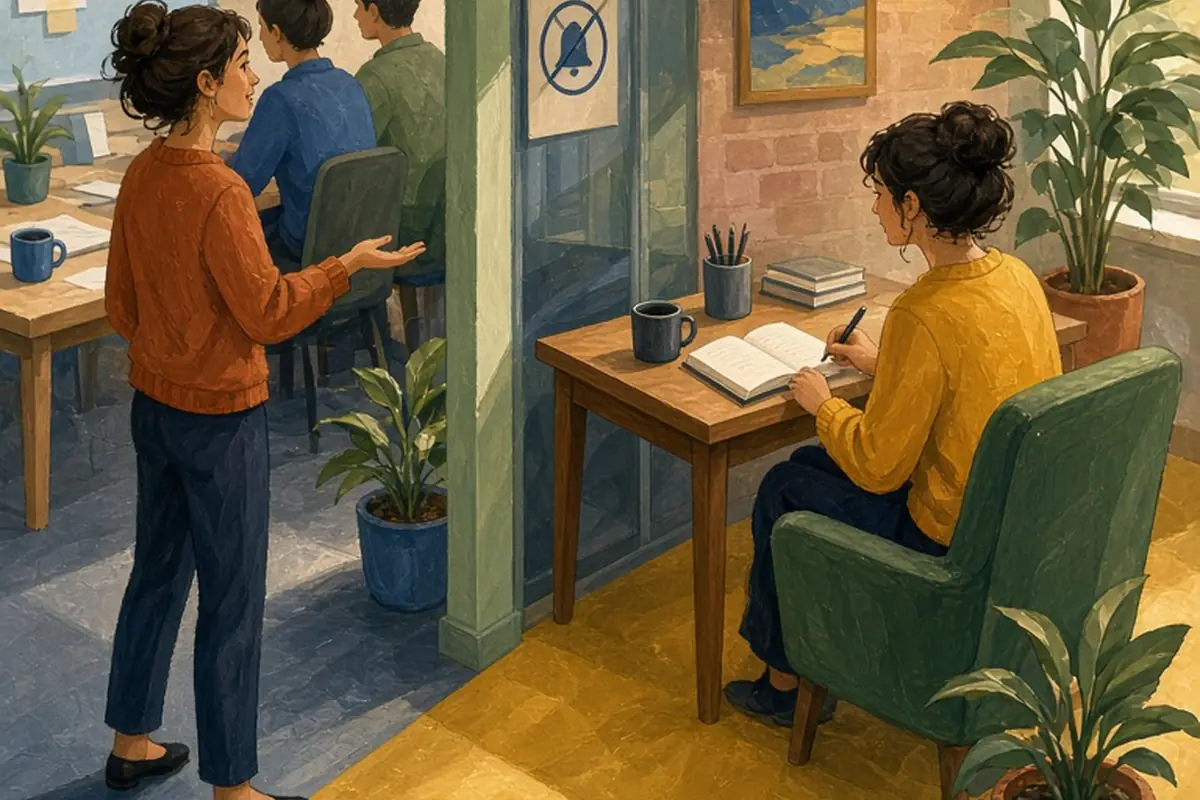
Alone time at work is intentional solitude reserved for deep concentration, mental rest, or processing complex tasks without workplace interruptions. You can secure it by blocking non-negotiable focus periods on shared calendars, stepping away from your workstation during breaks, setting clear communication statuses, and negotiating quiet zones. Prioritizing brief periods of professional solitude helps restore cognitive energy, reduces collaborative fatigue, and improves overall work quality.
Modern workplaces frequently celebrate constant collaboration, but continuous social engagement and frequent task switching can quietly drain your energy. Balancing teamwork with periods of deliberate isolation allows you to sustain attention, think critically, and finish demanding projects with far less stress.
Recognizing Collaborative Fatigue in the Modern Workplace
In many office environments, being productive is often confused with being constantly accessible. Employees bounce between instant messaging notifications, unscheduled drop-ins, and recurring meetings, leaving very little space for independent thought. Over time, this constant social connectivity produces collaborative fatigue. When your brain is forced to monitor ongoing conversational threads while attempting to complete analytical or creative tasks, performance naturally suffers. You might notice subtle signs of this depletion early on: struggling to read through a basic technical brief, rereading the same paragraph multiple times, or feeling an irrational wave of irritation whenever a colleague approaches your desk with a quick question.
Solitude acts as a necessary counterweight to this perpetual state of low-grade vigilance. Without moments of genuine quiet, your cognitive reserves become exhausted, which impairs judgment and increases the likelihood of avoidable errors. For instance, an accountant reviewing complex financial models or an engineer writing code needs uninterrupted processing time to track intricate details. When that person is interrupted every twelve minutes, restarting the mental chain of logic consumes substantial effort. Carving out alone time is not an act of antisocial withdrawal; rather, it is a practical operational choice designed to protect your attention, maintain accurate output, and prevent the quiet burnout that stems from over-communication.
Structuring Your Calendar with Protected Focus Blocks
Relying on spare moments to appear organically during the workday almost never succeeds. If open space exists on a shared calendar, colleagues will naturally book it for meetings, check-ins, or impromptu brainstorms. To establish consistent alone time, you must treat your focus periods with the same formal commitment as an appointment with an executive or client. Start by auditing your typical work week to identify when your cognitive energy peaks. If you write, analyze, or build most effectively in the morning, reserve a recurring two-hour window between nine and eleven in the morning on Tuesdays and Thursdays. Label this slot clearly as focused project work so teammates understand it is dedicated to deliverables rather than open availability.
Implementing this approach requires active management and practical compromises. A useful tactic is to group collaborative obligations into specific afternoons, leaving alternative days relatively clear for deep work. For example, a marketing manager might designate Wednesday as an internal meeting day, scheduling one-on-one sessions and planning huddles back-to-back, while reserving Thursday mornings exclusively for drafting campaign strategies. The trade-off here is schedule density: meeting-heavy days will feel intense and demanding, but they purchase unbroken blocks of solitude later in the week. If an urgent priority requires you to forfeit a scheduled block, make it an immediate habit to relocate that time elsewhere in the week rather than simply deleting it.
Communicating Boundaries Without Alienating Coworkers
Declaring that you need space can easily be misinterpreted as a lack of team spirit if the message is framed poorly. When colleagues do not know why you are unavailable, they may assume you are disengaged, unhelpful, or falling behind on team goals. To avoid misunderstandings, communicate your focus windows proactively and emphasize the mutual benefits. Frame your unavailability around delivering better outcomes for the group rather than simply wanting to avoid interaction. Let your teammates know when you will be offline, what specific deliverable you are finishing, and precisely when you will be accessible again to handle their questions.
Specific language makes a significant difference in how your boundaries are received. Instead of putting up a vague away message, use precise messaging such as: Focusing on the quarterly budget draft until two in the afternoon; I will check and reply to urgent messages at that time. If someone stops by your workspace in person while you are working through a detailed problem, offer a polite deferral paired with a definitive alternative. You might say: I am in the middle of finishing this report, but I want to give your question my full attention. Can we connect at quarter past three? This reassures the other person that their needs matter while preserving the mental momentum you need to finish your current task.
Navigating Open Offices and Establishing Micro-Sanctuaries
Open-plan office layouts present unique challenges for anyone attempting to secure quiet time. Visual distractions, nearby phone conversations, and spontaneous desk visits make sustained focus extraordinarily difficult. When you cannot close a physical office door, you must rely on environmental cues and mobility to create functional boundaries. Visual indicators, such as noise-dampening over-ear headphones, signal to passing coworkers that you are immersed in solitary effort. Many teams establish explicit internal agreements where headphones worn over both ears mean an employee is unreachable except for genuine emergencies.
In addition to visual signals, physically changing your location within the office building can provide temporary relief from social interruptions. Consider rotating to an unassigned booth, a secondary conference room that is temporarily empty, or a quiet lounge area where people generally do not linger to chat. A human resources coordinator might take their laptop to a quiet seating area on a different floor to complete sensitive employee reviews without being interrupted by casual passersby. The primary limitation of this tactic is office etiquette; you must respect shared space guidelines and avoid monopolizing multi-person meeting rooms for solo work during peak booking hours.
Using Solo Breaks to Support Midday Mental Recovery
Workplace alone time should not be limited strictly to heads-down task execution; it is equally valuable for cognitive recovery during breaks. In many office cultures, lunch is treated as an obligatory social function where colleagues eat together while continuing to discuss work projects or company politics. While collective socializing builds rapport, spending an entire workday engaged in conversation deprives introverted or overstimulated employees of necessary rest. Choosing to spend your midday break alone gives your nervous system a chance to decompress, reset its attention span, and release the tension accumulated throughout the morning.
To make a midday break genuinely restorative, physically detach yourself from both work tools and interpersonal demands. Leave your primary workstation to take a brisk twenty-minute walk around the block, find a quiet bench in a nearby park, or sit in your car with a book. Avoid spending this solitude scrolling through stressful news feeds or social media, as digital stimulation often mimics the demands of work. A software developer who spends forty minutes eating lunch quietly in a nearby green space often returns to their desk with sharper problem-solving abilities than a colleague who spent that same lunch hour engaged in rapid-fire office debates. The trade-off is passing up casual team socializing, which you can easily balance by attending group lunches once or twice a week.
Carving Out Intentional Solitude in Remote Work Environments
Working remotely eliminates physical office interruptions, but it introduces a distinct hazard: perpetual digital accessibility. When working from home, the boundary between professional demands and personal solitude often collapses entirely. Chat notifications, status indicators, and immediate email alerts create an invisible tether that demands continuous attention. Because colleagues cannot see what you are doing, they may expect instant replies to direct messages, interpreting a thirty-minute delay as inactivity. As a result, remote employees often feel more intensely monitored than in-office staff, driving them to stay tethered to communication channels all day.
Establishing alone time at home requires deliberate control over your digital infrastructure. Close email clients and collaboration platforms completely when tackling tasks that demand deep reasoning, or set your status to do not disturb with a scheduled end time. Establish clear asynchronous work expectations with your team, agreeing that not every message requires an immediate response unless it meets explicit emergency criteria. For example, a remote data analyst might log off team chat between ten and noon every morning to analyze raw datasets without alerts popping up on the screen. The primary risk of digital isolation is falling out of alignment with rapidly changing project requirements, which you can mitigate by posting a quick summary of your progress once your focus block concludes.
Balancing Solitude with Team Obligations and Visibility
While quiet time is essential for producing high-quality work, excessive isolation can backfire if managed without nuance. Professional advancement and collaborative trust rely heavily on interpersonal relationships, informal mentoring, and visible contributions to team goals. An employee who retreats behind closed doors or remains permanently offline risks being perceived as aloof, unapproachable, or unwilling to support colleagues. Total isolation also increases the danger of working in a silo, where you spend days polishing an assignment only to realize your direction drifted away from the team's evolving requirements.
The objective is not to maximize isolation at all costs, but to calibrate the balance between solitary productivity and cooperative availability. Evaluate your role realistically: individual contributors like copywriters or researchers may legitimately require four to five hours of alone time daily, whereas managers or project coordinators might only manage sixty to ninety minutes before their absence creates bottlenecks for others. Pay close attention to team rhythms, making yourself readily accessible during critical planning phases, launch days, and all-hands check-ins. By remaining actively engaged and helpful during collaborative periods, you build the social capital and trust necessary to take undisturbed solitude without question when you truly need it.
Illustrative Scenarios
Restructuring the Workday for Focus and Accessibility
A senior technical writer at a software consultancy felt continually overwhelmed by ad-hoc Slack questions, review requests, and spontaneous video calls from engineering teams. She consistently found herself working late into the evening simply to write documentation without interruptions. To address the problem, she spoke with her project manager and introduced a predictable daily structure: mornings from nine to eleven-thirty were reserved for quiet writing with communication apps turned off, while afternoons were dedicated to team reviews, editing requests, and office hours. She posted these hours in her status line and created a shared document where colleagues could drop questions asynchronously throughout the morning.
Key point: Predictable scheduling and transparent communication allow employees to secure significant alone time without leaving their teams unsupported or delaying project timelines.
Frequently asked questions
How do I ask my manager for more quiet time without seeming unproductive?
Frame your request around specific business deliverables and work quality rather than personal preference. Explain that setting aside dedicated periods of uninterrupted focus will help you complete complex tasks faster, minimize errors, and reduce project bottlenecks. Propose a short trial period with clear progress check-ins so your manager can evaluate the results firsthand.
What should I do if a coworker consistently ignores my focus status?
Address the pattern calmly and directly the next time an interruption occurs without an urgent reason. Acknowledge their question, gently reiterate that you are currently in a focus window, and suggest a specific time later in the day to discuss their topic. Maintaining consistent follow-through teaches colleagues to respect your boundaries without creating unnecessary friction.
How much alone time is realistic for someone in a leadership role?
Leaders generally have higher collaborative demands, making long stretches of daily isolation difficult to sustain. A practical target is sixty to ninety minutes per day, scheduled either early in the morning before team check-ins or late in the afternoon to review progress and plan strategy. Even brief, disciplined blocks of solitude provide leaders with the clarity needed for effective decision-making.
Is it rude to take a solo lunch when the rest of my team eats together?
Taking time for yourself at lunch is completely acceptable, provided you manage expectations gracefully. You can join the group once or twice a week to maintain social ties, while politely declining on other days by stating you have personal errands to run or need a quiet walk. Setting this routine early establishes that your solo breaks are a regular personal habit rather than an avoidance of your peers.
Your next step
Open your calendar right now, select two non-consecutive days next week, and block out a single sixty-minute focus window on each day to establish your new habit of deliberate workplace solitude.