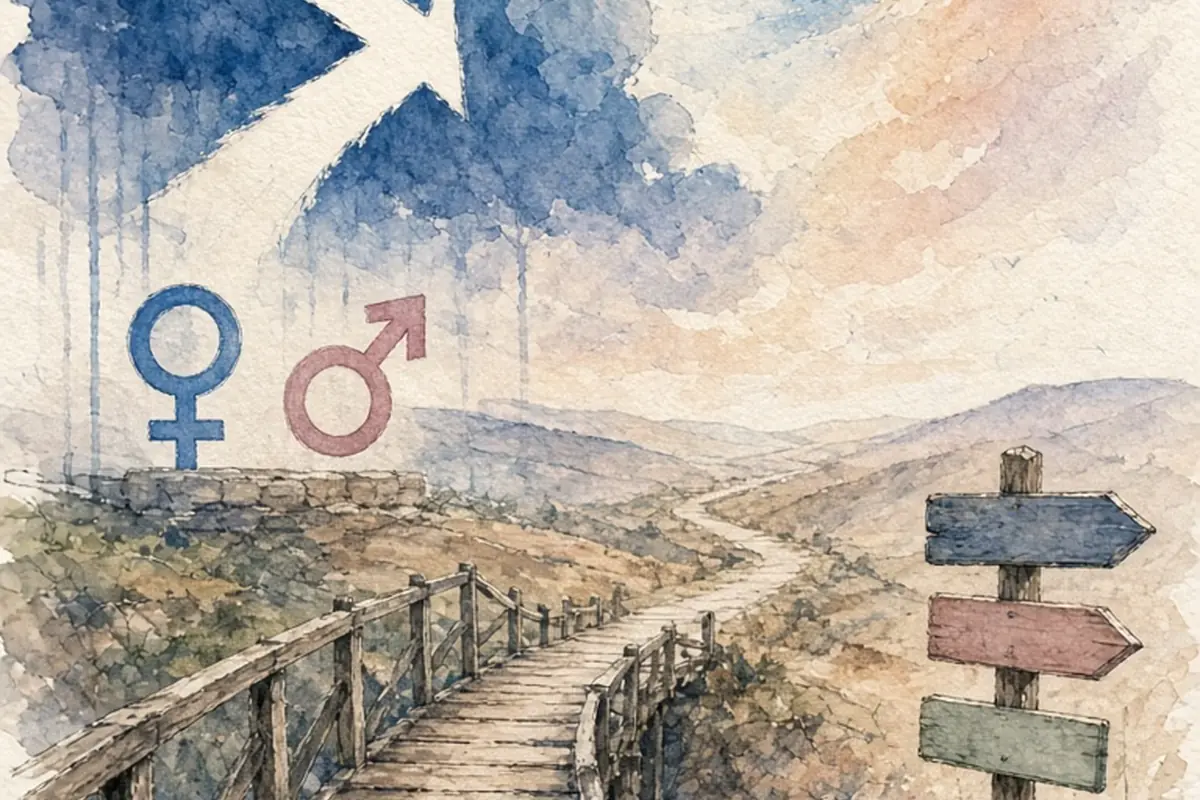
Aporagender is a nonbinary gender identity describing a gender that exists entirely apart from male, female, or anything in between. Unlike agender, which means having no gender, aporagender people feel a distinct, strong sense of gender that simply sits outside the binary spectrum altogether.
If you have ever felt that neither man, woman, nor any blend of the two describes your inner experience, you may have stumbled onto this word while searching for language that finally fits. This article explains what aporagender means, how it compares to related identities, and how to explore or support it thoughtfully.
What Aporagender Actually Means
Aporagender comes from the Greek-derived prefix apora, suggesting separation or being apart from. In community usage, it describes a gender identity that is wholly distinct from masculinity, femininity, and every point on the spectrum connecting them. An aporagender person does not feel like a mix of male and female, a midpoint between them, or a fluid movement across them. Their gender is its own thing, standing outside that framework entirely.
This is a subtle but meaningful distinction. Many nonbinary identities are still described in relation to the binary: demiboy, genderfluid, bigender, and androgyne all reference male, female, or the space between. Aporagender deliberately steps outside that reference system. The adjective form, aporine, works the way masculine or feminine does, describing a quality of gender that has no binary anchor.
Because the term emerged from online LGBTQ+ communities rather than clinical literature, its definition is shaped by the people who use it. That means you will find slight variations in how individuals describe it, and that flexibility is part of the point. The label exists to name an experience that older vocabulary could not capture, not to impose a rigid checklist.
How Aporagender Differs From Agender and Nonbinary
The most common confusion is between aporagender and agender. Agender means having no gender at all, or feeling genderless. Aporagender is nearly the opposite in one key respect: it describes a strong, present sense of gender that simply is not male, female, or related to either. Think of agender as an empty chair and aporagender as a chair occupied by something the existing seating chart never accounted for.
Nonbinary is the umbrella term for any gender outside the strict man-woman binary, so aporagender generally falls under it. But many aporagender people find that nonbinary alone feels too vague, because so much nonbinary language still orients itself around the binary it rejects. Saying my gender is not male or female is different from saying my gender has nothing to do with that axis at all.
Genderqueer, neutrois, and androgyne also get compared to aporagender. Neutrois often implies a neutral gender, which still positions itself on a spectrum between poles. Androgyne implies a blend. Aporagender rejects both framings. If none of these distinctions feel important to you, that is fine too; labels are tools for clarity and connection, not obligations.
What the Experience Can Feel Like
People who identify with aporagender often describe a long frustration with existing vocabulary before finding the term. A common thread in community discussions is the sense of being asked which side of a line you fall on, when your honest answer is that the line itself does not apply to you. The gender feels real and specific internally, yet every available comparison to male or female feels wrong.
For example, someone might feel perfectly comfortable having a gender, even a strong one, while finding every gendered label in the culture alien. They are not distressed by gender itself the way some agender people describe; they are distressed by the assumption that all genders must reference two options. When they encounter aporagender, the relief often comes from realizing the vocabulary failed them, not the other way around.
It is worth being honest about a limit here: internal experiences vary enormously, and no article can tell you what your gender is. These descriptions reflect patterns people have shared in community spaces, not diagnostic criteria. If your experience resembles some of this but not all, that tells you something useful either way.
Exploring Whether the Label Fits You
Exploration works best as a low-pressure experiment rather than a test you pass or fail. You might start by writing privately about how you experience gender, using your own words before reaching for any label. Notice whether your discomfort is with gender itself or specifically with the male-female framework. That single distinction often clarifies whether agender, aporagender, or something else deserves a closer look.
Another practical approach is trying the word on quietly. Use it in a journal, in an anonymous online space, or in your own thoughts for a few weeks. Pay attention to whether it produces relief, recognition, or nothing at all. A label that fits tends to feel like a door opening; one that does not fit usually feels like a costume, and both reactions are information.
Some questions people find useful during this kind of exploration include:
- When I imagine my gender, does it feel absent, or present but unrelated to male and female?
- Do words like androgyne or genderfluid feel close but slightly wrong, and if so, why?
- Would I feel relief if others understood my gender as its own category rather than a blend or midpoint?
- Does any label feel necessary to me right now, or am I exploring out of curiosity rather than need?
Pronouns, Presentation, and Telling Others
There is no standard aporagender presentation. Some aporagender people use they or them pronouns, some use neopronouns, some keep the pronouns they were raised with, and some use several sets. Because aporine gender has no cultural template, presentation becomes a genuinely personal choice rather than a signal others are trained to read. That freedom can feel liberating or exhausting depending on the day.
Coming out as aporagender carries a practical challenge: most people have never heard the word. Many people handle this by leading with the umbrella term first, saying something like I am nonbinary, and more specifically aporagender, which means my gender is not related to male or female at all. Offering a one-sentence definition up front saves you from repeating it and gives the listener a concrete frame.
You also get to choose how much explaining you owe anyone. A close partner may deserve a longer conversation; a coworker may only need your name and pronouns. The trade-off is real: fuller explanations build understanding but cost energy, while minimal explanations protect your energy but may leave people confused. Deciding in advance what you will share with whom keeps you from improvising under pressure.
Supporting Someone Who Identifies as Aporagender
If someone in your life uses this label, the most useful response is also the simplest: accept the identity as real and ask what they need from you. You do not need to fully understand aporine gender to respect it, any more than you need to understand a language to believe someone speaks it. Using their name and pronouns correctly matters far more than grasping the theory.
Curiosity is welcome when it is invited and clumsy when it is demanded. Asking would you be comfortable telling me what that word means to you respects their ownership of the explanation. Asking them to justify the identity, compare it to something more familiar, or prove it with their appearance puts them in the position of defending their existence, which wears people down over time.
One honest limitation: you will probably make mistakes, especially early on, and especially because aporagender has no familiar cultural script. A brief correction and a genuine effort going forward repairs more than a lengthy apology does. What damages trust is not the slip but the pattern of treating their identity as optional or debatable.
Misconceptions and the Limits of Labels
A few misconceptions follow aporagender around. One is that it is just agender with extra steps, which misses the core distinction between absent gender and non-binary-independent gender. Another is that microlabels like this are attention-seeking, when in practice most people adopt them after long private searching and use them mainly in spaces where precision helps. A third is that the identity requires androgynous presentation, when presentation and identity are separate things entirely.
It is also fair to acknowledge the genuine trade-offs of a very specific label. Aporagender offers precision and community for people it fits, but it requires explanation almost every time, and some people find that exhausting. Others worry that highly specific labels fragment solidarity. These are reasonable concerns, and the usual resolution is pragmatic: use the specific term where it helps and the umbrella term where it does not.
Finally, labels can change. Someone might identify as aporagender for years and later find a different word fits better, or drop labels altogether. That is not evidence the earlier label was fake; it is evidence that self-understanding evolves. A label is a description of your current best understanding, not a contract.
Illustrative Scenarios
A Composite Illustration: Finding the Word
Consider an illustrative composite, not a real person: someone spends years cycling through labels. Agender feels wrong because they clearly experience gender. Genderfluid feels wrong because nothing is shifting between male and female. When they read a definition of aporagender, the phrase a gender entirely separate from the binary produces immediate recognition. They try the word privately for a month, then share it with two close friends along with a one-sentence explanation.
Key point: The value of a precise label is often the relief of accurate self-description, not the label itself. Testing a word privately before adopting it publicly is a low-cost way to check the fit.
Frequently asked questions
Is aporagender the same as agender?
No. Agender means having no gender or feeling genderless, while aporagender means having a distinct gender that is simply unrelated to male, female, or the spectrum between them. The difference is between an absent gender and a present but non-binary-referenced one.
What pronouns do aporagender people use?
There is no single answer. Some use they or them, some use neopronouns, some use he or she, and some use multiple sets. The respectful approach is to ask the individual rather than assume.
Is aporagender part of the nonbinary umbrella?
Generally yes, since nonbinary covers genders outside the man-woman binary. However, some aporagender people emphasize that their gender is not merely outside the binary but entirely independent of it, which is why the more specific term exists.
Can my label change after I start using aporagender?
Yes, and that is normal. Labels describe your current best understanding of yourself, and that understanding can deepen or shift over time. Changing labels later does not invalidate what fit before.
Your next step
Your next step: spend ten minutes writing, in your own words and without any labels, what your experience of gender actually feels like. Then compare that description to the definitions of agender, nonbinary, and aporagender, and notice which one produces recognition rather than effort.