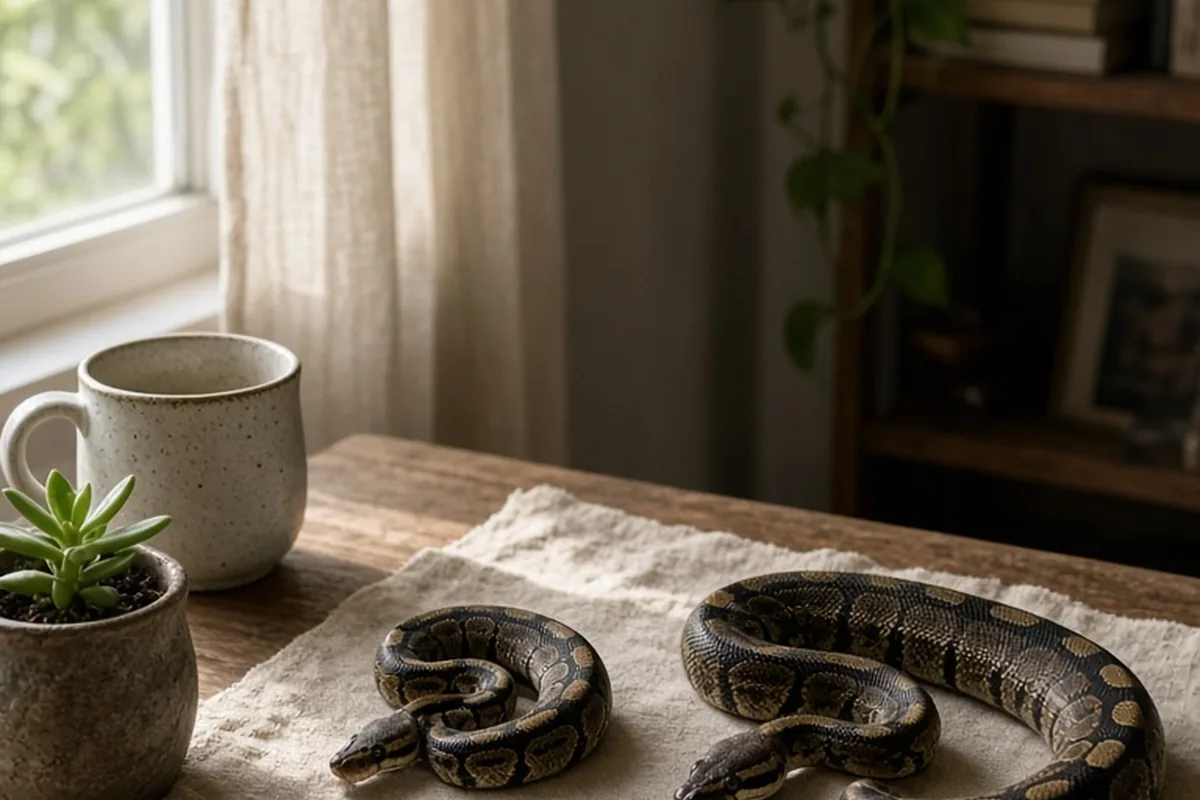
Male and female ball pythons make equally gentle companion pets, but neither sex is universally superior. Males generally stay smaller at three to four feet, requiring smaller enclosures and feeding on smaller prey. Females grow larger, often reaching four to five feet, which requires larger habitats and slightly higher food costs. For most pet keepers, size preference and budget dictate the best choice rather than temperament differences.
When choosing a first reptile or adding a new companion to your household, deciding between a male or female ball python is one of the very first decisions you will encounter.
Size Differences and Space Requirements
Female ball pythons are substantially heavier and longer than their male counterparts because evolutionary biology demands physical internal space to carry clutches of eggs. A typical mature female reaches four to five feet in total length and can weigh between 1,500 to 3,000 grams or more, presenting a visibly stout, heavy-bodied appearance. In contrast, adult males typically mature between three and three and a half feet, rarely exceeding four feet, with an average healthy weight hovering around 1,000 to 1,500 grams. This size gap may sound modest on paper, but in terms of physical mass and volume, an adult female can appear nearly twice the bulk of an average adult male.
Translating these physical dimensions into habitat planning is essential for long-term keeper success and home comfort. A full-grown male ball python can live comfortably in a standard 36-by-18-by-18-inch terrarium or a 40-gallon equivalent, provided adequate enrichment, hiding spots, and thermal gradients are maintained. An adult female, however, almost invariably requires a minimum enclosure footprint of four feet long by two feet wide by two feet tall to allow her to fully stretch out, thermoregulate properly, and navigate between warm and cool microclimates. Choosing a female means committing a significant portion of furniture or floor real estate to her enclosure, whereas a male offers greater flexibility for keepers living in smaller apartments or shared living spaces.
Feeding Habits and Prey Management
Feeding demands directly track the physical scale of the animal, creating distinct long-term nutritional logistics. Because adult males maintain a leaner, lighter body structure, their adult maintenance diet generally consists of small to medium frozen-thawed rats fed every ten to fourteen days. Female ball pythons, possessing greater body mass and higher baseline metabolic demands, often require medium to large rats on a similar schedule to maintain appropriate body condition. Sourcing larger feeder rodents is occasionally more difficult at general pet supply stores, which may necessitate ordering frozen rodents in bulk quantities online and maintaining dedicated freezer storage.
Both sexes are famous within the reptile hobby for occasional seasonal feeding strikes, though the underlying biological triggers can subtly differ. During the winter breeding season, mature males frequently refuse meals for weeks or even months as instinct shifts their focus toward locating mates rather than foraging. Mature females may also reduce their food intake during late autumn or winter, especially if environmental temperatures fluctuate slightly. Understanding that temporary fasting is normal for healthy adult ball pythons helps prevent keeper anxiety, but managing the wasted cost of uneaten large prey items for females can be slightly more frustrating than discarding smaller feeder rodents.
Temperament, Handling, and Personality Nuances
A widespread misconception among first-time reptile enthusiasts is that male and female ball pythons exhibit fundamentally different temperaments or behavioral traits. In reality, biological sex has virtually no direct correlation with docility, curiosity, or defensive behavior in this species. Ball pythons have earned their reputation as one of the world's most gentle pet reptiles because both males and females prefer curling into a defensive ball over striking when startled. Any behavioral variation you observe—such as willingness to explore during handling or sensitivity to sudden movement—stems from individual genetic temperament, early socialization, and consistent, respectful handling rather than whether the snake is male or female.
The primary difference during physical interaction comes down to the sensation of physical heft and muscular anchor strength. Handling an adult female ball python feels substantial; her thicker girth and heavier body mass create a grounded, deliberate presence as she moves through your hands or drapes across your shoulders. Handling an adult male feels noticeably lighter and more agile, making them slightly easier to support for younger family members or handlers who feel intimidated by holding a heavy-bodied constrictor. If your goal is a lightweight, low-strain handling experience, a male offers a noticeable ergonomic advantage.
Equipment Footprint and Long-Term Ownership Costs
The initial purchase price of a standard normal-pattern ball python is generally comparable between sexes, but ongoing housing and maintenance expenses tilt higher for females. Larger enclosures demand larger heating elements—such as higher-wattage ceramic heat emitters or radiant heat panels—to achieve and maintain steady ambient temperatures across a wider gradient. Furthermore, maintaining the essential 55 to 65 percent baseline humidity inside a 120-gallon enclosure requires substantially more substrate by volume, leading to higher recurring costs each time you perform a routine deep clean and substrate replacement.
Long-term budgetary differences also extend to waste management and habitat accessories. Larger snakes produce larger physical waste deposits, necessitating more frequent spot-cleaning and more heavy-duty sanitation protocols to keep the enclosure hygienic and odor-free. Additionally, heavy adult females require sturdier, larger hiding caves, heavier water basins that cannot be tipped over easily, and thicker climbing branches capable of supporting several pounds of body weight. While these cost differences are manageable over the thirty-plus-year lifespan of a healthy snake, they represent a cumulative difference in maintenance effort that prospective owners should factor into their budget.
Sex-Specific Health and Care Vulnerabilities
While both sexes share common health vulnerabilities such as respiratory infections and shedding complications when humidity is improperly dialed in, each biological sex carries unique reproductive considerations. Female ball pythons, even when housed completely alone and never introduced to a male, can occasionally develop and lay infertile eggs known in the hobby as slugs. While uncommon in virgin females, this biological process places significant metabolic strain on the snake and carries a slight risk of egg-binding, a condition where an egg becomes stuck in the reproductive tract and requires prompt veterinary evaluation.
Male ball pythons avoid egg-related complications entirely, but they possess their own distinct anatomical considerations regarding the hemipenes located at the base of the tail. During breeding season or following defecation, a male may occasionally experience a hemipenal prolapse, where the reproductive organ fails to retract fully into the vent, requiring gentle humidity baths or veterinary intervention to prevent tissue dehydration. Males can also occasionally develop hardened sperm plugs that require gentle assistance if shedding around the cloaca becomes problematic. Routine monitoring of your snake's lower body and vent area during normal handling ensures these sex-specific issues are caught and addressed early.
Evaluating Pet-Only Keeping Versus Breeding Intentions
For the vast majority of reptile enthusiasts, ball pythons are acquired strictly as personal companions rather than breeding stock. If you have no intention of producing clutches of eggs, selecting a pet should be guided solely by your space constraints, handling comfort, and personal aesthetic preferences rather than market value or morph genetics. Breeders often assign premium prices to female morphs because a single female represents the bottleneck for annual egg production, whereas a single male can breed multiple females. As a pet-only keeper, you can often find stunning male color morphs at significantly lower upfront purchase prices.
If you do envision a future interest in ethical small-scale breeding, your approach to selecting a sex must account for long-term developmental timelines. Female ball pythons take considerably longer to reach sexual maturity and safe breeding weight, typically requiring two and a half to three years to safely achieve the recommended 1,500-gram threshold. Males, by comparison, frequently mature and produce viable sperm plugs within twelve to eighteen months at weights around 700 to 800 grams. Starting with a well-established pet male allows you to master husbandry, enclosure stability, and feeding routines well before taking on the complex responsibilities and veterinary expenses associated with reproductive care.
Illustrative Scenarios
Comparing Space Needs in a Compact Living Area
An illustrative prospective keeper named Jordan lived in an 800-square-foot apartment and initially wanted a female ball python for its impressive presence. After measuring available living room furniture, Jordan realized that a four-foot by two-foot enclosure would occupy most of the available counter space and overwhelm the room. Jordan chose a captive-bred male instead, housing him comfortably in a compact three-foot enclosure that fit neatly on an existing shelving unit while providing the full experience of a docile, interactive companion.
Key point: Assessing real-world furniture dimensions and room layout before purchasing a snake prevents space-related keeper regret and ensures the animal receives an appropriately sized habitat.
Frequently asked questions
Are male or female ball pythons more aggressive?
Neither sex is inherently more aggressive than the other. Both male and female ball pythons share the same naturally calm, defensive disposition, preferring to curl tightly into a ball rather than bite when frightened. An individual snake's demeanor is shaped by gentle, consistent handling and proper habitat conditions rather than its biological sex.
Do female ball pythons eat better than males?
Females are often perceived as more enthusiastic eaters because their larger bodies require more caloric intake to support higher mass. However, both sexes can go through natural seasonal fasting periods, especially during cooler winter months. Proper temperature gradients and correct prey sizing have far more influence over feeding consistency than sex alone.
How can you tell if a ball python is male or female?
The only reliable methods to determine sex are physical probing or gentle popping performed by an experienced reptile veterinarian or reputable breeder. External visual cues like tail length or spur size are unreliable and often lead to incorrect assumptions. Never attempt to pop or probe a snake yourself without professional training, as improper technique can cause serious physical injury.
Is a male or female ball python better for a first-time owner?
Males are frequently considered slightly more practical for first-time owners due to their smaller adult size and lower spatial demands. A male snake requires a smaller enclosure footprint, consumes smaller prey items, and is lighter and easier to handle. However, if you have ample space for a large terrarium, a female makes an equally wonderful first reptile.
Your next step
Take careful measurements of your intended enclosure space and determine your preferred handling weight before browsing available snakes. Once you know your spatial limits and long-term budget, choose a healthy, well-started captive-bred individual whose size and personality align with your daily living routine.