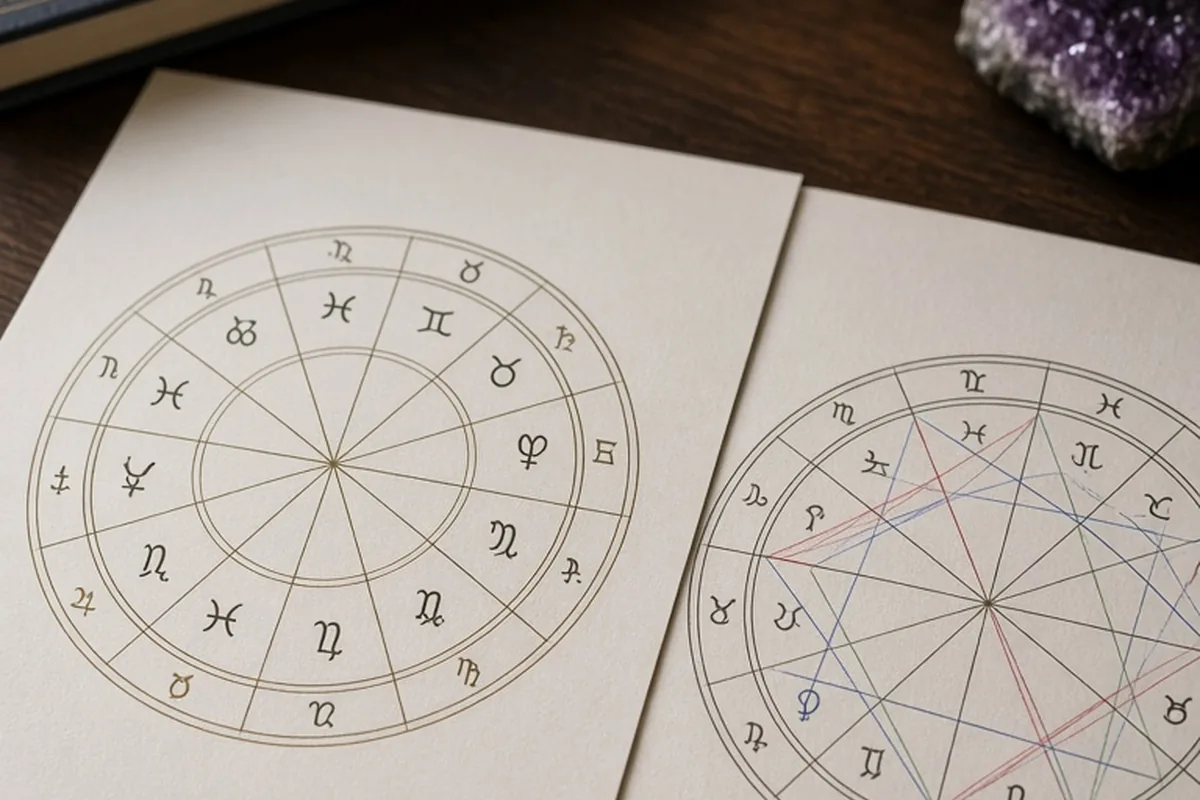
Astrology compatibility by birth chart compares two complete natal charts rather than just Sun signs. By analyzing synastry—the direct planetary aspects between both partners' charts—and house overlays, you assess emotional resonance through the Moon, romantic chemistry through Venus and Mars, communication styles via Mercury, and long-term commitment through Saturn and the Seventh House.
While popular horoscopes often reduce compatibility to simple Sun sign pairings, thorough astrological analysis examines the entire planetary landscape captured at each person's exact moment of birth. Evaluating two full charts reveals how your core personalities, emotional reflexes, communication habits, and partnership expectations interact in everyday life.
The Core Foundation: Comparing the Sun, Moon, and Rising Signs
A full birth chart compatibility analysis starts with the primary identity points, commonly referred to as the Big Three: the Sun, Moon, and Ascendant or Rising sign. While your Sun sign outlines your conscious ego, life purpose, and core values, the Moon reflects your instinctual emotional needs, subconscious habits, and attachment style. The Rising sign shapes how you present yourself outwardly, manage social interactions, and navigate initial physical attraction. When evaluating a relationship, harmonious connections between these three foundational placements create an immediate sense of familiarity and mutual recognition.
For example, if Partner A has a Cancer Moon and Partner B has a Pisces Moon, their shared water element allows them to intuitively validate each other's emotional vulnerabilities without needing extensive verbal explanations. Conversely, if one partner holds an Aries Moon that processes stress through immediate action while the other holds a Taurus Moon that requires calm deliberation, friction can arise during disagreements. The Ascendant also plays a crucial role; when your Rising sign forms a harmonious aspect to a partner's Sun or Moon, you naturally feel comfortable around their personal energy. A potential limit of focusing solely on the Big Three is that while they indicate basic personal comfort, they do not guarantee long-term stability or smooth communication across logistical areas of life.
Synastry Versus Composite Charts: Two Distinct Compatibility Tools
Astrological compatibility relies on two primary chart calculation methods: synastry charts and composite charts. Synastry places two individual natal charts on top of one another to observe how Planet A interacts with Planet B. This method shows individual reactions, pinpointing who triggers passion, who feels emotionally nurtured, and who might experience frustration during specific interactions. It remains the most common and immediate tool for diagnosing personal relationship chemistry, interpersonal triggers, and mutual attraction.
In contrast, a composite chart calculates the mathematical midpoints between the two individuals' planets to generate a single, distinct third chart that represents the relationship itself as an independent entity. For instance, two introverted individuals with solitary personal charts might generate a composite chart with an active Fifth House and Leo Sun, meaning that as a couple, they take on a much more social, expressive presence in their community. Synastry explains how the two people experience each other, whereas the composite chart explains where the partnership is headed and how it functions as a shared unit. Relying solely on one method can create blind spots, so experienced astrologers typically examine synastry first to understand interpersonal mechanics before turning to the composite chart for broader relationship themes.
Romantic and Physical Attraction: Examining Venus and Mars
Venus and Mars govern romantic attraction, affection, erotic desires, and personal values. Venus describes what you find pleasurable, how you give and receive love, and your aesthetic and social tastes. Mars represents your physical drive, passion, assertiveness, and the style in which you pursue what you desire. In birth chart synastry, the interactions between one partner's Venus and the other partner's Mars frequently signal strong mutual attraction, romantic chemistry, and physical magnetism.
A classic example occurs when Partner A's Mars sits in the same sign or degree as Partner B's Venus, often creating an immediate spark and effortless romantic pacing. However, planetary balance matters significantly. If Mars forms challenging aspects, such as a sharp square to the other person's Venus, initial passion can sometimes shift into impatience, misunderstandings regarding affection styles, or mismatched physical tempos. Venus also governs financial values and lifestyle preferences; when two charts show compatible Venus placements, partners tend to agree more easily on shared spending, social calendars, and home aesthetics. The trade-off is that strong Venus-Mars chemistry alone cannot sustain a partnership if emotional security and constructive communication are lacking.
Communication and Commitment: The Influence of Mercury and Saturn
Long-term relationship success depends heavily on everyday dialogue and mutual responsibility, represented astrologically by Mercury and Saturn. Mercury governs how you exchange ideas, process data, resolve daily disputes, and express your opinions. When Mercury forms supportive aspects between two birth charts, conversations flow naturally, humor aligns, and partners find it easier to de-escalate tension through constructive problem-solving. For instance, air-sign Mercury connections usually foster rich intellectual exchanges and shared curiosity.
Saturn, traditionally viewed as the planet of structure, discipline, and boundaries, provides the endurance required for enduring commitments. While difficult Saturn aspects can sometimes manifest as emotional distance, criticism, or a feeling of obligation, supportive Saturn contacts—such as a trine or sextile to the Sun, Moon, or Venus—create a reliable foundation of loyalty, accountability, and practical teamwork. Without supportive Saturn connections in synastry, even relationships with intense romantic chemistry may struggle to weather financial challenges, life transitions, or mundane routines. The key is balance: enough Saturn to provide longevity and security, but not so much rigidity that the partnership feels heavy or overly transactional.
Understanding Planetary Aspects: Trines, Sextiles, Squares, and Oppositions
Planetary aspects represent the geometric angles formed between planets across the two charts, indicating whether the energy between partners flows harmoniously or generates friction. Soft aspects, primarily trines (120-degree angles) and sextiles (60-degree angles), point to natural compatibility, shared flow, and areas where partners instinctively support one another. For example, a trine between one person's Sun and another's Moon provides mutual validation, where one person's basic identity naturally affirms the other's emotional instincts.
Hard aspects, such as squares (90-degree angles) and oppositions (180-degree angles), introduce dynamic tension, contrasting needs, and growth opportunities. An opposition between two Mercury placements might cause partners to approach every debate from polar-opposite perspectives, requiring active listening and compromise. A square between Moon and Mars can produce passionate reactions that quickly boil over into hurt feelings if emotional boundaries are ignored. While too many hard aspects can make daily coexistence feel exhausting, a chart with only soft aspects may occasionally lack the creative tension or motivation required for personal growth. The healthiest connections usually feature a workable balance of supportive aspects for comfort and manageable challenging aspects for mutual development.
House Overlays: How Your Planets Activate Your Partner's Life Areas
House overlays occur when planets from your birth chart fall within specific numerical houses of your partner's natal chart, showing exactly which areas of their life your presence stimulates. The twelve houses govern distinct domains, ranging from personal identity and family life to career ambitions and shared finances. Overlay analysis explains why you might bring out playful creativity in one person while inspiring intense career motivation in someone else.
For romantic partnerships, overlays into the Fourth, Fifth, Seventh, and Eighth Houses are particularly revealing. When your partner's Sun or Venus falls into your Seventh House—the house of committed partnership—you naturally perceive them as ideal long-term partner material. An overlay into your Fourth House of home and roots fosters a comforting, familial bond where you feel safe relaxing behind closed doors. In contrast, heavy overlays into the Eighth House of shared resources and vulnerability create intense, transformative emotional bonds that require high levels of trust. A common pitfall in overlay analysis is overemphasizing intense placements like the Eighth or Twelfth Houses, which can feel deeply captivating initially but may require strict emotional boundaries to prevent enmeshment.
Balancing Astrological Indicators with Real-World Relationship Skills
While birth chart compatibility provides an intricate symbolic map of relationship dynamics, it should serve as a reflective framework rather than a deterministic verdict. Astrological charts reveal natural predispositions, shared rhythms, and potential communication hurdles, but they cannot measure individual maturity, emotional regulation, shared values, or mutual commitment. Two individuals with mathematically challenging synastry who practice conscious communication and respect each other's boundaries often build a far healthier union than two people with textbook compatibility who neglect active partnership work.
Using astrology responsibly in relationships means using the birth chart to build empathy rather than to justify poor behavior or force an incompatible connection. If synastry highlights an area of friction—such as conflicting communication styles between fire and water Mercury placements—both partners can use that insight to slow down during arguments and choose clearer words. Astrological compatibility is best approached as a self-awareness tool that highlights where understanding comes naturally and where conscious effort, patience, and clear boundary-setting will be necessary for long-term health.
Frequently asked questions
What information is needed to calculate an accurate birth chart compatibility report?
You need the exact birth date, month, year, city of birth, and precise time of birth for both individuals. An accurate birth time is essential because it determines the Ascendant and the exact house placements, which shift significantly every few minutes.
Can two people with incompatible Sun signs still have a successful relationship?
Yes, because Sun signs represent only one small component of an entire natal chart. Strong, supportive aspects between Moon, Venus, Mars, and Ascendant placements can easily offset Sun sign differences and create deep, lasting compatibility.
Which planetary aspect indicates long-term commitment in synastry?
Supportive Saturn aspects to the Sun, Moon, or Venus, along with harmonious Seventh House overlays, are traditional indicators of long-term commitment. These placements encourage shared responsibility, patience, emotional maturity, and mutual dedication over time.
What is the difference between a synastry chart and a composite chart?
A synastry chart overlays two individual charts to examine how two distinct personalities interact on an interpersonal level. A composite chart calculates the mathematical midpoints of both charts to generate a single chart representing the relationship itself as an independent unit.
Your next step
To assess compatibility accurately, generate full natal charts for both individuals using verified birth times and examine synastry aspects across Moon, Venus, Mercury, and Saturn placements rather than relying solely on Sun signs.