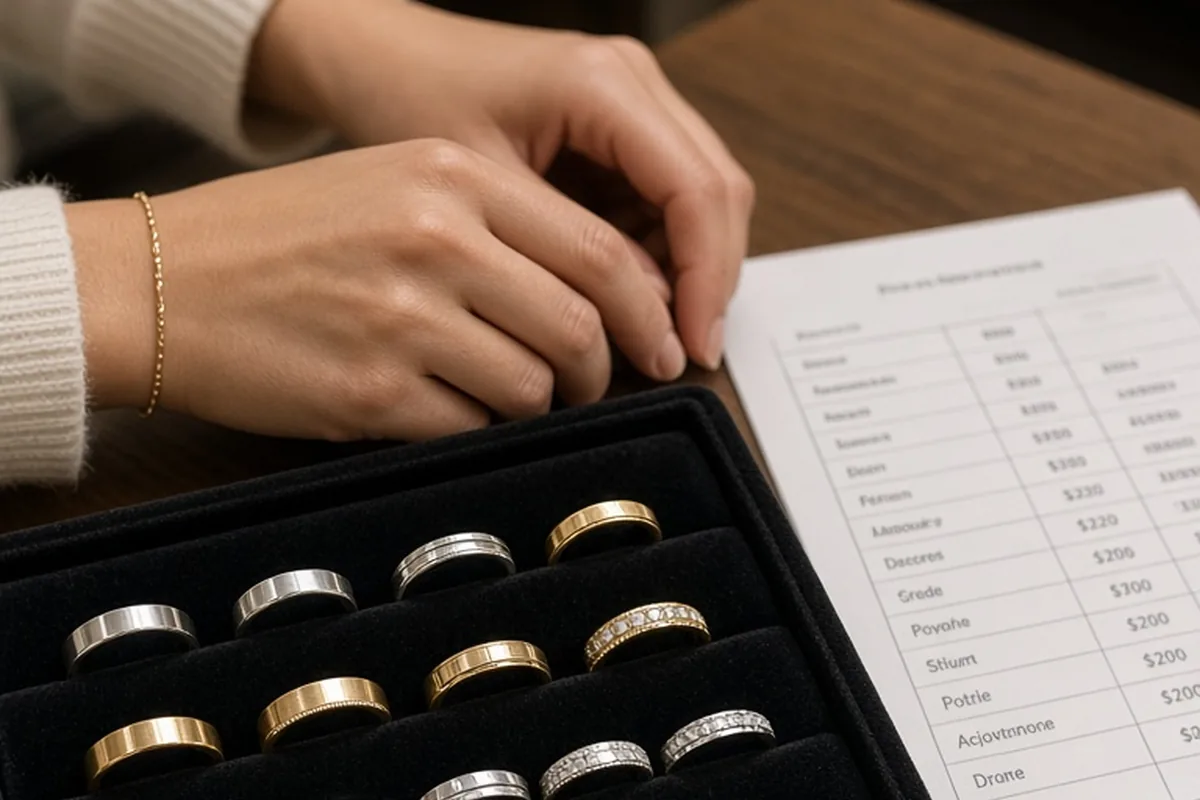
In the United States, couples typically spend between $500 and $1,500 on a standard wedding band, while diamond engagement rings often average between $3,000 and $6,000. Total costs vary widely depending on metal type, stone quality, and custom detailing. Rather than following rigid spending formulas, the most sustainable budget is one that aligns with your real savings, current cash flow, and shared long-term financial priorities.
Shopping for wedding rings often introduces unexpected emotional and financial pressure. Marketing campaigns and social traditions suggest arbitrary benchmarks that can leave couples second-guessing their choices. Understanding how ring pricing actually works helps you focus on what matters: finding enduring, meaningful pieces that fit your daily lifestyle and respect your household budget.
Differentiating Wedding Bands from Engagement Rings
A common source of confusion when researching ring expenses is the distinction between an engagement ring and a wedding band. An engagement ring traditionally features a prominent center stone—such as a diamond, sapphire, or moissanite—set on an ornate band. Because of the size and grading of the primary gemstone, engagement rings represent the larger portion of bridal jewelry expenditures, frequently ranging from several thousand dollars upward.
In contrast, wedding bands are the rings exchanged during the marriage ceremony and worn continuously by both partners. These bands tend to be simpler in profile, consisting of solid precious metal, subtle engravings, or smaller pavé accent stones. For a standard men's band in gold or platinum, typical pricing sits between $400 and $1,200, whereas women's bands with small channel-set or eternity diamonds usually range from $600 to $2,000. Keeping these categories distinct prevents unexpected sticker shock when planning your overall wedding budget.
Primary Factors That Drive Ring Prices
The overall price of any ring reflects a combination of raw materials, labor, and retail markup. Metal selection plays a foundational role in base costs. Platinum is denser, rarer, and naturally hypoallergenic, making it more expensive than 14-karat or 18-karat gold. Meanwhile, alternative contemporary metals like titanium, tungsten carbide, and cobalt chrome provide exceptional scratch resistance and durability at a fraction of the cost, often retailing between $100 and $400.
Gemstones represent another major price driver. If a wedding band incorporates diamonds, the total carat weight, clarity, color, and cut grade dictate the final estimate. Intricate physical craftsmanship—such as milgrain detailing, custom comfort-fit tapers, hand engraving, and filigree work—also adds bench labor fees. Furthermore, purchasing from luxury brand boutiques typically includes significant marketing overhead compared to working with local independent bench jewelers or online direct-to-consumer retailers.
- Precious metals: Platinum and high-karat gold command premium prices, while alternative metals offer durable budget alternatives.
- Stone volume and quality: Accent diamonds, eternity wraps, and custom settings increase labor and raw gem costs.
- Brand positioning: Big-box luxury storefronts carry higher markups than independent goldsmiths or direct-to-consumer fabricators.
Moving Past the Salary Benchmark Myth
Decades of jewelry marketing popularized the idea that a buyer should spend two or three months of gross salary on rings. This concept was originally created by mid-twentieth-century diamond advertising agencies to establish a social baseline, not by financial planners. Following an arbitrary percentage formula takes no account of your existing student loans, housing goals, retirement contributions, or wedding reception expenses.
A healthier financial strategy treats ring selection as an intentional purchase based on current cash availability. Buying a ring should never require high-interest consumer credit cards or draining emergency savings funds. When couples evaluate what they can afford without borrowing, they protect their upcoming marriage from avoidable debt and start their shared life on solid financial ground.
Practical Strategies for Balancing Quality and Cost
Achieving an elegant, lasting look does not require overspending if you know where to make smart trade-offs. One of the most effective ways to lower costs on diamond-accented bands is opting for lab-grown diamonds. Chemically, physically, and optically identical to mined stones, lab-created gems typically cost 60 to 80 percent less, allowing you to choose higher cut grades or wider carat profiles within a modest budget.
You can also optimize metal choice based on everyday practicalities. A 14-karat gold band contains 58.3 percent pure gold mixed with durable alloy metals, making it more resistant to scratching and daily wear than softer 18-karat gold while costing significantly less. Additionally, considering vintage or heirloom jewelry can provide unique character, sentimental value, and substantial savings on raw materials and manufacturing markups.
- Explore lab-grown diamonds: Identical visual and physical performance at a fraction of natural diamond pricing.
- Choose 14k over 18k gold: Better surface durability for everyday wear alongside lower raw material costs.
- Consider estate and vintage rings: Access distinctive designs and quality metals without standard retail markups.
- Simplify the band profile: Classic domed or flat comfort-fit bands require less labor than complex multi-stone pavé channels.
Navigating Ring Conversations and Lifestyle Needs
Choosing rings involves balancing personal aesthetics, lifestyle demands, and financial comfort. A ring that looks stunning in a showroom display case might prove uncomfortable or impractical for someone who works with heavy machinery, performs clinical medical duties, or exercises regularly. Discussing daily habits ensures you choose a piece that withstands your actual routine without requiring constant repair or removal.
Direct communication about budgets also sets a positive precedent for collaborative money management. When one partner prefers a minimalist design while the other desires custom stone settings, candidly comparing options helps you find common ground. Approaching the decision as a team removes unspoken expectations, builds trust, and ensures both partners feel respected in their style preferences and financial boundaries.
Accounting for Long-Term Care, Sizing, and Protection
The purchase price of a ring is not the only expense to keep in mind over its lifetime. Certain metals and styles require periodic maintenance to preserve their structural integrity and finish. For instance, white gold requires occasional rhodium replating every one to three years to maintain its bright silver sheen, which typically costs between $40 and $100 per treatment.
Resizing is another critical consideration. Plain gold, silver, and platinum bands can be easily adjusted by a jeweler if your finger size changes over time. However, full eternity bands with continuous diamonds and contemporary alternative metals like tungsten or ceramic cannot be resized, meaning you may need an entirely new band if fit changes dramatically. Finally, adding ring insurance through a dedicated jewelry policy or a homeowner's rider usually costs around 1 to 2 percent of the ring's appraised value annually, offering peace of mind against loss or theft.
Illustrative Scenarios
Choosing Daily Practicality Over Tradition
Julian felt anxious while browsing jewelry stores, assuming he had to spend over $1,500 on a heavy platinum band to prove his commitment. Because he works daily as a landscape architect, he worried about scratching an expensive piece or damaging prongs. After talking openly with his partner about his daily routine, they looked into durable alternative metals. Julian selected a brushed titanium band with a comfort-fit interior for $180, which easily handled physical outdoor work. They put the remaining money toward their honeymoon travel fund, relieving Julian's anxiety.
Key point: Choosing a ring tailored to your real everyday habits protects your investment and removes unnecessary financial pressure.
Finding Value Through Transparent Compromise
Maya and David initially found themselves in a tense disagreement over bridal jewelry costs. Maya wanted a delicate diamond band that matched her engagement ring, while David was worried about depleting their home down-payment savings. Instead of letting resentment build, they scheduled an appointment with an independent jeweler to review options within a firm $800 ceiling. By choosing lab-grown accent diamonds set in 14-karat white gold, Maya received the exact visual aesthetic she loved while staying completely within David's comfortable savings target.
Key point: Transparent budget discussions and modern stone alternatives allow couples to honor aesthetic desires without compromising shared financial security.
Frequently asked questions
Who is traditionally responsible for buying the wedding bands?
Historically, each partner purchased the other's wedding band, or families contributed toward the cost. Today, most modern couples pool their wedding funds or purchase their own rings according to individual financial comfort and shared agreement.
How far in advance should we purchase our wedding rings?
It is best to purchase rings roughly two to three months before the ceremony. This timeframe allows ample room for custom fabrication, accurate sizing adjustments, and personalized metal engraving without last-minute rush fees.
Is ring insurance necessary for standard wedding bands?
Insurance is strongly recommended for high-value rings containing valuable diamonds or platinum, typically costing $10 to $20 annually per $1,000 of value. For inexpensive alternative metal bands, self-insuring through emergency savings is often more economical than paying annual premiums.
Your next step
Take an evening this week to review your existing savings and discuss your daily work routines together, then establish a clear, joint price ceiling before stepping into a jewelry store.