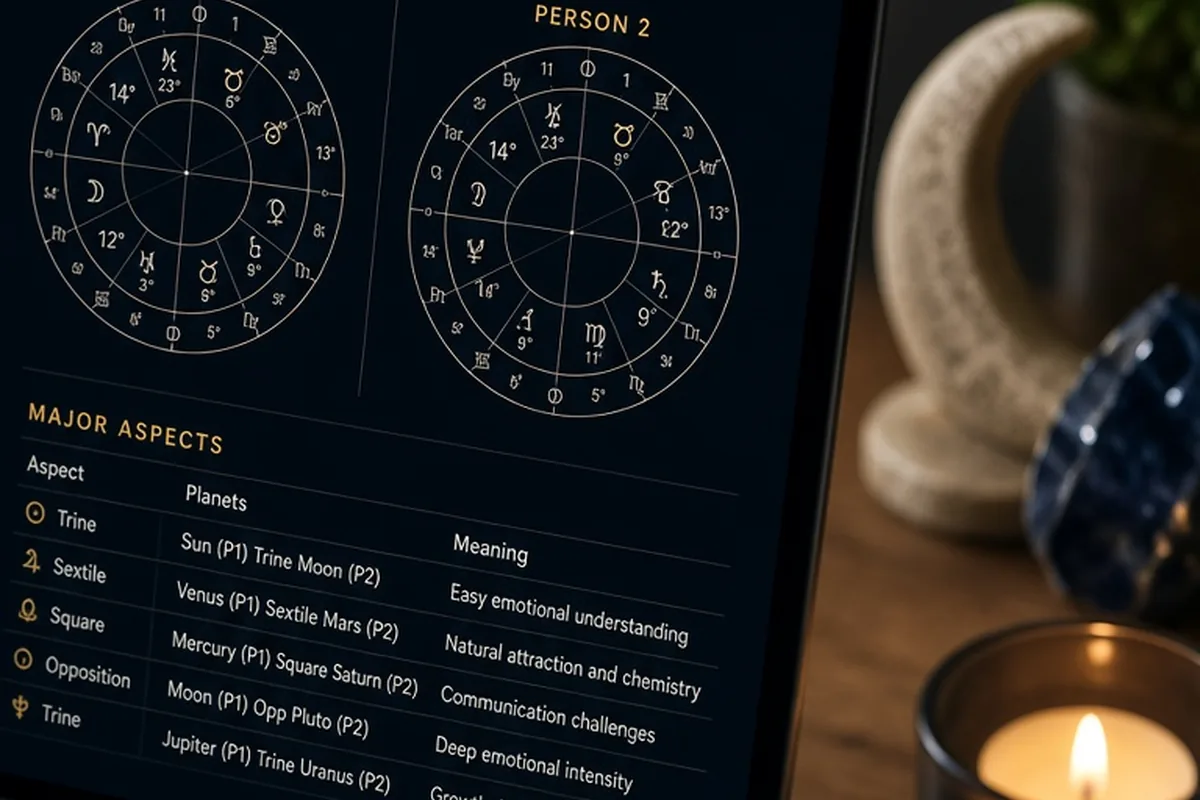
Free birth chart compatibility tools compare the exact planetary placements of two people using a method called synastry. By overlaying one person's birth chart onto another's, these calculators evaluate the mathematical angles—called aspects—between key planets like the Sun, Moon, Venus, and Mars. This reveals shared communication patterns, emotional resonance, areas of friction, and personal chemistry without requiring expensive software or specialized chart-drawing tools.
Exploring astrological compatibility goes far beyond matching basic Sun signs in a magazine column. When you generate a full comparison chart online, you receive a detailed map of how two distinct personalities interact across every area of life.
The Essential Data Needed for an Accurate Free Synastry Chart
To get an accurate compatibility reading from any free chart calculator, you need three pieces of information for both individuals: the exact calendar date of birth, the city and country of birth, and the precise time of birth. While birth dates provide the general signs for slower-moving planets, the exact birth time establishes the Ascendant, or Rising sign, and anchors the twelve astrological houses. Because the Earth rotates through all twelve signs in a twenty-four-hour period, a difference of just fifteen minutes can shift the house placements of multiple planets, altering the context of your compatibility reading.
If you do not have an exact birth time for one or both people, you can still generate a comparison chart, but you must recognize its limitations. Most free software defaults unknown birth times to 12:00 PM (noon). A noon chart allows you to evaluate planetary aspects—such as how your Venus interacts with your partner's Mars—with reasonable accuracy. However, you will not be able to rely on house overlays or the Moon's exact degree, since the Moon moves roughly thirteen degrees per day. When working with incomplete data, focus your interpretation on the slower planetary contacts rather than house positions.
Key Planetary Placements That Shape Relationship Chemistry
When evaluating a free synastry chart, certain planets carry significantly more weight in personal relationships than others. The Sun represents core identity, conscious goals, and vitality, while the Moon governs emotional safety, instinctive reactions, and subconscious needs. A supportive connection between your Sun and your partner's Moon is widely regarded as one of the strongest indicators of mutual comfort, as it allows one person's natural self-expression to validate the other person's emotional baseline.
Beyond the luminaries, Venus and Mars define how affection, romance, and physical attraction operate between two people. Venus illustrates what a person values, how they show love, and their aesthetic preferences, whereas Mars represents drive, assertiveness, and physical passion. For example, if your Venus forms a harmonious angle to your partner's Mars, you will likely experience an easy, reciprocal rhythm of attraction and appreciation. Mercury is equally critical for daily longevity, as it outlines how you exchange ideas, negotiate differences, and resolve conversational misunderstandings.
Understanding Major Aspects: Trines, Sextiles, Squares, and Oppositions
Planetary aspects are the angular distances measured between two planets across the 360-degree zodiac wheel. In free synastry reports, these aspects are generally categorized into harmonious contacts and dynamic contacts. Harmonious aspects, such as trines (120 degrees) and sextiles (60 degrees), indicate a natural flow of energy where both individuals understand each other effortlessly. For instance, a trine between both partners' Mercury placements suggests that conversations flow naturally and shared viewpoints come without struggle, though excessive harmony can occasionally lead to complacency.
Dynamic aspects, including squares (90 degrees) and oppositions (180 degrees), generate friction, chemistry, and growth. A square between one person's Moon and the other's Saturn can highlight moments where emotional vulnerability meets perceived coldness or strict boundaries, requiring deliberate communication to resolve. Oppositions function like a see-saw, where two opposing energies must find balance through compromise. Rather than viewing squares and oppositions as negative omens, seasoned astrologers interpret them as catalytic points that challenge both partners to mature and develop new relationship skills.
House Overlays and Where the Dynamic Plays Out in Daily Life
House overlays occur when one person's planets fall within specific houses of the other person's birth chart. While aspects describe how two energies interact, houses reveal the specific arena of life where that interaction takes place. For example, if your partner's Sun falls into your fourth house, their presence naturally impacts your domestic life, sense of family, and private world. You may feel an instinctive urge to build a home with them or share your personal history.
Certain houses are traditionally linked to romantic partnerships. The fifth house highlights playfulness, creativity, dating, and mutual enjoyment, making strong fifth-house overlays common in relationships that start with intense romantic excitement. The seventh house governs committed one-on-one partnerships, legal unions, and cooperative agreements; having a partner's personal planets in your seventh house often signals that you view them as an equal counterpart. The eighth house brings deep psychological bonding, shared resources, and vulnerability, which can create profound closeness but also demands high levels of trust.
Identifying Growth Edges and Outer Planet Influences
Outer planets—Saturn, Uranus, Neptune, and Pluto—often introduce deeper, long-term themes into synastry charts. Saturn contacts typically introduce themes of structure, duty, and commitment. When Saturn touches personal planets like Venus or the Sun, it can either create lasting loyalty or produce feelings of being judged and restricted if expectations are too rigid. Uranus brings sudden excitement, independence, and unconventional rhythms, which can feel thrilling initially but may challenge partners who desire predictable routines.
Neptune and Pluto represent emotional sensitivity and profound transformation, respectively. Neptune aspects can foster deep spiritual connection and empathy, but they also carry a risk of idealizing a partner and ignoring real-world boundaries. Pluto aspects introduce intensity, magnetic attraction, and psychological depth, which can sometimes manifest as control struggles if neither partner is willing to be genuinely vulnerable. Recognizing these patterns in a free report helps both people identify their shared growth edges without projecting unrealistic blame onto the astrology.
How to Evaluate and Choose a Reliable Free Compatibility Tool
Not all free birth chart compatibility tools provide the same level of depth or accuracy. When selecting an online resource, look for calculators that offer a visual bi-wheel chart alongside a comprehensive aspect grid. Reliable tools allow you to adjust orb tolerances—the allowable degree of separation for an aspect—and let you select between different house systems, such as Placidus or Whole Sign. A clear aspect table should explicitly list the exact degree, sign, and orb of every planetary connection.
Be cautious of free tools that reduce relationship potential to a single percentage score or use overly deterministic language. Automated algorithms that declare a connection 'doomed' or 'soulmate material' based on isolated aspects oversimplify complex human interactions. A quality compatibility tool acts as a structured mirror, presenting the underlying geometric data and providing balanced interpretations that respect personal agency, emotional maturity, and mutual effort.
Integrating Synastry Insights into Real-World Communication
The most practical benefit of reading a birth chart compatibility report is gaining empathy for how your partner experiences the world differently from you. If your chart reveals that your partner has Mercury in a water sign while yours is in an air sign, you can understand why they may need time to process emotions before engaging in a logical debate. Instead of interpreting their quietness as disinterest, you can adapt your approach and create a safe environment for open dialogue.
Astrological compatibility should never be used to excuse unhealthy behavior or bypass mutual accountability. A challenging chart aspect does not force someone to be distant, just as a harmonious chart aspect does not guarantee a trouble-free relationship. Treat the insights from your free chart report as conversational starting points that encourage thoughtful listening, personal accountability, and collaborative problem-solving in your day-to-day partnership.
Frequently asked questions
Can two people be compatible if their Sun signs clash?
Yes, two people can be highly compatible even if their Sun signs form a difficult aspect. A complete birth chart contains many other planetary factors, including Moon, Venus, Mars, and Rising signs, which often create strong harmony that balances out Sun-sign differences.
What is the difference between a synastry chart and a composite chart?
A synastry chart overlays two individual birth charts to see how the two people interact with each other directly. A composite chart calculates the mathematical midpoints between both charts to create a single, unique chart that represents the relationship itself as an independent entity.
How important is an exact birth time for a compatibility report?
An exact birth time is essential for determining the Ascendant, house overlays, and the exact position of the Moon. Without an accurate time, you can still evaluate planetary aspects like Venus and Mars, but the specific life areas where those energies play out will remain uncertain.
Do free birth chart compatibility calculators show twin flames or soulmates?
Free compatibility calculators show planetary geometry and psychological dynamics rather than spiritual labels. While certain intense contacts, like strong Pluto or nodal connections, can feel deeply transformative, genuine relationship success depends on real-world respect, communication, and commitment.
Your next step
Gather the exact birth dates, times, and locations for both individuals, generate a detailed synastry bi-wheel chart on a reputable free platform, and use the aspect table to explore your communication styles and shared emotional patterns together.