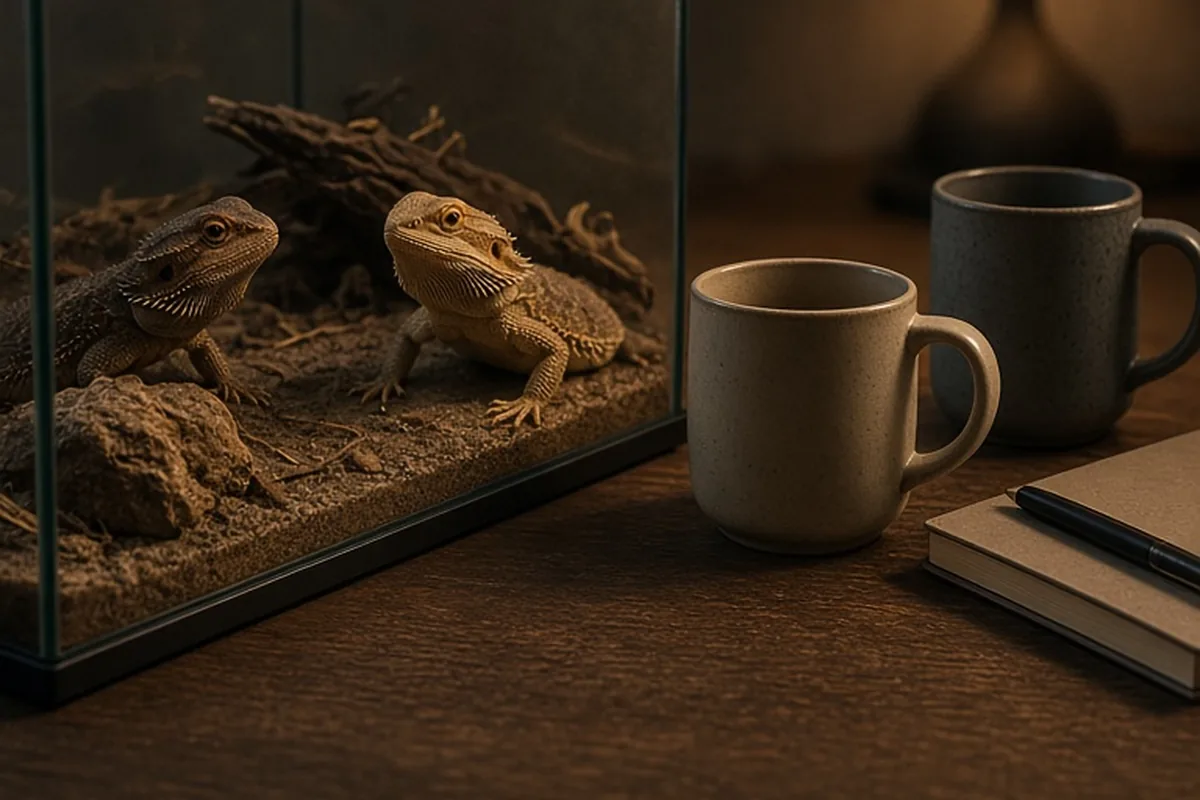
No, male and female bearded dragons should not live together in the same enclosure. Bearded dragons are strictly solitary, territorial animals that thrive alone. Housing a male and female together causes chronic psychological stress, violent territorial fighting, food and heat deprivation, severe physical injuries, and dangerous health complications for the female from continuous, unwanted mating attempts and non-stop egg production.
It is common for pet owners to assume that reptiles enjoy companionship in the same way social mammals do. However, applying human social expectations to solitary reptiles frequently leads to preventable illness, behavioral deterioration, and severe physical trauma.
Understanding the Solitary Nature of Bearded Dragons
In their native Australian habitats, central bearded dragons (Pogona vitticeps) lead completely independent lives. They do not form pair bonds, live in colonies, or share resources with peers. A wild dragon establishes a home range where it hunts insects, grazes on vegetation, and claims the best basking perches to regulate its body temperature. Contact with other dragons is limited to brief territorial disputes or momentary encounters during the spring breeding season, after which both lizards immediately part ways.
When confined within the artificial boundaries of a captive enclosure, natural dispersal becomes impossible. A subordinate dragon cannot walk away to establish its own territory, and a dominant dragon cannot patrol its space without constantly encountering an intruder. This forced proximity runs directly counter to their hardwired evolutionary instincts. Even when dragons appear peaceful on the surface, living in shared quarters forces their nervous systems into a persistent state of alertness and guarded tension that undermines their long-term health.
The Severe Physical Toll of Constant Mating Pressure
The primary danger of cohabitating an intact male and female bearded dragon is the male's relentless reproductive drive. In the wild, seasonal temperature fluctuations and geographic distance naturally regulate breeding cycles. In captivity, where temperatures, lighting schedules, and food availability remain stable year-round, a sexually mature male will continuously attempt to mate with any female sharing his living space. He will pursue her around the enclosure, relentlessly head-bobbing, stamping his feet, and chasing her into corners.
During courtship and copulation, a male bearded dragon restrains the female by biting down forcefully on the back of her neck and head. When this behavior happens repeatedly in a confined habitat, the female suffers open puncture wounds, lacerations, damaged scales, and potential skin infections. Furthermore, the physical strain of constant breeding forces the female's body to produce repeated clutches of eggs throughout the year. Continuous egg production rapidly depletes a female's internal calcium reserves, leaving her vulnerable to metabolic bone disease, severe muscle wasting, follicular stasis, and life-threatening egg binding (dystocia).
Resource Competition and Dominance Behaviors
Captive enclosures contain localized resources: a specific basking hotspot, a targeted ultraviolet-B (UVB) emission zone, a food bowl, and designated hiding areas. When two dragons share these limited resources, competition is inevitable. The larger or more assertive dragon will consistently claim the prime basking location directly beneath the heat and UVB lamps, while pushing the other to suboptimal peripheral areas.
A common point of confusion for reptile keepers is seeing one bearded dragon resting directly on top of another on a basking branch. While human observers often misinterpret this as cuddling or affection, it is actually a classic reptilian dominance display known as 'stacking.' The dominant dragon climbs over the subordinate dragon to monopolize the heat and light, physically blocking the lower dragon from absorbing the essential UVB rays needed to synthesize vitamin D3 and process dietary calcium. Over weeks and months, the suppressed dragon experiences poor digestion, weakened immunity, and stunted growth.
Physical Aggression and Permanent Traumatic Injuries
Territorial disputes between cohabitated bearded dragons frequently escalate from subtle intimidation into direct physical violence. Warning signals include aggressive head-bobbing, puffing out a blackened beard, hissing, and flattening the body horizontally to appear larger. If the subordinate dragon cannot escape the dominant dragon's field of view, the interaction turns physical.
Bearded dragons possess powerful jaws equipped with small, serrated teeth designed to crush chitinous insect shells. When directed at another lizard, these bites inflict catastrophic damage. Veterinary clinics routinely treat cohabitated dragons for severed toes, amputated tail tips, deep flesh wounds, fractured limbs, and severe eye trauma. Once fighting begins, it rarely stops spontaneously, and in many tragic cases, larger dragons inflict fatal injuries on smaller cage mates before the owner realizes a conflict is occurring.
Recognizing the Hidden Signs of Cohabitation Stress
Not all signs of cohabitation distress are bloody or overt. In many instances, the psychological toll of cohabitation manifests as subtle, gradual behavioral decline. A stressed or intimidated dragon will spend excessive amounts of time hiding in the cooler corners of the vivarium, avoiding open basking platforms, or displaying dark, persistent stress lines across its belly and throat.
Appetite suppression is another major indicator of chronic cohabitation stress. The submissive lizard may refuse live feeder insects or leafy greens because approaching the feeding dish puts it in close proximity to the dominant dragon. This leads to progressive weight loss, dehydration, and lethargy. The chronic elevation of stress hormones also impairs the dragon's immune response, rendering it significantly more susceptible to opportunistic respiratory infections and intestinal parasite blooms.
How Responsible Breeders Manage Mating Encounters
Prospective keepers sometimes wonder how breeding occurs if males and females cannot live together. Professional and ethical reptile breeders never house pairs together on a permanent basis. Instead, both dragons are raised and maintained in separate, individual enclosures until they reach full physical maturity, optimal body weight, and peak health.
When breeding is intentional, the female is introduced into the male's enclosure for a brief, closely monitored encounter lasting anywhere from a few minutes to half an hour. The keeper observes the entire interaction without leaving the room, ready to intervene immediately if excessive aggression occurs. Once copulation concludes, the female is promptly returned to her own dedicated habitat where she can rest, feed, and lay her eggs in a calm, predator-free environment without continued harassment.
Proper Housing Setup and Long-Term Separation Guidelines
The gold standard for bearded dragon welfare is straightforward: one dragon per enclosure. An adult bearded dragon requires a minimum enclosure size of 120 gallons (measuring roughly 4 feet long by 2 feet wide by 2 feet high) equipped with its own independent thermal gradient, high-output linear UVB lighting, hiding caves, and feeding stations.
When keeping multiple dragons in the same home, housing them in separate tanks is only the first step. Bearded dragons have exceptional eyesight and can easily spot one another across a room. Constantly seeing a conspecific can trigger persistent glass surfing, black bearding, and territorial agitation. To prevent visual stress, position enclosures so they do not face one another, or install opaque background covers along the sides and back panels of each tank to block line of sight completely.
Illustrative Scenarios
Illustrative Scenario: Resolving Chronic Basking Competition
A keeper housed a young adult male and female bearded dragon in a single four-foot enclosure, believing their habit of resting together under the heat lamp signified bonding. Over six months, the female developed dark belly markings, lost muscle mass along her tail base, and consistently avoided eating when greens were offered. A veterinary assessment revealed mild calcium deficiency and neck scarring from repeated mating grips, while the male remained robust and active. The owner purchased a separate 120-gallon enclosure and installed solid side panels to prevent the two lizards from seeing each other.
Key point: Physical co-location caused the dominant male to monopolize heat and UVB while subjecting the female to continuous stress; separating the pair into individual enclosures enabled the female to regain healthy weight and normal basking behaviors within weeks.
Frequently asked questions
Can two female bearded dragons live together safely instead?
Housing two females together is still strongly discouraged. While you eliminate the risk of mating harassment, female bearded dragons are equally territorial and will compete aggressively for basking areas, food, and prime resting spots. Dominance displays, stress, and bite injuries occur frequently between cohabitated females.
Can male and female bearded dragons have shared floor time outside their tanks?
No, shared free-roaming time is unsafe. Even outside their enclosures, a male will instinctively chase, stress, or attempt to mount a female, which can trigger sudden defensive biting and severe injuries. Allow each dragon out for exercise and exploration individually.
What should I do if my dragons are currently living together?
Separate them immediately into individual enclosures, even if you must use a secure temporary tub or tank divider while setting up a permanent habitat. Perform a thorough physical check for bite wounds, missing toes, or lethargy, and schedule an appointment with an exotics veterinarian if you notice signs of weight loss, egg binding, or infection.
Your next step
Inspect your current reptile setup today and arrange independent enclosures measuring at least 4x2x2 feet with dedicated lighting and visual barriers for each bearded dragon.