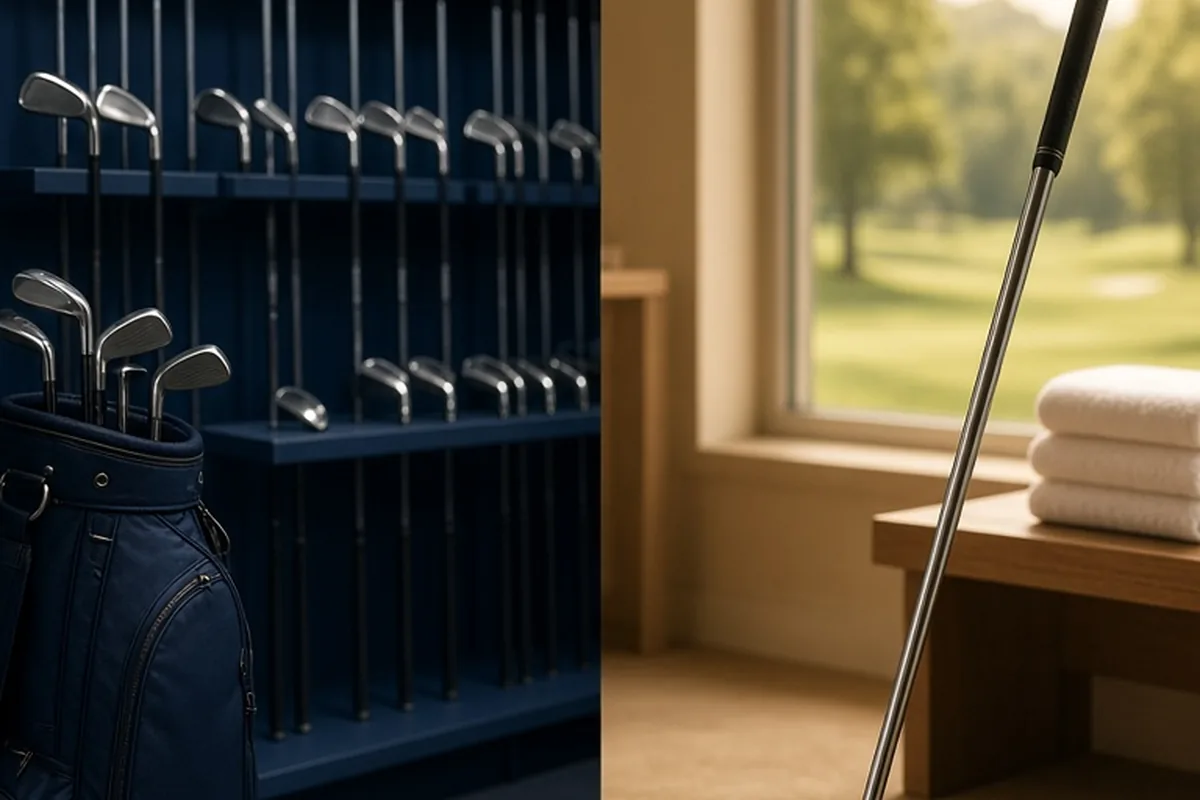
Yes, a woman can certainly use men's golf clubs. Golf clubs respond to physical mechanics, swing speed, and height rather than gender. Taller women and those with athletic, faster swings often gain better control, consistent contact, and improved distance by choosing men's standard, light, or senior flex clubs instead of standard women's sets.
Walking into a pro shop can make equipment choices feel rigid, especially when aisles are strictly divided into separate sections for men and women. Understanding how golf equipment actually works allows you to look past marketing categories and select gear that matches your physical build and swing dynamics.
Why Club Dynamics Matter More Than Gender Labels
Golf equipment manufacturers design off-the-rack sets based on demographic averages. Traditional women's sets are typically built for an average height of five feet four inches to five feet five inches, paired with slower swing tempos and moderate swing speeds. To help these players launch the ball into the air, manufacturers produce clubs with flexible graphite shafts, higher lofts, lighter swingweights, and smaller grips. Conversely, standard men's clubs assume a height of five feet nine inches to five feet ten inches with moderate to fast swing tempos.
A golf ball does not register the gender of the person swinging the club. The ball responds exclusively to impact physics, including clubhead speed, attack angle, face angle, and strike location on the face. If a woman stands five feet eight inches tall or generates swing speeds comparable to an athletic male amateur, swinging a standard women's club can actually hinder her progress. The club may feel too short, forcing improper posture, or the shaft may bend excessively during the downswing, causing erratic dispersion.
Choosing gear based entirely on physical metrics creates immediate advantages. When the length, weight, and stiffness of your club align with your swing mechanics, you can make a natural, balanced turn without having to compensate for ill-fitting equipment. Exploring men's or unisex options opens up thousands of component combinations that standard retail ladies' packages simply do not provide.
Key Differences Between Standard Men's and Women's Sets
To evaluate whether men's equipment will suit your game, it helps to understand the four primary engineering differences between standard men's and women's clubs. The first difference is overall length. A standard men's driver measures around forty-five to forty-five and a half inches, while a standard ladies' driver is usually forty-four inches. Irons also differ by approximately one inch throughout the entire set, which directly influences your spine angle and stance distance from the ball.
The second major factor is shaft flex and weight. Shafts are graded by stiffness, traditionally categorized as Ladies (L), Senior/Lite (A), Regular (R), Stiff (S), and Extra Stiff (X). Women's clubs almost universally feature lightweight graphite shafts with high torque and soft flex profiles designed to flex deeply under gentle swing speeds. Men's regular and stiff shafts are made from either heavier graphite or steel, providing greater structural stability against aggressive transitions and higher rotational speeds.
The third and fourth variables involve grip diameter and clubhead loft. Men's clubs come equipped with standard-diameter grips, whereas ladies' clubs use undersized grips to accommodate smaller hands. Furthermore, women's clubs typically carry two to three degrees more loft on fairway woods, hybrids, and irons to assist with upward launch. If you already generate ample trajectory, excessive loft can lead to ballooning ball flights that rob you of roll and distance.
Signs You May Benefit from Playing Men's Golf Clubs
Certain physical profiles and swing characteristics make men's clubs a vastly superior choice for many female golfers. Height is the most straightforward indicator. If you are five feet seven inches or taller, standard women's clubs will often force you into excessive knee bend or a rounded upper back just to place the clubhead flat on the turf at address. Men's standard lengths or trimmed men's clubs allow taller players to maintain an athletic, upright spine angle that protects the lower back.
Swing speed and athletic background are equally decisive factors. Women who played sports requiring explosive rotational power, such as softball, tennis, hockey, or volleyball, frequently develop swing speeds well above average. When an athletic player swings an overly flexible ladies' shaft, the shaft bends excessively during the transition, causing the clubhead to lag behind and deliver an open face at impact, resulting in high push-slices.
A few common playing experiences indicate that your current women's clubs might be underperforming for your swing:
Your natural ball flight climbs excessively high into the wind and falls straight down with zero forward roll.
You feel an uncomfortable whippiness or lack of control at the top of your backswing.
You consistently make contact toward the toe of the club because the shaft length feels too short.
You find yourself gripping the club excessively tight because the standard undersized ladies' grip feels too narrow in your fingers.
- Your natural ball flight climbs excessively high into the wind and falls straight down with zero forward roll.
- You feel an uncomfortable whippiness or lack of control at the top of your backswing.
- You consistently make contact toward the toe of the club because the shaft length feels too short.
- You find yourself gripping the club excessively tight because the standard undersized ladies' grip feels too narrow in your fingers.
The Strategic Value of Men's Senior and Lite Flex Equipment
Transitioning to men's gear does not mean you must immediately jump to heavy steel regular or stiff shafts. In fact, one of the most effective and popular equipment categories for female golfers is the men's Senior, Lite, or A-flex range. These clubs serve as an ideal bridge between traditional ladies' equipment and standard men's regular gear.
Men's senior flex clubs combine the extended length of a men's build with a lightweight graphite shaft that offers slightly more bend than a standard regular flex. For a player who needs an extra inch of club length for comfort but does not generate the aggressive swing speed required to load a heavy steel shaft, senior flex graphite provides the perfect balance. It delivers clean trajectory and solid feel without causing premature fatigue over eighteen holes.
Furthermore, men's fairway woods and hybrids in senior flex are widely available on both the new and pre-owned market. Because manufacturers produce a vast volume of men's equipment, choosing from this category gives you access to a much wider variety of modern clubhead designs, adjustable hosels, and movable weighting systems that are frequently omitted from pre-packaged ladies' sets.
Managing Grip Thickness and Hand Ergonomics
While club length and shaft stiffness are primary considerations, grip sizing is a subtle detail that directly impacts your control over the clubface. Standard men's clubs feature a zero-point-six-zero-inch core diameter grip, which is noticeably thicker than a standard ladies' grip. Playing with a grip that does not match your hand size can alter your release mechanics and wrist action through the ball.
If a grip is significantly too thick for your hand, your fingers may struggle to wrap securely around the handle, potentially restricting your natural wrist hinge and making it harder to square the clubface at impact, leading to a tendency to leave shots out to the right. Conversely, a grip that is slightly fuller than an undersized ladies' grip often relieves tension in the forearms and prevents overly active hands from hooking the ball aggressively.
The good news is that grip size is the easiest and most affordable component to modify on any golf club. If you find a set of men's irons that match your swing speed and height, you can easily have a club technician install undersized or ladies' grips on those shafts. Customizing the grip allows you to enjoy the mechanical advantages of a men's shaft and head while keeping the tactile comfort tailored to your hands.
Potential Drawbacks of Clubs That Are Too Heavy or Long
While playing men's clubs can transform your game if you need the extra length or stiffness, using equipment that is genuinely too heavy carries distinct trade-offs. The total static weight of a club, along with its swingweight (the distribution of weight toward the clubhead), affects how easily you can maintain rhythm across a full round. If a club is too heavy, your swing speed can decrease, reducing total carry distance.
Excessive weight can also encourage swing compensations. When a player struggles against the heft of a steel-shafted men's iron, she may slide her hips toward the target, cast the club early from the top of the swing, or collapse her posture through impact to help lift the ball into the air. Over time, these compensations can lead to inconsistent strikes, joint strain in the lead wrist or elbow, and general muscle fatigue on the back nine.
Length can also become a double-edged sword. While taller players benefit from standard men's lengths, a club that is even half an inch too long for your posture will cause the heel of the club to sit higher than the toe at address. This upright lie angle tilts the clubface left of the target, frequently producing unwanted hooks or fat, heavy contact behind the ball. Proper evaluation ensures you do not trade one mechanical problem for another.
Practical Steps to Test and Build Your Ideal Setup
If you are considering switching to men's clubs, begin by gathering baseline data on your swing rather than buying a complete set off the rack. Visiting an indoor simulator or an outdoor driving range equipped with launch monitors allows you to observe your actual numbers. Look specifically at your driver swing speed, your 7-iron carry distance, and your typical ball trajectory to establish an objective starting point.
Take advantage of demo days or club fitting sessions where you can hit identical clubheads with different shaft specifications side by side. Compare a ladies' flex graphite shaft, a men's senior flex shaft, and a men's regular flex shaft. Pay attention to shot dispersion—how tightly your shots cluster together—rather than purely focusing on occasional long hits. A shaft that provides tighter grouping and predictable carry will lower your scores faster than sporadic extra yardage.
Remember that you do not need an all-or-nothing approach. Many female players build hybrid setups that mix categories to suit different areas of their game. You might choose a men's regular driver and fairway wood for stability off the tee, paired with men's senior flex hybrid irons that provide high-launching forgiveness into greens, completed with wedges custom-shortened to your preferred feel around the putting surface.
Illustrative Scenarios
Finding Consistency Through Shaft Weight Adjustment
A five-foot-nine recreational golfer with an athletic tennis background struggled with severe slice dispersion and ballooning trajectory using a boxed ladies' set. During an informal equipment trial, she tested a men's senior flex graphite iron set alongside a men's standard regular flex driver. The added length immediately improved her posture at address, allowing her to rotate freely without hunching over the ball. Within a few sessions, her ball flight flattened out into a penetrating trajectory, and her lateral shot dispersion narrowed significantly because the firmer shaft kept pace with her rotational speed.
Key point: Matching equipment length and shaft stiffness to your physical stature and natural tempo produces more reliable ball striking than remaining restricted to gender-labeled packages.
Frequently asked questions
Can a woman use men's irons but keep a women's driver?
Yes, mixing sets is entirely practical and common among golfers. Many players appreciate the added length and control of men's irons for approach shots while preferring a lighter, higher-lofted women's driver to maximize launch off the tee. What matters most is that each individual club fits your swing speed and turf interaction.
How do I know if my golf clubs are too short for me?
If your clubs are too short, you will often feel cramped at address, forced to bend excessively at the waist or knees to reach the ball. You may also notice consistent mishits off the toe of the club or find your divots unusually deep because of a steep downswing angle. A simple static wrist-to-floor measurement can confirm if you need longer shafts.
Will using men's clubs hurt my swing if I am a beginner?
Using men's clubs will not hurt your development as long as their physical dimensions match your height and strength. However, playing clubs that are significantly too heavy or stiff can encourage swing flaws like casting or poor hip rotation. Starting with lighter graphite shafts in men's senior or regular flex is usually the safest route for athletic beginners.
Your next step
Visit a local golf retail center or practice facility to hit demo irons in both men's senior flex and women's standard flex, noting which weight and length allow you to maintain natural posture and clean center-face contact.