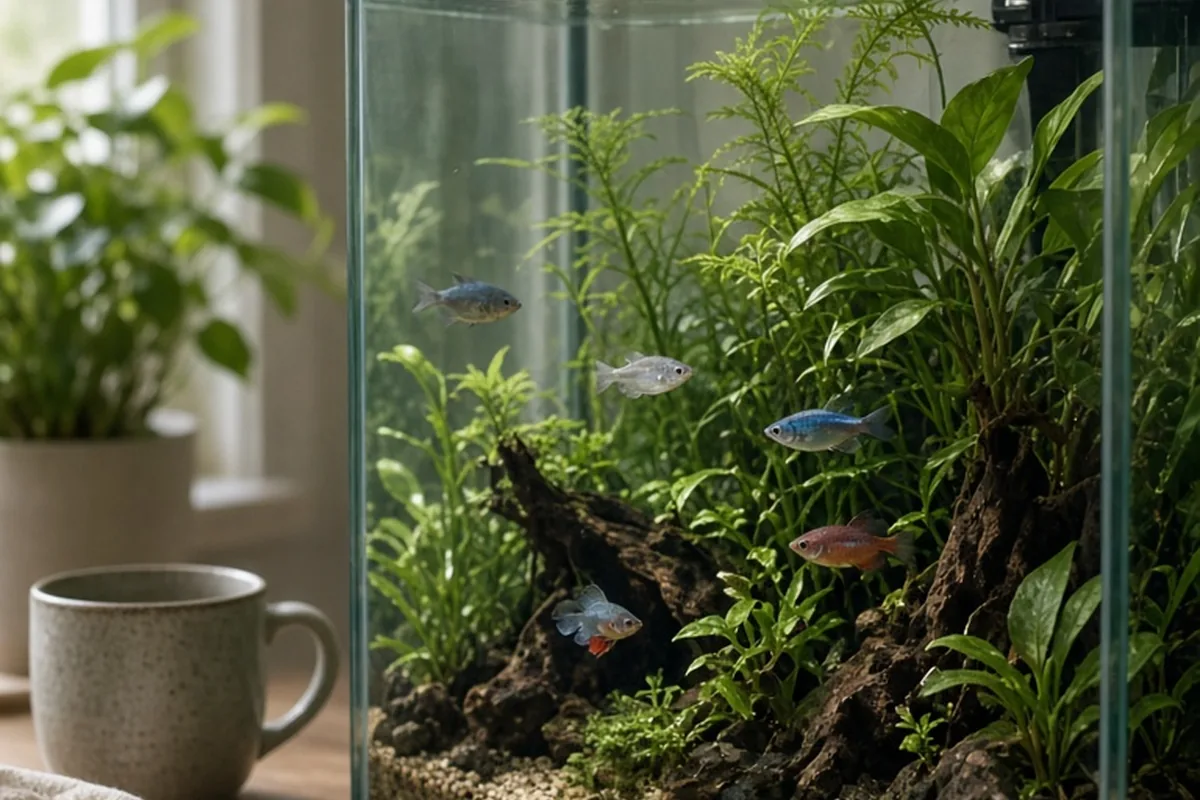
Yes, female betta fish can live with other fish under the right conditions. Unlike males, females tend to show lower territorial aggression, making them suitable candidates for peaceful community aquariums or all-female sororities. Success depends heavily on tank size, visual barriers like live plants, water parameters, and choosing calm, non-nipping species that do not resemble bettas in shape or vivid finnage.
Housing female bettas in a community setting offers aquarists a chance to observe social behaviors that rarely appear in solitary setups. While female bettas are generally more adaptable than males, successful cohabitation requires thoughtful planning, deliberate species selection, and an aquarium environment structured to minimize territorial competition.
Understanding Female Betta Temperament and Social Dynamics
Female betta fish, scientifically known as Betta splendens, share the same labyrinth organ and predatory instincts as their male counterparts, but their social thresholds are noticeably different. In their natural habitats across Southeast Asia, these fish navigate shallow, densely vegetated waters where territories overlap and encounters are frequent. While males will almost always fight other males to the death or severe injury, females generally display a broader spectrum of temperaments ranging from completely docile to moderately territorial.
Individual personality plays a decisive role in whether a female betta will tolerate roommates. Some individuals ignore neighboring fish entirely, spending their day foraging among aquatic plants and resting on broad leaves. Other females can be assertive, chasing faster tank mates away from feeding zones or claiming a specific cave as private territory. Before committing a female betta to a shared ecosystem, it is helpful to observe her behavior in a holding container or single tank when presented with visual stimuli, such as a mirror or nearby tank, to gauge her baseline reactivity.
Understanding this temperament variance prevents common husbandry mistakes. Assuming all females are automatically peaceful leads to overcrowded or poorly matched tanks, while assuming they are strictly solitary denies keepers the chance to build diverse community displays. Treating each female betta as an individual with unique boundaries is the cornerstone of successful long-term aquarium management.
Top Compatible Tank Mates for a Female Betta
Selecting the right companions involves matching water parameter requirements, swimming zones, and behavioral patterns. Ideal tank mates occupy different levels of the water column, such as the substrate or mid-water regions, leaving the upper reaches primarily to the betta. Furthermore, suitable companions should lack long, flowing fins that might trigger predatory biting, and they must possess calm temperaments that will not stress the betta through frantic movement or fin-nipping.
Bottom-dwelling species make some of the safest and most functional tank mates. Small catfish, specialized algae grazers, and peaceful invertebrates rarely interact with a female betta directly, focusing instead on scavenging leftover food and grazing on biofilm along the gravel and hardscape.
Small, peaceful schooling fish that remain in the mid-water zone can also thrive alongside a female betta, provided the school is large enough to feel secure without crowding the tank volume.
- Corydoras Catfish: Gentle, armored bottom dwellers such as Panda, Pygmy, or Bronze Corydoras that stay near the sand and completely ignore upper-level swimmers.
- Kuhli Loaches: Nocturnal, eel-shaped bottom scavengers that hide during bright hours and clean food debris without competing for open swimming space.
- Harlequin Rasboras: Calm, tight-schooling fish that occupy the mid-water column and display non-aggressive, steady swimming habits.
- Ember Tetras or Neon Tetras: Small, colorful schooling species that are generally too small and peaceful to nip fins when kept in proper schools of six or more.
- Otocinclus Catfish: Dedicated, miniature algae eaters that maintain a strictly vegetarian diet and stay glued to glass or plant foliage.
- Mystery Snails and Amano Shrimp: Effective cleanup crew members that add diversity; Amano shrimp are large enough to avoid being eaten, unlike tiny cherry shrimp.
Species and Physical Traits to Avoid in the Same Tank
Certain aquatic species introduce immediate friction when paired with female bettas due to behavioral incompatibilities or physical triggers. The primary danger categories include aggressive fin-nippers, hyperactive species that outcompete the betta for food, large territorial predators, and fish that visually mimic the silhouette of a rival betta. Avoiding these combinations eliminates the majority of stress-induced illnesses and physical injuries in community aquariums.
Fish with long, flowing tails, such as male fancy guppies, can confuse a female betta and trigger territorial strikes because she perceives them as rival bettas. Conversely, notorious fin-nipping species such as Tiger Barbs, Serpae Tetras, and certain Danio varieties will actively target the betta's delicate pectoral and ventral fins. In addition, housing a female betta with a male betta in a permanent community environment must never be attempted; males will relentlessly harass and physically damage females outside of short, controlled breeding setups.
Large cichlids, aggressive gouramis, and predatory catfish also pose a direct threat of predation or severe territorial violence. When evaluating any prospective companion, always verify that its adult size remains modest, its dietary needs match a standard omnivorous or micro-predator profile, and its behavioral reputation across the hobby is consistently peaceful.
The Female Betta Sorority: Conditions, Rules, and Risks
A female betta sorority is an advanced aquarium setup where five or more female bettas are housed together in a single tank. While visually stunning, sororities are inherently complex and carry a higher risk profile than housing a single female with other species. In a sorority, the bettas establish a strict linear dominance hierarchy, often called a pecking order, through minor flaring, chasing, and posturing.
To maintain stability in a sorority, aquarists must provide a minimum tank volume of thirty to forty gallons, heavily planted from substrate to surface. Housing an odd number of females—typically at least five to seven individuals—is critical because it distributes hierarchical pressure across the group rather than concentrating aggression onto a single submissive fish. Choosing sorority sisters that were raised together from the same spawn can significantly improve cohesion, as they are already accustomed to one another's presence.
Despite perfect parameters, sororities can suddenly destabilize due to illness, changes in water conditions, or the maturation of a particularly dominant individual. Keepers must always have fully cycled backup tanks or dividers ready to separate fish immediately if persistent fin damage, stress stripes, or relentless chasing occurs. Sororities should only be attempted by experienced hobbyists prepared for constant observation and intervention.
Aquarium Setup, Aquascaping, and Environmental Requirements
Creating a physical environment that supports multi-species cohabitation requires deliberate choices in tank volume, filtration flow, and aquascaping design. A standard ten-gallon tank is the absolute minimum for housing a single female betta alongside a few small snails or dwarf shrimp, but a twenty-gallon long tank represents the ideal baseline for a true community featuring schooling fish and bottom dwellers. The extra horizontal swimming space allows distinct territories to form naturally.
Sightline breaks are the single most effective tool for preventing territorial friction. Densely planted areas using species like Java Fern, Anubias, Amazon Swords, and floating plants such as Water Lettuce or Salvinia create natural visual partitions. When fish cannot maintain continuous visual contact with one another across the tank, territorial instincts remain subdued, and subordinate fish have ample opportunities to rest without being targeted.
Water movement and filtration must also be calibrated carefully. Bettas possess heavy fin structures and labyrinth organs requiring easy access to the water surface; strong, turbulent filter currents will exhaust them and cause chronic stress. Using an adjustable sponge filter or fitting a gentle baffle to a hang-on-back filter ensures clean, oxygenated water while keeping surface currents tranquil and comfortable for all residents.
Acclimation Steps and Managing Day-to-Day Interactions
The method used to introduce fish into a community tank strongly influences their initial relationship. If you are adding a female betta to an established community, float her in a clear breeder box or transparent container inside the main tank for thirty to sixty minutes. This allows her to observe the other inhabitants without having immediate physical contact, giving you time to evaluate her curiosity versus overt hostility before release.
If you are adding other fish into a tank where a female betta already lives, rearrange the decorations, rocks, and driftwood prior to the introduction. Shifting the physical landscape resets the betta's established territorial boundaries, forcing all inhabitants to explore and claim new spaces simultaneously. Feeding the existing residents right before introducing new fish also reduces foraging agitation and distracts the betta during the release.
During daily maintenance, observe feeding behavior closely. Female bettas are opportunistic, vigorous eaters that readily consume floating flakes, pellets, and frozen foods, sometimes gorging themselves before slower bottom fish can eat. To prevent bloating in the betta and malnutrition in bottom dwellers, feed floating micro-pellets at one end of the tank for the betta and surface fish, while dropping sinking wafers or pellets into dense plant cover for catfish and loaches.
Frequently asked questions
Can a female betta live in a community tank smaller than ten gallons?
A tank under ten gallons does not provide enough swimming room or broken sightlines for a female betta to share space safely with other fish. Smaller volumes concentrate biological waste and force constant physical proximity, which elevates stress and sparks territorial aggression. For multi-species communities, a twenty-gallon tank is the standard recommendation.
Can male and female bettas live together in a shared aquarium?
Male and female bettas should never be housed together permanently in any home aquarium setup. Outside of brief, tightly supervised breeding encounters managed by experienced breeders, males will continually harass, chase, and physically harm females. Keeping males and females in separate tanks protects both fish from severe injury.
How do you know if a female betta is too aggressive for tank mates?
Clear indicators of excessive aggression include continuous chasing, biting fins, flaring gills relentlessly, and guarding the entire tank from other fish during feeding. If these behaviors persist past the first few hours or result in physical fin damage, the female betta should be moved to her own separate tank.
What water temperature and pH do female betta community tanks require?
Female bettas thrive in stable water temperatures between 78 and 80 degrees Fahrenheit with a neutral pH ranging from 6.5 to 7.5. All community companions selected for the aquarium must naturally share these warm, tropical parameters to ensure proper metabolic and immune health.
Your next step
Evaluate your aquarium dimensions to ensure at least twenty gallons of swimming space, install dense live plants to create visual breaks, and introduce peaceful bottom dwellers like Corydoras catfish before adding your female betta.