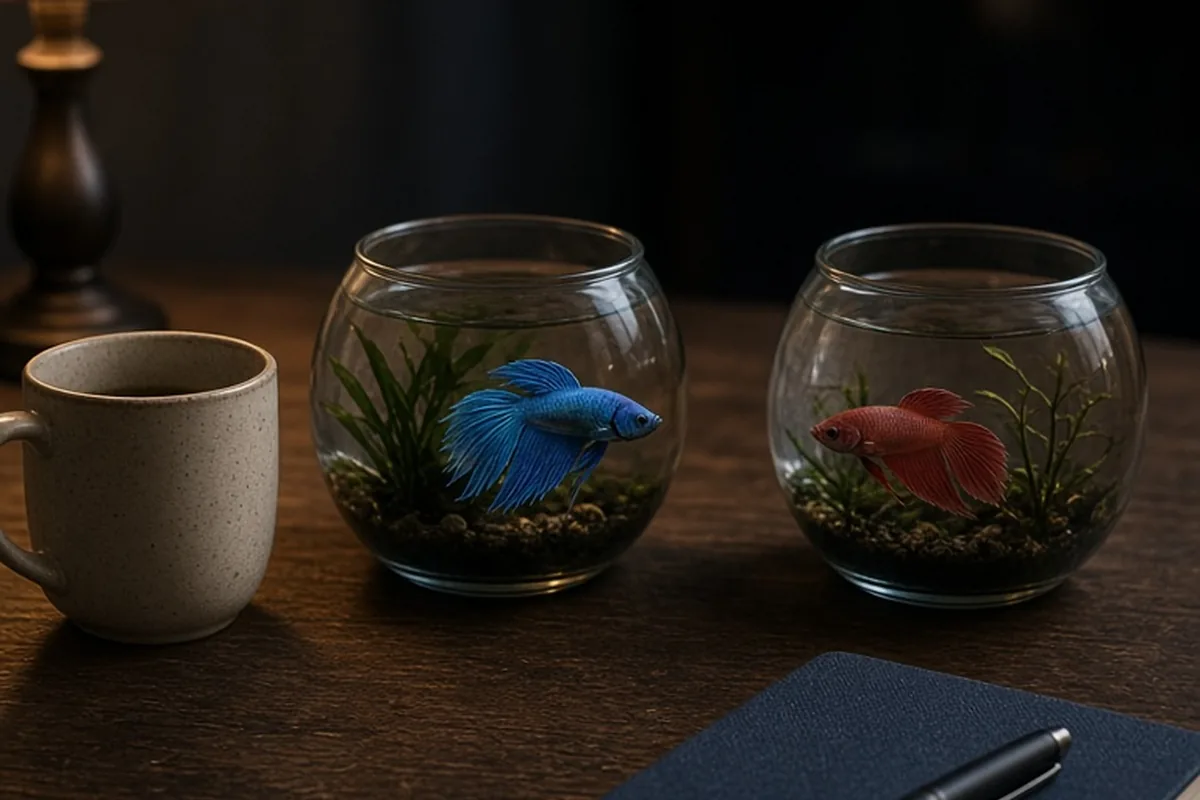
No, you should not keep a male and female betta fish together in the same aquarium permanently. Betta splendens are naturally solitary and highly territorial. Housing them in the same enclosure almost always leads to intense fighting, severe fin damage, chronic stress, and potentially fatal injuries. The only exception is brief, heavily monitored pairing by experienced hobbyists solely for active breeding.
Aquarium enthusiasts often wonder if housing a male and female betta together creates a harmonious pair similar to other community species. Understanding natural betta behavior and territorial instincts helps clarify why cohabitation poses severe risks to their health.
Why Male and Female Bettas Cannot Share a Permanent Tank
In the wild, Siamese fighting fish (Betta splendens) inhabit shallow waters, rice paddies, and slow-moving streams across Southeast Asia. These natural habitats feature dense vegetation and vast horizontal territory, allowing individual fish to establish independent zones. When a male and female encounter each other in nature, the interaction is brief and purpose-driven, concluding as soon as breeding finishes. In a home aquarium, physical boundaries prevent the female from retreating once the interaction concludes.
Captive-bred bettas have been selectively cultivated for generations, which has intensified aggressive and territorial behaviors, particularly in males. When a male shares an enclosed volume of water with a female, he views her either as a rival claiming his territory or as a reproductive partner that must submit immediately. If the female is not receptive or ready to spawn, the male will relentlessly chase and attack her. Conversely, aggressive females frequently ambush males, nipping at their long, delicate fins and inflicting serious physical trauma.
The constant presence of another betta inside the same glass walls disrupts their natural instinct to maintain solitary space. The physiological toll of perpetual visual and chemical stimulation causes chronic elevation of stress hormones, which suppresses the immune system and leaves both fish vulnerable to opportunistic bacterial and fungal infections.
Recognizing Signs of Cohabitation Stress and Physical Aggression
When male and female bettas are placed together, behavioral changes often occur immediately, though outright physical violence can sometimes develop gradually over several hours or days. Initially, you may observe persistent flaring, where either fish expands its opercular gill covers and spreads its fins to intimidate the other. This posturing is quickly followed by high-speed chasing, cornering, and forceful nipping directed at the tail, ventral fins, and body flanks.
Physical damage from these encounters is obvious and dangerous. Victims of cohabitation aggression typically display shredded or missing fin rays, missing scales, torn gill covers, and open flesh wounds that can easily develop secondary columnaris or fin rot. Even if physical contact is limited, behavioral suppression manifests through clamped fins, loss of vibrant coloration, horizontal stress stripes on females, refusing food, and hiding motionlessly behind filter tubes or near the substrate.
A common misconception is that a peaceful initial hour means the fish have bonded. In reality, territorial disputes often escalate after dark or once the fish settle into their surroundings. A tank that appears tranquil in the afternoon can turn fatal overnight, making cohabitation an unpredictable hazard.
The Controlled Breeding Exception and Its Strict Limitations
The single scenario where male and female bettas interact in captivity is controlled, short-term breeding managed by experienced fish keepers. This process is complex, demanding, and requires extensive preparation rather than simply dropping two adult fish into a shared display tank. Dedicated breeders prepare both fish for several weeks with specialized high-protein diets and maintain separate conditioned tanks before any physical introduction takes place.
During breeding, the pair is introduced using visual barriers, such as a transparent chimney or separate floating container, allowing them to assess each other safely. The female is released only when she displays vertical breeding bars and the male has constructed a sturdy bubble nest. Once spawning concludes and the female releases her eggs into the nest, she must be removed immediately. The male transitions into a protective parental mode and will violently attack the female if she remains in the spawning tank.
Breeding betta fish requires significant commitment, including dedicated nursery tanks, live food cultures for tiny fry, and dozens of individual containers to separate juvenile males once they mature. It is not a casual method for keeping two pet fish together.
- Conditioning requires two to three weeks of separate housing with enriched live or frozen nutrition.
- Visual introduction must occur through glass or clear plastic before any direct contact.
- Physical pairing lasts only a few hours until egg deposition is complete.
- Immediate separation is required as soon as spawning ends to protect the female from lethal attacks.
Safe Alternatives for Housing Both Sexes in the Same Setup
If you want to keep both a male and a female betta without purchasing two entirely separate aquarium systems, a divided tank provides a practical solution. A divided aquarium utilizes a secure, opaque or semi-opaque physical partition that splits a larger tank into two distinct, fully isolated compartments. This setup allows each fish to have its own dedicated territory while sharing water filtration, heating, and lighting.
When setting up a divided system, the partition must fit flush against the glass walls and lid to prevent either fish from jumping or squeezing into the adjacent side. Completely opaque dividers are strongly recommended over clear perforated acrylic. Clear dividers allow continuous visual contact, which causes chronic flaring, exhaustion, and territorial frustration. Ensure that the total tank size provides at least five gallons of swimming space per compartment, meaning a divided setup should be at least ten gallons in total volume.
Water flow between compartments should be balanced carefully. While shared filtration simplifies maintenance, chemical pheromones present in the water can still trigger territorial alertness. Installing adequate mechanical filtration and dense live plants along the divider helps diffuse water movement and provides psychological security.
Understanding Female Sororities Versus Mixed Cohabitation
Some aquarists hear about betta sororities and mistakenly assume that adding a male into a group of females creates a balanced community. A betta sorority is an advanced aquarium setup consisting solely of multiple female bettas, typically five or more, housed in a heavily planted tank of twenty gallons or larger. Female sororities rely on distributing territorial hierarchy across a group to prevent a single fish from being singled out.
Introducing a male into a female sorority completely destabilizes the group dynamic. The male will either aggressively target individual females or become overwhelmed and attacked by the combined group. Female bettas are capable of formidable aggression, and a group of females can easily corner, exhaust, and kill a solitary male.
Even all-female sororities carry high failure rates and require extensive experience to manage safely. For everyday hobbyists seeking a peaceful, low-stress aquarium, keeping individual bettas in separate five-gallon or larger aquariums remains the gold standard for animal welfare.
Choosing Peaceful Community Mates for a Single Betta
If your goal is a lively, diverse aquarium rather than a solitary fish, bettas can thrive alongside select non-betta tank mates under the right conditions. A male or female betta can often share a well-filtered, established aquarium of ten gallons or larger with peaceful, non-aggressive species that do not resemble other bettas in shape, color, or behavior.
The ideal tank mates occupy different swimming zones and lack long, flowing fins that could trigger predatory or territorial responses. Bottom-dwelling species and peaceful invertebrates make exceptional companions because they rarely cross paths with a betta resting near the surface.
Always evaluate your individual betta's temperament before introducing companions. While some bettas show complete indifference toward other aquatic life, others aggressively patrol every corner of the tank. Always have a backup container ready in case your betta proves too territorial for a community environment.
- Invertebrates such as Nerite snails, Mystery snails, and adult Amano shrimp.
- Bottom dwellers including small Corydoras catfish and peaceful Kuhli loaches.
- Calm, short-finned schooling fish such as Harlequin rasboras or Ember tetras in tanks of fifteen gallons or larger.
- Avoid fin-nipping species like Tiger barbs, bright fancy guppies, or other labyrinth fish like gouramis.
Frequently asked questions
Can a male and female betta live together in a very large tank?
Even in aquariums of fifty gallons or more, housing a male and female betta together is unsafe. The male will actively seek out the female or defend feeding areas aggressively, resulting in severe stress and inevitable fighting whenever their paths cross.
How long can a male and female betta be together during breeding?
A breeding pair should only remain in the same water for a few hours while active spawning takes place. As soon as the female finishes depositing her eggs, she must be removed immediately to prevent the male from attacking her.
Can baby male and female bettas live together?
Young betta fry can live together in a grow-out tank for the first eight to ten weeks of life. However, once their labyrinth organs develop and territorial instincts emerge around two to three months of age, males and aggressive females must be separated into individual quarters.
Do male bettas get lonely living by themselves?
Male bettas do not experience loneliness because they are naturally solitary animals. They thrive best in their own dedicated five-gallon or larger planted aquarium where they feel safe from territorial competitors.
Your next step
Provide each betta fish with its own separate, filtered, and heated aquarium of at least five gallons, or install a secure opaque divider to keep both fish healthy and stress-free.