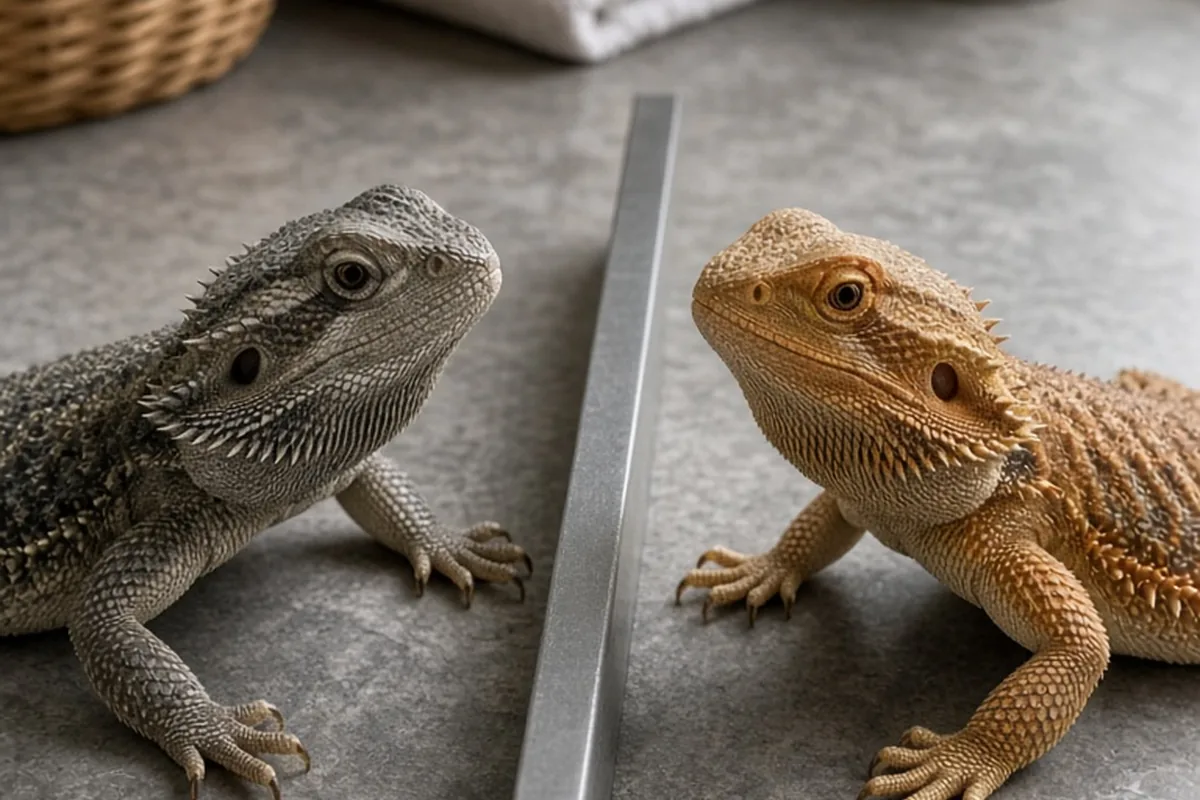
You should not keep a male and female bearded dragon together in the same enclosure permanently. Bearded dragons are naturally solitary, territorial animals. Housing them together leads to relentless mating attempts, chronic psychological stress, resource bullying, severe territorial fights, and serious reproductive complications for the female. They should only ever share space during brief, carefully supervised breeding encounters.
While it is natural for pet owners to worry that a solitary reptile feels lonely, applying mammalian social dynamics to reptiles creates significant welfare risks. In captivity, forcing a male and female bearded dragon to share limited territory undermines their basic biological needs and safety.
Understanding the Solitary Biology of Bearded Dragons
In their native Australian arid and semi-arid habitats, central bearded dragons (Pogona vitticeps) live independent lives spread across vast territories. Wild dragons do not establish pair bonds, herd structures, or family groups. Instead, they actively patrol individual foraging areas and only seek out conspecifics when seasonal environmental cues trigger a brief mating period. Outside of these transient encounters, encountering another dragon is viewed as a threat to survival and territory rather than a social opportunity.
When two dragons are placed inside an enclosure, even a relatively large one, the natural flight response is completely eliminated. In the wild, a subordinate or non-receptive dragon simply runs away to establish territory elsewhere. In a terrarium, physical boundaries trap both animals in perpetual proximity. This unnatural confinement forces their territorial and survival instincts into continuous conflict, leading to an environment where at least one animal is always under biological duress.
The Toll of Relentless Mating Behavior on Females
Sexually mature male bearded dragons possess an intense, instinctual reproductive drive that does not diminish when housed continuously with a female. A male dragon communicates his intent through aggressive displays, including darkening his beard to jet black, rapid head-bobbing, and actively pursuing the female around the habitat. During actual copulation, the male must physically immobilize the female by forcefully biting her neck and nape.
When confined together, the female has no means of escaping these advances. The constant pursuit causes severe physical and metabolic exhaustion. Repeated mating leads to back-to-back egg clutches, which drain the female of vital calcium and fat reserves. Over time, this chronic reproductive pressure frequently leads to severe nutritional depletion, follicular stasis, egg binding (dystocia), and a significantly reduced lifespan for the female dragon.
Resource Monopolization and Covert Social Bullying
Reptilian aggression does not always look like an open, violent brawl. In many cohabitating pairs, the dominant animal asserts control through passive territorial suppression that inexperienced keepers often misinterpret as affection. For instance, when one bearded dragon lays directly on top of another under a basking lamp, casual observers often call it cuddling. In reality, this behavior is a calculated dominance display known as stacking, where the top dragon blocks the subordinate dragon from receiving heat and essential ultraviolet light.
The consequences of resource monopolization compound quickly over weeks and months. The subordinate dragon, which is typically the female in a mixed-sex pair, is systematically denied equal access to the best basking temperatures, high-output UVB zones, and food dishes. Without proper heat and UVB exposure, the suppressed dragon cannot digest food efficiently or synthesize vitamin D3, predisposing them to metabolic bone disease, stunted growth, immune suppression, and chronic lethargy.
Physical Trauma and Emergency Health Hazards
Even pairs that have lived peacefully for months can suddenly experience violent outbreaks of physical aggression. Territorial skirmishes between bearded dragons happen with little advance warning and often result in catastrophic injuries. Common physical trauma includes severed toes, amputated tail tips, severe bite wounds along the cranial ridges, eye injuries, and deep skin tears that are highly vulnerable to secondary bacterial infections.
Treating these injuries requires immediate veterinary care, systemic antibiotics, and often surgical intervention or tail amputation. Furthermore, if a female develops egg binding due to stress-related inability to find a secure nesting site or calcium depletion from over-breeding, surgical removal of the reproductive tract is often the only life-saving option. The financial and emotional costs of emergency veterinary care far exceed the expense of providing separate enclosures from the beginning.
Recognizing Warning Signs of Cohabitation Distress
If you currently have a male and female housed in the same tank, it is critical to evaluate their daily behaviors objectively. Stress in reptiles is frequently silent and understated. Recognizing these early behavioral cues allows you to intervene before permanent physical harm occurs.
Be on high alert if either dragon exhibits any of the following subtle or overt indicators of distress:
Frequent arm-waving displays, which signal submissiveness and high anxiety in a threatened dragon.
Darkened throat tissue or persistent dark stress markings across the belly and chest.
One dragon consistently retreating to the cool end of the tank, hiding inside caves, or avoiding the main basking branch.
Noticeable differences in growth rates, body weight, or muscle mass between the two animals.
Loss of appetite, refusal to chase live feeder insects, or sudden frantic glass-surfing along the walls of the enclosure.
- Frequent arm-waving displays, which signal submissiveness and high anxiety in a threatened dragon.
- Darkened throat tissue or persistent dark stress markings across the belly and chest.
- One dragon consistently retreating to the cool end of the tank, hiding inside caves, or avoiding the main basking branch.
- Noticeable differences in growth rates, body weight, or muscle mass between the two animals.
- Loss of appetite, refusal to chase live feeder insects, or sudden frantic glass-surfing along the walls of the enclosure.
Creating Safe, Independent Enclosures for Multiple Dragons
The gold standard for keeping multiple bearded dragons is maintaining completely independent habitats for each individual. Each adult bearded dragon requires a minimum enclosure size of 120 gallons (48 inches long by 24 inches wide by 24 inches tall) equipped with its own dedicated temperature gradient, high-output linear UVB fixture, and basking platform.
When arranging multiple terrariums in the same room, make sure the dragons cannot maintain direct eye contact. Even seeing another dragon through glass can trigger territorial posturing, perpetual head-bobbing, and chronic stress. You can easily solve this by applying opaque background vinyl to the sides of glass tanks or stacking front-opening wooden or PVC enclosures with solid side walls.
Protocol for Controlled, Intentional Breeding Encounters
The only scenario where an adult male and female should share the same space is during planned, professional breeding introductions. Responsible breeding requires that both dragons are fully mature (at least 18 to 24 months old), clinically healthy, and of appropriate body weight. The female must have substantial fat pads at the base of the skull and tail to ensure she can withstand the energetic demands of egg development.
During a breeding trial, introductions should take place in a neutral area or inside the male enclosure under unbroken human supervision. The interaction should last only long enough for successful copulation to occur, which usually takes only a few minutes. Once mating concludes, the female must be immediately returned to her own private habitat with access to optimal nutrition, calcium supplementation, and a designated lay box filled with a moist sand-soil mixture.
Frequently asked questions
Can a male and female bearded dragon live together if the enclosure is very large?
Even in an exceptionally large terrarium, keeping a male and female together remains unsafe. The male will still track and pursue the female within the confined space, leading to resource competition, chronic stress, and unavoidable breeding attempts.
What if my male and female dragons grew up together as babies?
Juveniles may tolerate each other temporarily, but this changes abruptly when they reach sexual maturity between 8 and 18 months of age. As hormones surge, natural territorial and mating instincts emerge, making separation necessary regardless of their history.
Do female bearded dragons get lonely without a male partner?
No, bearded dragons lack the neural wiring for mammalian social bonding and do not experience loneliness. Solitary housing provides them with complete security, stress-free access to resources, and an environment where they thrive.
Your next step
Separate your male and female bearded dragons into their own dedicated, visual-blocked enclosures to ensure both reptiles live safe, healthy, and stress-free lives.