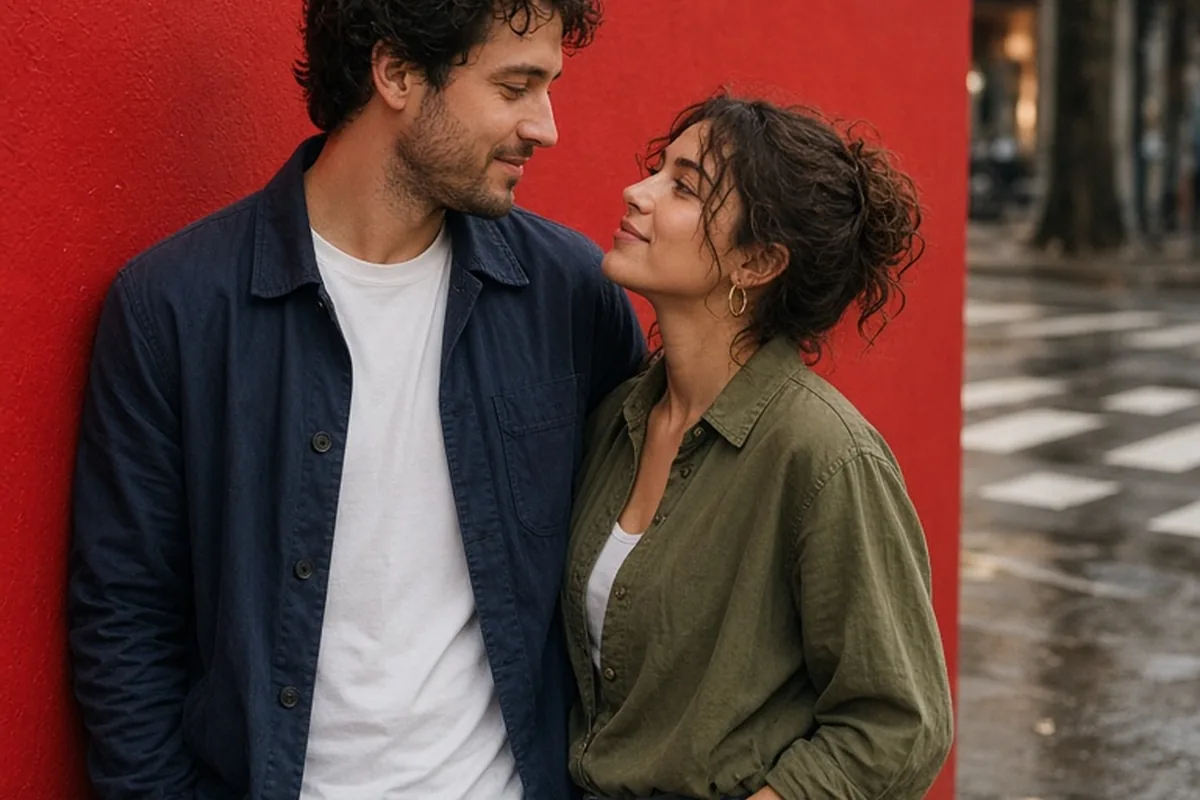
To pose casually against a red wall, lean into relaxed physical contact while letting the bold backdrop create visual contrast. Stand shoulder-to-shoulder with one partner leaning back against the surface, try a walking profile along the wall, or sit closely on the ground. Wear neutral or muted tones like navy, white, olive, or denim so your clothes balance the intense background rather than clash with it.
A vibrant red wall turns an everyday street corner or studio space into a dynamic visual setting, but high-impact color can easily overpower subtle couple poses if the composition feels rigid or cluttered. Creating photos that look effortless requires thoughtful body language, balanced styling choices, and an understanding of how saturated backgrounds interact with natural light.
Balancing Wardrobe Colors Against an Intense Backdrop
Red is one of the most visually dominant colors in photography, drawing the viewer's eye immediately. When selecting outfits for a casual shoot in front of a red wall, the goal is to complement the background rather than fight it for attention. Wearing solid red, hot pink, or neon shades often creates a visual clash and flattens the image, making it difficult to distinguish your silhouettes from the background. Instead, focus on grounding palettes that offer gentle contrast and allow your expressions to remain the center of the frame.
Classic neutrals like crisp white, cream, charcoal, beige, and deep navy provide an effortless balance against warm masonry or painted stucco. Earthy tones such as muted olive green, slate blue, and washed denim also pair exceptionally well with red because they sit naturally across the color wheel without looking overly staged. For example, one partner wearing a soft cream knit sweater and medium-wash jeans while the other wears an unstructured navy overshirt creates a cohesive, relaxed aesthetic that feels curated yet unforced.
Consider incorporating varied textures rather than complex graphic prints. Waffle weaves, linen, denim, and brushed cotton add subtle visual depth to the portrait without introducing distracting patterns that compete with the texture of brick or paint. If you do choose a pattern, opt for a small, understated design like subtle pinstripes or a muted micro-check on only one partner, keeping the other partner in solid tones to maintain visual harmony.
Relaxed Standing and Leaning Postures
Standing flat against a wall with arms pinned at your sides often results in a rigid, mugshot-like appearance. To establish a candid and relaxed mood, use the wall as a physical prop that supports natural movement. When you distribute your weight unevenly or lean slightly into the surface, your shoulders drop and your posture immediately becomes more natural and fluid.
A reliable configuration involves having one partner lean their upper back or single shoulder against the wall with one foot kicked back resting lightly against the baseboard. The second partner stands slightly forward, angled at roughly forty-five degrees toward their partner rather than facing the camera head-on. They can gently rest one hand on the leaning partner's forearm, hook a thumb into a pocket, or wrap an arm around the other partner's waist. This creates organic asymmetry and varied heights, preventing the pose from feeling symmetrical or stiff.
Avoid pressing your entire spine flat against the masonry, as this tends to push shoulders upward and creates artificial tension in the neck. Keep a slight distance between the lower back and the surface, bending at least one knee or crossing one ankle over the other. The subtle angle of relaxed joints makes the interaction feel like an authentic pause in a casual conversation rather than an enforced photo stance.
Creating Depth with Leading Lines and Walking Poses
Shooting straight at a wall creates a two-dimensional plane that can sometimes make the frame feel compressed. To introduce depth and a sense of narrative to casual couple photos, position the camera at an oblique angle along the length of the wall. This turns the architectural surface into a leading line that pulls the viewer's focus directly toward the couple while blurring the background into a soft gradient of red.
Incorporating slow movement is one of the most effective ways to break physical stiffness. Try walking hand-in-hand alongside the wall at a leisurely pace, taking small steps while maintaining close physical proximity. One partner can look slightly ahead toward the camera while the other looks at their partner, sharing a brief smile or private comment. The natural movement loosens facial muscles, generates soft motion in hair and clothing, and yields unposed, candid frames.
When executing a walking shot, slow your usual stride down by half. Moving too quickly can introduce camera blur in shaded areas and often leads to awkward leg extensions when caught mid-step. Aim for a gentle stroll where both partners stay aligned, keeping joined hands relaxed at your sides rather than swinging them aggressively back and forth.
Seated and Low-Angle Compositions
Dropping the perspective down to the ground changes the scale of the red wall, making the background feel expansive while fostering a cozy, intimate mood. Seated poses are inherently informal and provide natural resting positions for your hands, which eliminates the common worry of not knowing what to do with your arms while standing.
Find a clean sidewalk, step, or curb adjacent to the wall. One effective setup is sitting side-by-side with your backs resting lightly against the wall, knees loosely bent, and shoulders touching. One partner can rest an arm over the other's knee or wrap an arm around their partner's shoulder, bringing heads close together. Alternatively, one partner can sit with their back to the wall while the other sits slightly forward, leaning back into their partner's chest, creating a layered, supportive composition.
Be mindful of posture when sitting on the ground, as it is easy to slump into a rounded spine. Lengthen through the torso while keeping the shoulders relaxed downward. If the surface is dusty or damp, carrying a small neutral blanket, a folded jacket, or a clean tote bag to sit on will protect your clothing while remaining discreetly out of the frame.
Managing Lighting and Color Casts on Skin Tones
A primary technical challenge when shooting against a saturated red wall is managing color reflection, known as a color cast. When bright sunlight hits a vivid red surface, it acts as a colored reflector, bouncing strong red light back onto skin, hair, and clothing. This can cause faces to look overly flushed, sunburned, or uneven if the lighting angle is not carefully managed.
To minimize intense red bounce, position yourselves two to three feet away from the wall rather than pressing directly against it. This small separation allows natural ambient light to fall cleanly onto your faces while keeping the wall softly focused in the immediate background. Overcast days or open shade—where a building blocks direct overhead sunlight—are ideal for red backgrounds because the diffuse daylight keeps skin tones natural while rendering the red wall rich and matte.
If you are shooting during golden hour or direct sun, angle your bodies so the primary light source strikes your faces from the front or side, rather than bouncing directly off the wall onto your cheeks. Photographers can also adjust the white balance slightly cooler or use a subtle tint correction in editing to balance out any residual warmth on skin highlights.
Encouraging Natural Micro-Interactions and Touch
The most compelling casual couple portraits rely on subtle, authentic micro-interactions rather than grandiose, dramatic embraces. Small physical connections convey warmth and comfort naturally without looking rehearsed or theatrical. Focusing on gentle interactions also takes your attention away from the camera lens, reducing performance anxiety.
Incorporate unforced gestures into your posing rotation. Gently tucking a strand of hair behind your partner's ear, linking pinkies instead of interlocking full hands, resting a chin lightly on a partner's shoulder, or adjusting a jacket collar creates dynamic points of contact. These small motions provide natural pauses for the photographer to capture in-between moments that reflect genuine rapport.
Use quiet conversation to keep expressions fresh and relaxed. Instead of holding a frozen smile while waiting for the shutter, whisper a lighthearted joke, talk about what you plan to eat after the shoot, or recount a funny shared memory. Natural laughter engages the entire face, softening the eyes and jawline in a way that staged smiles rarely replicate.
Frequently asked questions
What colors should we avoid wearing against a red wall?
Avoid wearing bright red, magenta, or neon colors, as they blend into or clash aggressively with the wall. High-contrast patterns like busy multi-colored florals can also overwhelm the composition. Stick to solid neutrals, denim, navy, or earthy tones to keep the visual focus balanced.
How do we keep from looking stiff when posing in front of a flat wall?
Create asymmetry by bending at least one joint, such as resting one foot on the wall or placing a hand in a pocket. Angle your bodies slightly toward each other at forty-five degrees rather than facing the camera flat, and keep a small gap between your lower back and the surface.
What time of day is best for couple photos against a bold red wall?
Open shade during mid-morning, late afternoon, or soft light on an overcast day works best. Direct midday sun bounces strong red reflections onto skin tones, whereas soft, indirect daylight preserves natural complexions while keeping the wall vibrant.
Your next step
Pick out coordinated neutral outfits, locate a clean red wall in open shade, and practice three simple poses—a leaning stance, a slow walking profile, and a grounded seated position—for your next casual shoot.