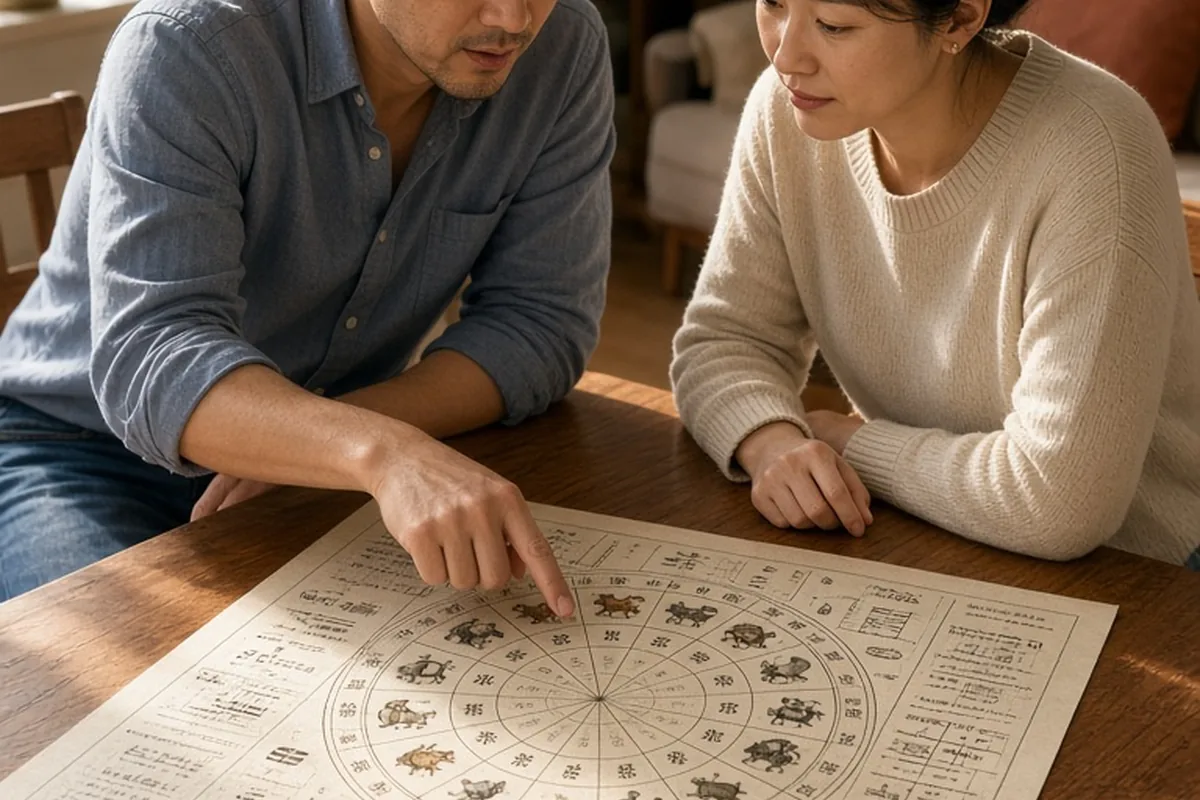
In Chinese astrology, compatibility is shaped by far more than your birth year animal. Core influences include San He three-sign harmony trines, Liu He six paired affinities, the Five Elements (Wu Xing) interaction cycles, and birth month, day, and hour signs within the Four Pillars (BaZi) framework. While these cultural tools offer engaging archetypes, genuine relationship success depends on shared values, mutual respect, emotional maturity, and clear daily communication.
Exploring traditional Chinese astrology offers a rich symbolic vocabulary for understanding interpersonal dynamics, personal tendencies, and interpersonal chemistry. By examining how traditional branch associations, element cycles, and holistic birth charts interact, partners can use these ancient patterns as thoughtful conversational mirrors rather than rigid relationship rules.
The Four Pillars of Destiny: Why Your Birth Year Animal Is Only One Fourth of the Story
In popular culture, people often equate Chinese astrology strictly with the twelve animals assigned to birth years, such as the Dragon, Horse, or Ox. Within traditional BaZi, or the Four Pillars of Destiny, your birth year represents only the outermost pillar. The complete framework incorporates four distinct pillars: the year, month, day, and hour of your birth. Each pillar governs a distinct facet of identity, life timing, and relational connection, which means evaluating two people using only their birth years overlooks three-quarters of their traditional astrological portrait.
The day pillar, often called the Day Master, holds particular significance for romantic harmony and domestic life. While the year pillar reflects social background, ancestry, and outward presentation, the day pillar symbolizes the inner self and the intimate partnership. A couple might share challenging year signs but possess harmonious day branches and supportive Day Master elements. This nuanced layering explains why two people who appear ill-matched under simple calendar horoscopes often build stable, peaceful lives together.
Treating the year animal as an absolute verdict creates unnecessary anxiety. If you choose to explore Chinese astrology to better understand yourself and a partner, viewing the full chart provides a much broader perspective. This holistic view reveals complex strengths and natural friction points rather than reducing a human bond to a single animal mascot.
San He Compatibility Triangles and How the Four Zodiac Trines Operate
One of the foundational concepts in Chinese astrological compatibility is the San He, or Three Harmonies system. Under this framework, the twelve animals divide into four equilateral compatibility trines based on complementary temperaments, natural motives, and shared outlooks on life. Signs located four years apart belong to the same trine, forming alliances that traditional practitioners describe as naturally cooperative, supportive, and mutually reinforcing across long periods.
The first trine brings together the Rat, Dragon, and Monkey, often characterized as dynamic initiators driven by ambition, intellectual curiosity, and high energy. The second trine unites the Ox, Snake, and Rooster, grouping deep thinkers known for persistence, deliberate decision-making, and loyalty. The third trine consists of the Tiger, Horse, and Dog, characterized by idealism, independence, courage, and humanitarian impulses. Finally, the fourth trine includes the Rabbit, Goat, and Pig, marked by artistic appreciation, empathy, emotional responsiveness, and a desire for domestic tranquility.
When partners share a San He trine, they frequently find that their basic pacing and priorities align without extensive negotiation. However, sharing a trine is neither a guarantee of effortless romance nor a substitute for interpersonal skills. Two partners driven by high ambition might find themselves competing for dominance, while two gentle, conflict-avoidant partners might struggle to address difficult domestic decisions. The trine provides a general thematic baseline rather than an infallible compatibility guarantee.
Liu He Six Harmonies and Direct Earthly Branch Oppositions
Beyond the three-sign trines, Chinese astrology identifies the Liu He, or Six Harmonies, representing intimate one-on-one pairings between specific Earthly Branches. These paired signs sit opposite each other in specialized energetic geometry: Rat pairs with Ox, Tiger with Pig, Rabbit with Dog, Dragon with Rooster, Snake with Monkey, and Horse with Goat. In traditional interpretation, Liu He bonds reflect mutual attraction, grounded support, and deep unspoken understanding, often functioning like complementary polarities that balance each one's blind spots.
Conversely, the system describes direct branch oppositions, commonly known as six clashes or Liu Chong. These involve signs located directly six years apart on the zodiac wheel, such as the Rat facing the Horse, or the Tiger confronting the Monkey. Cultural interpretations describe these pairings as having conflicting instincts: one sign may value stability while the other seeks spontaneous movement, or one may prioritize emotional expressiveness while the other leans toward cool pragmatism.
Facing an opposition does not spell disaster for a real-world couple. Many successful partnerships thrive precisely because opposite perspectives encourage personal development, shared resilience, and diverse problem-solving strategies. When partners approach differing styles with genuine curiosity instead of defensive posture, an astrological opposition simply highlights predictable areas where clear expectations and emotional validation will matter most.
The Five Elements and Their Generative or Weakening Cycles in Daily Interactions
The twelve animal signs do not exist in isolation; they are deeply intertwined with the Five Elements, known as Wu Xing: Wood, Fire, Earth, Metal, and Water. Each calendar year introduces an animal paired with a specific elemental expression, such as a Water Rabbit or a Wood Dragon. Furthermore, each animal possesses inherent fixed elements within its branch. Examining compatibility requires observing how these elemental forces influence and modify one another across two people's charts.
The elements interact through continuous cycles of creation and control. In the generative cycle (Sheng), elements support and nourish one another: Water feeds Wood, Wood fuels Fire, Fire creates Earth, Earth bears Metal, and Metal enriches Water. Relationships exhibiting generative elemental dynamics often feel restorative, giving partners a sensation of mutual encouragement and comfort. In contrast, the overcoming or controlling cycle (Ke) reflects tension: Water douses Fire, Fire melts Metal, Metal cuts Wood, Wood depletes Earth, and Earth dams Water.
Rather than viewing a controlling cycle as toxic or forbidden, traditional practitioners interpret it as an engine of discipline, transformation, and refinement. In everyday life, an Earth-heavy partner may provide needed boundaries and grounding structure for a chaotic Water partner, while that Water partner introduces flexibility and emotional depth to rigid Earth. Understanding elemental balances helps couples see how their individual temperaments can balance one another when handled with respect.
Recognizing Cultural Interpretations Versus Real-World Communication Needs
While exploring Chinese astrology provides historical richness and fascinating archetypes, keeping the system in healthy perspective is essential for emotional wellbeing. Astrological systems are interpretive cultural lenses, philosophical frameworks, and narrative tools, rather than empirical psychological assessments or binding life scripts. Relying on zodiac signs to make binding romantic commitments, dismiss viable suitors, or justify unkind behavior harms real interpersonal growth.
In modern relationships, compatibility is ultimately forged through observable actions: reliable follow-through, kind boundary enforcement, shared financial transparency, and genuine emotional safety. A couple possessing theoretically perfect San He and Liu He alignments will still struggle if one partner avoids difficult conversations, hides critical feelings, or ignores agreements. Symbolic alignment can never compensate for a fundamental lack of consideration, honesty, or interpersonal commitment.
A constructive way to use Chinese astrology is as an entertaining, gentle prompt for deeper self-reflection. If a chart comparison highlights potential friction between spontaneous independence and methodical planning, let that insight guide a candid, low-pressure conversation about weekly schedules and personal downtime. Using the signs to clarify real communication habits allows ancient metaphors to serve contemporary connection without imposing superstitious limitations.
Navigating Apparent Astrological Clashes Without Ending a Promising Partnership
Discovering that your animal signs or elemental profiles clash under traditional charts can provoke unnecessary worry, especially if extended family members hold traditional beliefs. If you find yourself in an astrological mismatch with someone you admire, step back from fatalistic predictions. Cultural lore contains numerous counterbalances, including secondary chart placements, auspicious calendar choices, and symbolic remedies, precisely because ancient practitioners understood that life and love are multifaceted.
Begin by separating symbolic friction from actual relational friction. Ask yourself concrete questions grounded in present reality: Does this person respect your limits? Do you handle minor disagreements calmly? Can you express vulnerability without fearing ridicule? If the answers to these everyday relational questions are positive, an abstract zodiac clash holds no power over the health of your partnership. Your day-to-day choices carry far greater weight than ancestral chart archetypes.
If cultural or family expectations place pressure on your relationship due to zodiac matching, focus on demonstrating tangible stability and mutual care. In modern societies, showing that a couple communicates respectfully, shares mutual life goals, and supports one another through stressful events reassures traditional relatives far more effectively than theoretical chart alignments. Treat your bond as a living agreement created by two conscious individuals, not an unchangeable script dictated by your birth date.
Frequently asked questions
Can two people with clashing Chinese zodiac signs have a happy marriage?
Yes, individuals with opposing or clashing signs frequently build joyful, lasting marriages. Astrological signs represent symbolic personality tendencies rather than guaranteed destinies. Real-world success depends on communication habits, emotional maturity, mutual trust, and how effectively partners navigate their differences.
Which Chinese astrology signs are considered universally compatible?
No signs are universally compatible across every context. However, signs within the same San He trine, such as the Rat, Dragon, and Monkey, or those in Liu He pairs like the Tiger and Pig, are traditionally regarded as sharing naturally comfortable chemistry and aligned values.
How does the birth element change compatibility between two signs?
The birth element adds an essential modifier to the baseline animal sign. Two signs that might otherwise clash can find balance if their corresponding elements follow a supportive, generative cycle, such as Water nurturing Wood, which softens potential personality friction.
Is it wise to break up with someone over an unfavorable Chinese horoscope?
Ending a healthy relationship solely because of an unfavorable horoscope is not advisable. Chinese astrology is an interpretive cultural tradition, not a clinical measurement of relationship viability. Base major romantic decisions on how your partner treats you and whether your core values align.
Your next step
Take an hour with your partner to look up both of your full Four Pillars charts together, and use any apparent contrasts as relaxed conversation starters about your preferred communication styles and daily routines.