The most effective Christian youth group activities combine collaborative problem-solving, intentional vulnerability, and shared service to connect teens socially and spiritually. Rather than relying entirely on chaotic games or passive lectures, leaders build lasting bonds through structured low-stakes mixers, community-focused outreach projects, student-led devotional discussions, and quiet reflection spaces. These formats allow adolescents to practice their faith actively, lower social defenses, and form supportive peer friendships rooted in mutual encouragement rather than social popularity.
Adolescence brings a strong desire for genuine belonging alongside an intense fear of social awkwardness, making youth ministry a delicate balance between welcoming fun and spiritual substance. When a gathering relies exclusively on frantic entertainment, students often have fun without ever sharing a meaningful thought, while dry lectures can leave newcomers feeling isolated. Crafting an intentional rhythm of activities helps teenagers explore their beliefs, navigate social anxieties, and discover dependable friends within their faith community.
Low-Stakes Icebreakers That Break Down Cliques Without Embarrassment
Many traditional youth group games fail because they put introverted students on the spot or rely on embarrassing physical stunts that heighten social anxiety. A healthier approach uses low-stakes, cooperative mixers where everyone participates simultaneously without public scrutiny. One effective option is the Common Ground Grid, where each teen receives a card listing universal, non-threatening experiences, such as having lived in another state, knowing how to play an instrument, or disliking chocolate. Students move around the room to find a unique peer for each square, sparking brief one-on-one conversations that naturally bridge friend groups without forcing anyone to speak into a microphone.
Another dependable activity is the Silent Lineup Challenge, where students must arrange themselves in order of birth month or house number without speaking, relying entirely on hand gestures, facial expressions, and teamwork. Leaders can follow this five-minute game with a brief debrief on how easy it is to make assumptions about others before communicating. Because these games require cooperation across existing friendship boundaries, they lower conversational barriers early in the evening. Teens leave the opening segment feeling energized and included rather than self-conscious.
Hands-On Service Projects That Turn Faith into Shared Action
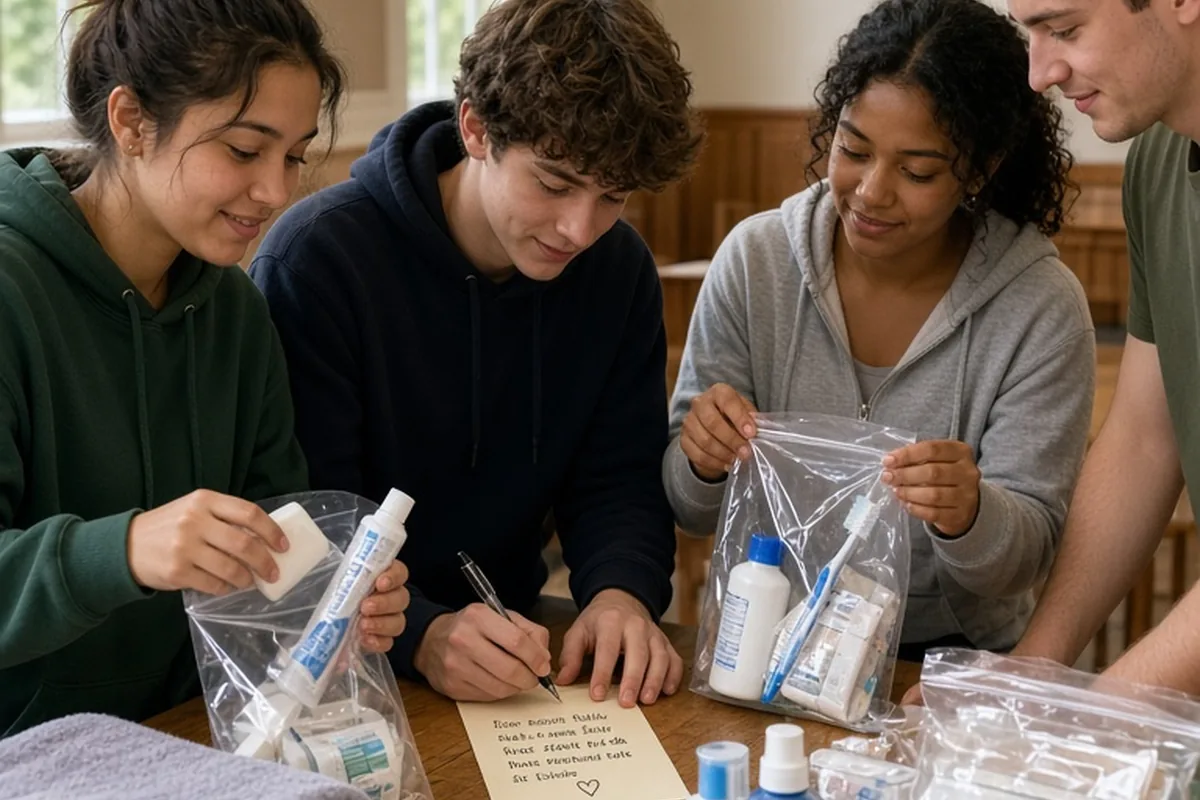
Shared physical labor bonds teenagers much faster than sitting in circles trying to force conversation. When youth work together toward a tangible goal that helps others, social hierarchies tend to fade because everyone shares a clear purpose. An engaging format is the Blessing Bag Assembly Line, where students partner with a local community organization to assemble hygiene kits, cold-weather packs, or non-perishable snack packs for unhoused neighbors. Divide students into coordinated teams responsible for different stations, such as sorting items, quality checking, and writing handwritten cards featuring encouraging notes or favorite Bible verses.
To deepen the impact, coordinate intergenerational service projects where youth assist older church members with seasonal yard care, window cleaning, or small home repairs. Structure the afternoon so teams take a scheduled thirty-minute break to sit with the homeowner over lemonade and ask two simple interview questions about their high school years and how their faith guided them through difficult seasons. This setup provides teens with living examples of perseverance, teaches active empathy, and builds camaraderie as they see their peers serving with humility.
Christian Youth Group Small-Group Discussions Teens Will Actually Join
Standard classroom-style Bible studies often stall when leaders ask broad, intimidating questions like what a complex theological passage means to individual students. Adolescents often stay silent because they fear giving a biblically incorrect answer or appearing overly religious to their friends. Leaders can transform this dynamic by framing small-group time around ethical dilemmas and case studies based on modern teenage experiences. Present a written scenario depicting a student navigating peer pressure, digital exclusion, or balancing sports schedules with church commitments, and ask small groups of four to five students to debate practical solutions alongside relevant Scripture.
Another reliable tool is the Anonymous Question Box, where teens write candid questions about doubts, relationships, family stress, or spiritual questions on index cards without signing their names. Small-group leaders can pull these cards during a casual setting, such as a hot chocolate night, opening the room for guided discussion. Leaders should model vulnerability by acknowledging when questions do not have simple answers, demonstrating that a mature faith welcomes honest questions and that the youth group is a safe space to wrestle with life together.
Prayer Stations and Reflection Nights That Cultivate Intimacy with God
Adolescents face relentless digital and academic stimulation throughout the week, making quiet, contemplative spaces deeply refreshing when thoughtfully prepared. Interactive prayer stations allow students to engage with faith at their own pace without the pressure of praying aloud. Set up five distinct tables around the room with specific themes. A confession station might feature water-soluble paper where teens write down a private burden and watch it dissolve in a bowl of water, visualizing forgiveness. A thanksgiving station can offer an open chalkboard where youth write short notes of gratitude for people who supported them during the week.
Complement these with a global focus station featuring printed profiles of humanitarian projects or international communities facing hardship, alongside blank postcards where teens can write notes of encouragement to missionary partners. Dimming the overhead lights and playing quiet instrumental music gives students the freedom to spend five to ten minutes at the stations that resonate with them. Concluding with a voluntary group circle allows those who feel moved to share an insight, while allowing quieter participants to process their thoughts without pressure.
Collaborative Large-Group Games That Emphasize Teamwork Over Athletic Skill
High-energy games are a staple of youth ministry, but traditional sports-based games frequently alienate less athletic students and reinforce school social tiers. To maintain excitement while fostering genuine inclusion, design games where success depends on puzzle-solving, strategic communication, and collective cooperation. An Escape Room Night turns the youth facility into an interconnected series of challenges where teams decode ciphers based on biblical history, navigate blindfolded obstacle courses guided solely by teammates' verbal cues, and construct load-bearing structures using simple craft supplies.
Another balanced alternative is Strategy Dodgeball or Medic Tag, where eliminated players can be continuously revived through team tasks, such as solving a riddle or having a designated medic tag them back into play. Leaders should form teams intentionally by mixing grade levels and personality types rather than allowing students to pick their own squads. When athletic upperclassmen must rely on creative underclassmen to solve clues to advance, artificial social barriers collapse and mutual respect takes their place.
Practical Approaches for Leaders Navigating Cliques and Relational Friction
Youth leaders inevitably encounter social cliques, defensive body language, and students who resist group activities. Directly confronting a tight-knit friend group in public usually breeds resentment and causes them to pull away. A more constructive strategy is to quietly empower influential students by giving them specific hospitality roles, such as greeting newcomers at the door, pairing with a new student for a team challenge, or leading an element of the night's setup. Directing their social energy toward serving others helps influential youth model hospitality without feeling scolded.
For students who sit apart from the group or decline to play games, respect their boundaries rather than forcing participation. Offer low-pressure alternative roles, such as running the audio-visual presentation, keeping score, or managing refreshments. Adult leaders should make a point to sit beside observing students for a few minutes, asking low-stakes questions about their week without demanding deep spiritual commentary. Creating an environment where students are accepted even when they need time to warm up builds the relational trust required for long-term spiritual growth.
Illustrative Scenarios
Bridging Age Gaps in a Mid-Sized Youth Group
During free-time basketball at a suburban youth group, high school juniors consistently dominated the court, while three new eighth-grade boys stood on the sidelines feeling excluded. The youth pastor initially considered canceling open gym entirely to prevent hurt feelings. Instead, the leader restructured the time into a half-court tournament where every high schooler was paired with a middle schooler, awarding bonus points whenever the younger teammate scored. The older boys shifted naturally into supportive coaching roles, celebrating their younger teammates' shots. Within three weeks, the younger students began arriving early specifically to hang out with the upperclassmen.
Key point: Restructuring competitive activities into cooperative multi-age partnerships builds cross-grade friendships much more effectively than eliminating popular games.
Engaging a Hesitant Student in Group Conversations
A tenth-grade student named Maya attended youth group regularly but never spoke during small-group discussions, frequently looking at the floor when leaders asked broad questions about faith. The small-group leader realized that the open discussion format was triggering public performance anxiety rather than spiritual engagement. The leader introduced paired think-pair-share moments and anonymous reflection cards, allowing students to write down their thoughts or discuss ideas with a single partner before opening the floor. Relieved of public pressure, Maya began sharing thoughtful insights with her partner and eventually volunteered reflections to the wider circle.
Key point: Lowering public speaking pressure through paired sharing and written reflections enables introverted students to contribute meaningfully to spiritual conversations.
Frequently asked questions
What should leaders do if a student refuses to participate in youth group games?
Avoid forcing the student to play or calling attention to their hesitation, which often increases anxiety. Instead, offer them a helpful non-social role, such as keeping score, operating the soundboard, or running the game timer, while letting them know they are welcome to join the game whenever they feel comfortable.
What is the recommended group size for meaningful youth Bible discussions?
Groups of four to six students generally provide the ideal balance for adolescent discussions. Larger groups often allow talkative students to dominate while quiet members fade into the background, whereas smaller cohorts give every student a natural turn to share without prolonged awkward pauses.
How often should youth ministry schedule relational games versus direct teaching?
Rather than separating fellowship and Bible teaching into different weeks, the most balanced ministries integrate both during each meeting. Using a collaborative mixer to introduce the evening's theme creates social safety, making students significantly more receptive to the biblical lesson and small-group reflection that follow.
How can leaders prevent older teens from dominating younger students in combined groups?
Establish intentional teams with mixed ages and assign older teens specific mentoring or supporting responsibilities within cooperative tasks. For personal and sensitive discussions, separate students into age-appropriate breakout groups so middle schoolers and high schoolers can address developmental topics with their immediate peers.
Your next step
Review your upcoming youth group schedule and replace one unstructured social segment with a low-pressure cooperative activity, briefing your volunteer team to facilitate mixed-age partnerships rather than letting students self-segregate.