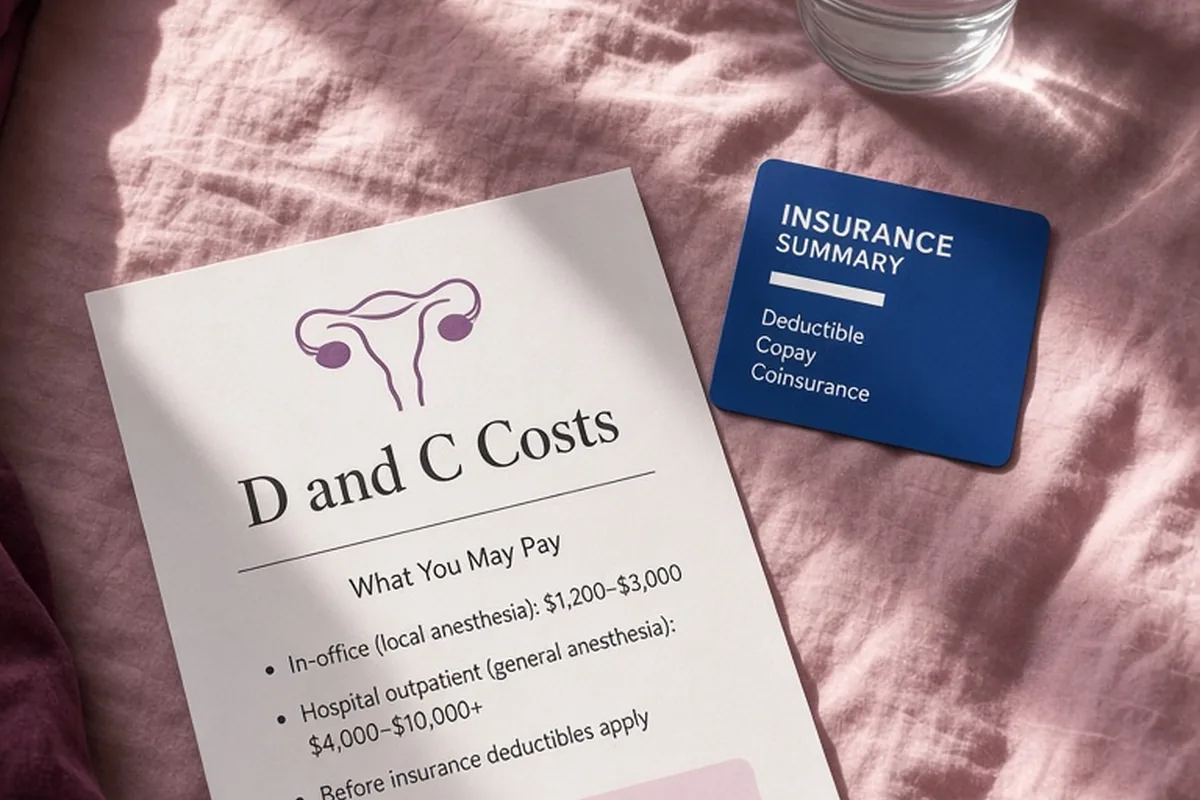
A dilation and curettage (D and C) typically costs between $1,500 and $8,000 without insurance, depending heavily on the setting and anesthesia used. In a private clinic or physician office under local anesthesia, total charges often range from $1,200 to $3,000. When performed in a hospital outpatient surgery center under general anesthesia, total facility, surgeon, and pathology fees frequently range from $4,000 to $10,000 or more before insurance deductibles apply.
Navigating the financial side of a medical procedure is often stressful, particularly when dealing with pregnancy loss, heavy bleeding, or diagnostic testing. Understanding the distinct charges that make up your total bill can help you plan your budget, evaluate insurance coverage, and advocate for clearer cost estimates before treatment.
Primary Factors That Determine Total D and C Expenses
The overall price tag of a dilation and curettage varies substantially based on several clinical and administrative elements. The primary variable is the clinical setting where the procedure occurs. Having the procedure performed in a doctor's office or dedicated clinic environment carries significantly lower overhead than receiving care in a full-scale hospital operating room or an ambulatory surgical center. Hospital settings append facility fees that often double or triple the total baseline charge.
Another major factor is the type of anesthesia administered during the procedure. Local anesthesia, paracervical blocks, or mild oral sedatives administered in an office setting involve minimal additional personnel and drug costs. In contrast, deep sedation with intravenous propofol or general anesthesia administered by a certified registered nurse anesthetist or board-certified anesthesiologist introduces independent professional charges and dedicated monitoring fees that add substantial sums to your statement.
The clinical indication for the procedure also influences coding, billing complexity, and diagnostic follow-up. A D and C performed for first-trimester pregnancy loss management may involve different surgical codes and instruments than one conducted to evaluate postmenopausal uterine bleeding or remove endometrial polyps. Furthermore, geographical variations in regional cost of living and local healthcare market competition directly shape provider fee schedules nationwide.
- Clinical setting: In-office procedure suites carry the lowest facility overhead, while hospital operating rooms generate the highest fees.
- Sedation level: Local numbing blocks are far less expensive than monitored intravenous sedation or general anesthesia.
- Pathology processing: Evaluating tissue samples in an external laboratory generates separate billing charges.
- Geographic region: Metropolitan surgical centers often charge higher base rates than regional community providers.
Comparing In-Office Procedures and Hospital Surgical Centers
Understanding the differences between an in-office D and C and a hospital-based surgical intervention helps clarify why price quotes vary so widely. When a physician performs a manual or electric vacuum aspiration D and C directly in an exam room, they utilize minimal disposable equipment, local anesthesia, and clinic nursing staff. Because the provider owns or leases the office space directly, you typically receive a single consolidated bill covering both the provider's professional services and the procedure room overhead.
In contrast, choosing or requiring a hospital outpatient department means the hospital functions as an independent billing entity. In this environment, you receive at least two distinct bills: one from the surgeon for their professional manual fee, and one from the hospital representing the facility charge. The facility charge covers room sterilization, nursing staff shift hours, surgical tray setup, recovery bay monitoring, and hospital overhead. This facility bill is frequently several times larger than the surgeon's fee itself.
While an office setting is substantially more economical, it may not be suitable for every clinical circumstance. Patients with specific medical complexities, bleeding disorders, severe uterine anomalies, or extreme anxiety requiring deep unconsciousness may necessitate the advanced life-support safeguards and specialized equipment found only in an accredited surgical center or hospital.
How Health Insurance, Deductibles, and Copays Apply
For patients utilizing private health insurance, employer-sponsored plans, or government coverage like Medicaid, out-of-pocket costs depend entirely on benefit design rather than the facility's gross charge. A D and C is routinely classified as an outpatient surgical procedure rather than a routine preventive visit. Consequently, your annual deductible must usually be satisfied before your insurance provider begins contributing toward the allowed expense.
Once your deductible is met, your policy structure determines whether you pay a flat copayment or a percentage coinsurance rate, commonly ranging between ten and thirty percent of the insurer's contracted rate. For example, if an in-network hospital agrees to an allowed amount of $4,000 for the entire episode of care and your plan requires a twenty percent coinsurance after a met deductible, your personal financial responsibility would be $800.
It is essential to verify prior authorization requirements before scheduling a non-emergency procedure. Insurers often demand pre-certification confirming medical necessity based on diagnostic ultrasound findings or ongoing clinical symptoms. Failing to secure prior authorization before elective scheduling can result in full claim denial, leaving the policyholder responsible for the entire undiscounted balance.
- Annual deductible: The total sum you must pay for covered services before your health plan starts sharing costs.
- Coinsurance percentage: Your shared percentage of the insurer's negotiated rate once the deductible has been satisfied.
- In-network provider verification: Ensuring the surgeon, facility, anesthesiologist, and pathologist all participate in your plan network.
- Prior authorization: Administrative approval from your insurer validating the clinical necessity of the procedure.
Navigating Self-Pay Discounts, Cash Pricing, and Financial Assistance
Patients without health insurance, or those with high deductibles who choose not to file a claim, can often access significantly lower self-pay bundled rates. Many outpatient clinics, independent surgical centers, and reproductive healthcare practices offer transparent, all-inclusive cash prices. These package rates combine the clinician's fee, basic local sedation, routine supplies, and standard recovery care into a single flat payment collected at the time of service.
If you receive care at a non-profit or community-based hospital, federal regulations require the facility to maintain a formal Financial Assistance Policy (FAP). Under these charity care guidelines, individuals and families earning below specific multiples of the federal poverty guidelines can qualify for partial or complete balance forgiveness. Applying for financial assistance typically requires submitting recent tax returns, pay stubs, or bank statements to verify household income.
Even when charity care is unavailable, most medical billing departments will negotiate prompt-pay discounts. Asking billing managers for a cash discount of twenty to forty percent in exchange for paying in full immediately, or setting up an interest-free monthly installment schedule, can prevent accounts from being transferred to collection agencies while making payments manageable.
Separate and Hidden Fees on Your Itemized Statement
Medical billing for surgical interventions is notoriously fragmented, often resulting in multiple separate statements arriving weeks apart for a single procedure. Being aware of these potential independent line items prevents surprise when reviewing your mail. The first primary charge is the professional fee billed by the gynecologist or surgeon who performed the manual dilation and curettage.
The second primary invoice is the institutional facility charge from the surgical center or hospital. Beyond these two core components, patients frequently receive a separate bill from an independent anesthesiology group if intravenous sedation or general anesthesia was administered. Anesthesia billing relies on base procedure units plus exact elapsed time increments measured in fifteen-minute blocks.
Additional ancillary charges often include surgical pathology services, where tissue evacuated from the uterus is examined microscopically by an external laboratory specialist to rule out molar pregnancy, infection, or cellular abnormalities. Patients with Rh-negative blood may also see separate pharmacy charges for Rh immune globulin injections, pre-procedure prophylactic antibiotics, or post-procedure pain management medications.
- Surgeon professional fee: Compensation for the physician's surgical labor and immediate clinical oversight.
- Facility charge: Overhead billing for room reservation, sterilization protocols, disposable equipment, and nursing staff.
- Anesthesiology group fee: Separate professional charges for sedative administration and physiological monitoring.
- Pathology analysis: Laboratory examination of extracted tissue specimens to confirm clinical diagnoses.
- Medications and blood products: Specialized injections such as Rh immunoglobulin, cervical preparation agents, and antibiotics.
How to Request a Good Faith Estimate and Audit Final Bills
Under the federal No Surprises Act, healthcare providers and facilities are legally required to furnish uninsured and self-pay patients with a written Good Faith Estimate (GFE) upon scheduling or inquiry. This document must list expected charges for the primary procedure alongside reasonably anticipated ancillary items like anesthesia and room fees. When obtaining an estimate, request the exact Current Procedural Terminology (CPT) codes, such as code 58120 for diagnostic D and C or code 59812 for miscarriage management.
Once your care is complete and bills arrive, never pay an aggregate statement balance without first reviewing a fully itemized invoice. Request an itemized statement detailing every individual CPT code, revenue code, and quantity charged. Compare these line items directly against your Explanation of Benefits (EOB) sent by your insurance company to ensure the provider did not bill you more than the approved patient-responsibility amount.
If you identify discrepancies, duplicate entries, or services billed that you did not receive, contact the provider's billing office promptly to initiate a formal dispute. You have the right to request a clinical chart audit or invoke independent dispute resolution if your final self-pay charges substantially exceed the initial Good Faith Estimate without documented medical justification.
Illustrative Scenarios
Evaluating Setting Differences: Clinic Package Versus Hospital Estimate
A patient diagnosed with an incomplete early miscarriage received two distinct care pathways. Her hospital-affiliated physician quoted an outpatient hospital surgery under IV sedation, which involved an estimated $6,500 hospital facility fee, an $800 surgeon fee, and an uncalculated anesthesia charge, leaving the patient facing a $3,500 out-of-pocket balance under her high-deductible plan. Upon inquiring with an independent women's health clinic, the patient was offered an in-office manual vacuum aspiration using local anesthesia and mild oral sedation for a flat, self-pay bundled rate of $1,400.
Key point: Procedure settings and anesthesia choices directly drive total medical costs. Asking whether an in-office option is clinically appropriate can reduce out-of-pocket expenses by thousands of dollars.
Frequently asked questions
Is a D and C covered by health insurance for a miscarriage?
Yes, most health insurance plans cover a D and C when it is medically necessary to manage an incomplete, missed, or spontaneous pregnancy loss. Your final out-of-pocket cost will depend on your specific policy's annual deductible, coinsurance percentage, and whether all involved providers are in-network.
Why did I receive multiple separate bills for one D and C procedure?
Hospitals and surgical centers frequently utilize separate billing entities for different components of care. You will commonly receive independent invoices from the facility, the attending surgeon, the anesthesiology practice, and the pathology laboratory that processed your tissue sample.
Can I negotiate my D and C medical bill if I do not have insurance?
Yes, self-pay patients can actively negotiate their bills by requesting a prompt-pay discount or applying for the hospital's income-based financial assistance policy. Many facilities will discount standard billed charges by thirty to fifty percent or provide zero-interest installment plans when asked.
Your next step
Contact your provider's billing department today to request the specific CPT codes for your procedure and ask for a detailed written Good Faith Estimate before scheduling.