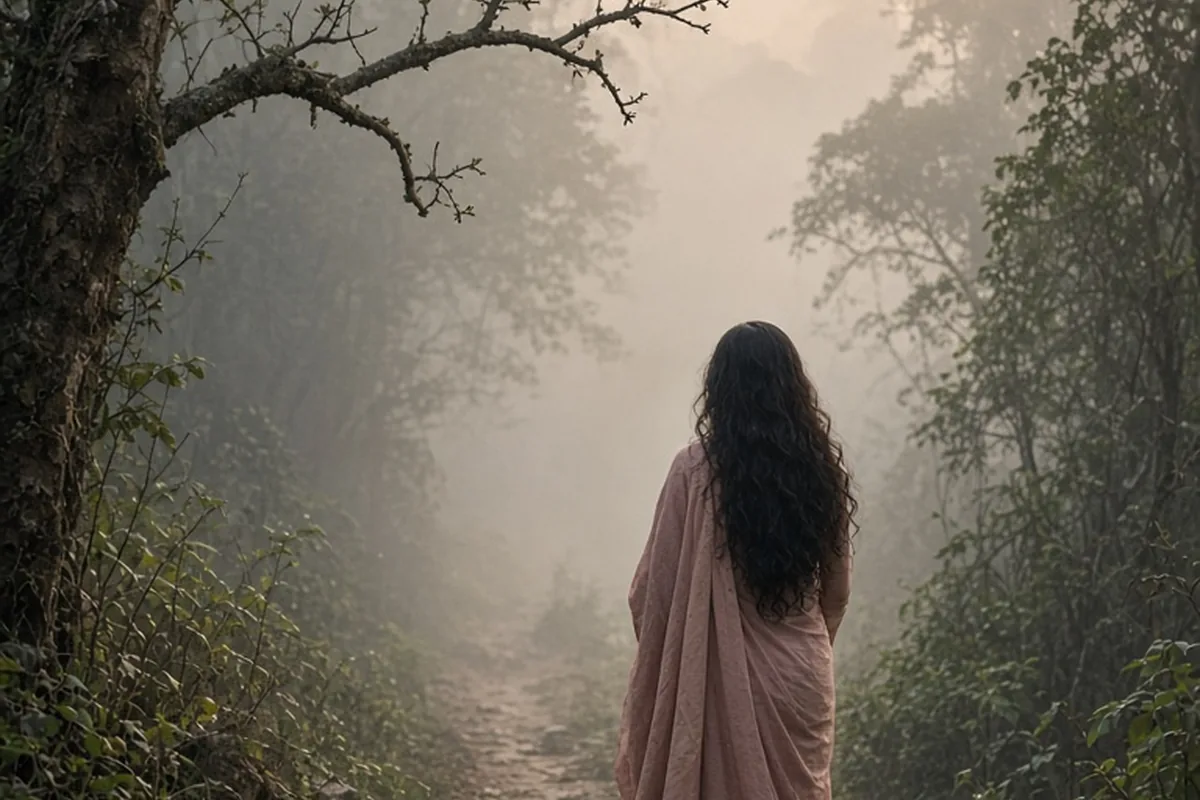
Duryodhana's daughter Lakshmana led a deeply tragic life marked by isolation between two warring dynasties. Though married to Krishna's son Samba to bridge the Kauravas and Yadavas, she endured the violent death of her father and twin brother in the Kurukshetra War. Decades later, she witnessed the total annihilation of her marital clan during the Yadava fratricide, leaving her entirely bereaved.
In epic traditions like the Mahabharata and regional retellings, the personal experiences of royal women provide a poignant lens into the devastating collateral costs of generational conflict and royal ambition.
The Royal Birth and Privileged Childhood in Hastinapura
Lakshmana was born as the beloved daughter of Duryodhana, the eldest of the Kaurava brothers, and his chief consort Bhanumati. Growing up alongside her twin brother, Lakshmana Kumara, she enjoyed the immense wealth, military protection, and cultural opulence of the Kuru court. From an early age, Lakshmana was described in tradition as possessing extraordinary beauty, intelligence, and grace. Duryodhana doted on his children, shielding them from the bitter rivalries and political animosity brewing between the Kaurava elders and their cousins, the Pandavas.
Despite the splendor of Hastinapura, Lakshmana's childhood was overshadowed by the looming political storm. While royal princesses were trained in fine arts, governance, and diplomacy, their futures were frequently intertwined with strategic alliances. Her early upbringing represented a fleeting period of stability in a royal house that was rapidly hurtling toward self-destruction. Understanding her early life highlights the dramatic contrast between her protected youth and the profound, compounding grief that defined her later adulthood.
The Swayamvara and the Dramatic Abduction by Samba
When Lakshmana reached marriageable age, Duryodhana arranged a magnificent Swayamvara, inviting princes and monarchs from across the subcontinent. Among the attendees was Samba, the handsome and spirited son of Krishna and Jambavati. Intrigued by Lakshmana's reputation and captivated by her presence, Samba chose not to participate in the traditional contest. Instead, driven by impulse, he abducted the princess directly from the assembly hall in his chariot, defying the formal protocols of royal courtship.
The Kaurava warriors, led by Karna, Duryodhana, and Bhishma, reacted with outrage at the breach of protocol. They pursued Samba, overpowered him after a fierce battle, and imprisoned him in Hastinapura. The incident threatened to spark an immediate war between the Yadavas of Dwaraka and the Kauravas. Balarama traveled to Hastinapura to negotiate a peaceful resolution. When the Kuru elders initially spoke insolently to him, Balarama demonstrated his formidable strength by using his plowshare to begin dragging the city into the Ganges. Shaken by this display of divine power, Duryodhana relented, embraced Samba as his son-in-law, and arranged a lavish wedding, sending Lakshmana to Dwaraka with a vast dowry of elephants, gold, and jewels.
Life in Dwaraka and the Fragility of Dual Loyalties
Following her wedding, Lakshmana adjusted to life as a Yadava daughter-in-law in the prosperous coastal city of Dwaraka. Her position was uniquely delicate; she was the daughter of the Kaurava prince who was the primary antagonist of the Pandavas, yet she lived among Krishna's household, which maintained deep familial and strategic ties to the Pandava brothers. Despite these underlying political tensions, classical accounts describe her as being welcomed with affection by Krishna, Jambavati, and the wider Yadava royal family.
Nevertheless, living between two politically entangled houses placed an immense emotional burden on Lakshmana. She was forced to navigate domestic life while knowing that the ideological rift between her birth family and her husband's relatives was widening every year. When diplomatic avenues between the Pandavas and Kauravas permanently collapsed, Lakshmana found herself geographically and socially aligned with the allies of those who would ultimately fight and destroy her paternal home.
The Trauma of the Kurukshetra War and Familial Destruction
The outbreak of the eighteen-day Kurukshetra War marked the first major catastrophe in Lakshmana's life. As the battle raged, she remained in Dwaraka, forced to receive ongoing reports of carnage from afar. Early in the conflict, her beloved twin brother, Lakshmana Kumara, was slain on the battlefield by the young Pandava hero Abhimanyu. The loss of her twin severed her deepest emotional connection to her childhood and plunged her into profound personal mourning.
By the conclusion of the war, the devastation was total. Her father Duryodhana, all of her paternal uncles, and nearly every fighting man of Hastinapura were killed. Lakshmana watched her entire maternal and paternal lineage collapse in a matter of weeks, leaving only widowed elders behind. The knowledge that her father's uncompromising pride had led to this total ruin added a layer of psychological complexity to her grief, leaving her marooned in a marital family that had actively guided the Pandavas to victory.
The Yadava Curse and the Disintegration of Dwaraka
Decades after the Kurukshetra War, tragedy struck Lakshmana's life once more, this time originating within her own marital household. Her husband Samba and other young Yadava princes engaged in a disrespectful prank, disguising Samba as a pregnant woman and mockingly asking visiting sages—including Vishwamitra, Durvasa, and Kanva—to predict the child's gender. Enraged by their insolence, the rishis pronounced a curse stating that Samba would give birth to an iron bolt or pestle that would destroy the entire Yadava clan.
The curse materialized when Samba produced a heavy iron club. In a desperate bid to avert the prophecy, King Ugrasena ordered the iron pestle ground into fine dust and thrown into the sea, with a single remaining triangular tip cast away. However, the iron dust washed ashore and grew into sharp eraka grass, while the cast-off metal tip was swallowed by a fish and later retrieved by a hunter named Jara. Lakshmana was forced to watch her husband become the unwitting catalyst for a doom that echoed the earlier destruction of her birth family.
The Final Isolation: The Musala Parva and Dwaraka's Submersion
The culmination of the curse occurred at the pilgrimage site of Prabhasa during the Musala Parva. Consumed by arrogance and intoxicated with liquor, the Yadava princes fell into bitter internal arguments. The dispute escalated into an uncontrollable civil war where the men pulled up the iron-infused eraka grass and used it as lethal weapons against one another. Samba was killed alongside his brothers, cousins, and elders in the chaotic fratricide.
Following the death of Krishna and Balarama, Arjuna arrived to evacuate the surviving women, children, and elderly citizens of Dwaraka before the rising sea submerged the city. Lakshmana, having lost her husband, her sons, and her extended marital family, was evacuated alongside other royal widows. Deprived sequentially of her childhood home, her twin, her parents, her spouse, and her adopted city, her final years were spent in austere mourning and spiritual seclusion, embodying the ultimate cost of dynastic destruction.
Philosophical Lessons from Lakshmana's Tragic Arc
Lakshmana's narrative offers a profound meditation on the innocent bystanders of epic conflicts. In epic literature, public focus often gravitates toward heroic warriors, grand oaths, and battlefield feats. Yet characters like Lakshmana illuminate the private, quiet suffering that persists long after the warriors have fallen. Her life demonstrates how individuals can be caught between powerful systemic forces, carrying the sorrow of multiple warring factions without having agency in their political decisions.
Reflecting on her story allows modern readers to examine the realities of grief, resilience, and historical memory. Rather than viewing epic literature solely through victorious triumphs or dramatic villainy, exploring figures like Lakshmana fosters a deeper empathy for those who bear the emotional weight of societal collapse, reminding us of the enduring human need to honor sorrow with dignity and compassionate understanding.
Frequently asked questions
Who was Lakshmana's mother according to the Mahabharata traditions?
Lakshmana was the daughter of Duryodhana and his principal queen, Bhanumati (also referenced as Mayuri in certain regional traditions). She was raised with great care in the royal palace of Hastinapura alongside her twin brother, Lakshmana Kumara.
How did Lakshmana react to her abduction by Samba?
Traditional texts indicate that while Samba abducted Lakshmana abruptly during her Swayamvara, the two developed genuine affection once the initial political conflict was resolved by Balarama. Her life in Dwaraka became her primary home until the Yadava clan's eventual downfall.
Did Lakshmana have any children with Samba?
Yes, traditional lineages record that Lakshmana and Samba had children, including a son named Ushnika. However, the subsequent generational lines were heavily disrupted by the catastrophic civil strife of the Musala Parva and the submergence of Dwaraka.
Your next step
To gain a richer understanding of epic narratives, study the lesser-known perspectives of royal women like Lakshmana whose lives reveal the profound human costs behind historic conflicts.