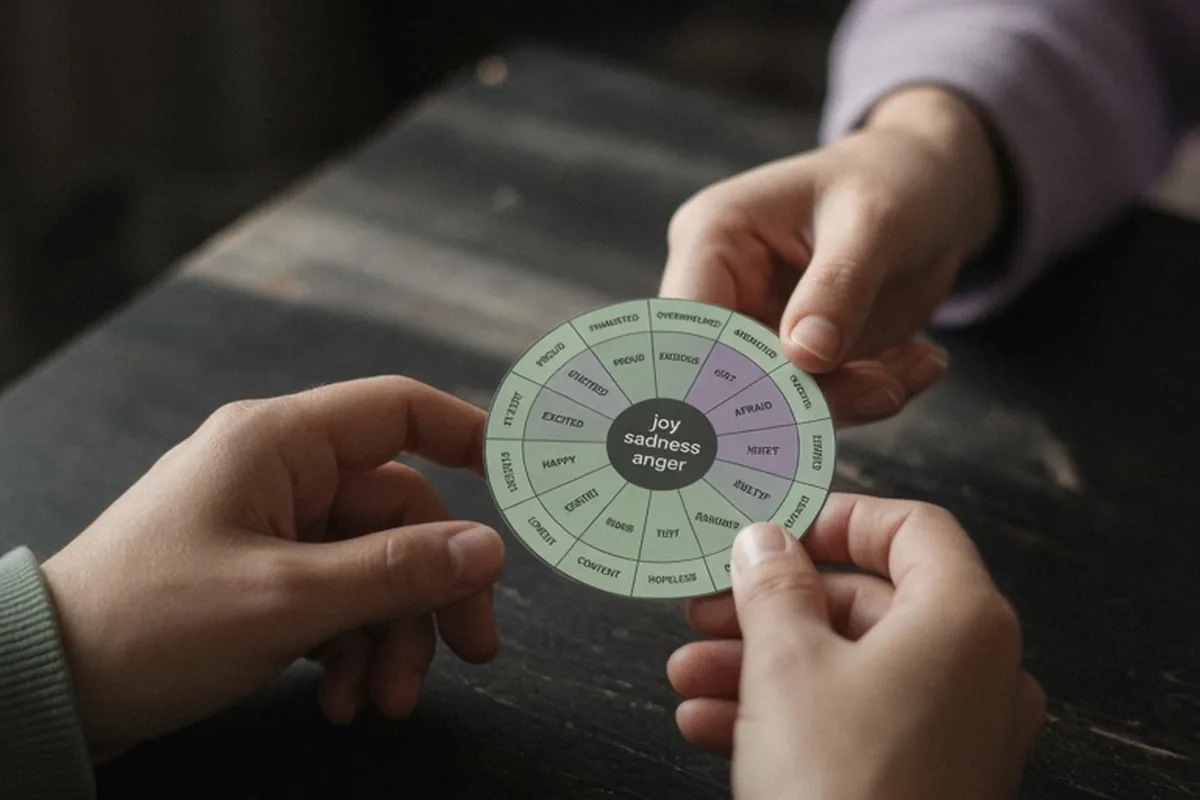
An emotion wheel is a visual tool designed to help people identify, articulate, and process complex feelings. Typically organized with core primary emotions at the center, such as joy, sadness, anger, fear, surprise, and disgust, the wheel expands outward into increasingly specific secondary and tertiary terms. This structure allows individuals to move beyond vague emotional states and pinpoint the exact nature of their internal experiences.
Many people struggle to describe how they feel when stress, conflict, or grief arises, often falling back on generic labels like mad, stressed, or fine. Learning to label your internal state accurately is one of the most effective ways to make sense of your needs and communicate clearly with the people in your life.
How the Emotion Wheel Is Structured to Organize Internal States
The emotion wheel organizes the broad spectrum of human feelings into an accessible, concentric circular format. At the very center of the wheel sit primary emotions—typically foundational survival states like joy, sadness, fear, anger, disgust, and surprise. Because these primary categories can feel overly broad or blunt, the diagram expands outward into secondary and tertiary rings. Each outward layer breaks down the central feeling into subtler, more descriptive variations. For instance, anger might expand into frustration, resentment, or feeling betrayed, which gives much richer context to an otherwise reactive state.
Understanding this visual architecture helps you locate where an emotional response originates and where it settles in real life. When you look at the circular layout, you can track how an immediate physical reaction transforms into a specific cognitive assessment. Moving from the broad core to the outer edges provides a practical vocabulary that Bridges physical sensations and cognitive understanding, helping you make sense of why a particular situation caused such an intense reaction.
Moving from Vague Reactivity to Granular Emotional Awareness
Psychologists often discuss emotional granularity, which is the ability to distinguish between specific emotional states rather than treating all negative feelings as a uniform blur. When you only know that you feel bad, choosing an appropriate coping strategy is difficult. You might try to fix an apparent anger issue when your underlying feeling is actually exhaustion, vulnerability, or loneliness. Using an emotion wheel builds emotional granularity by offering distinct terms that clarify what kind of support or action you truly require.
Consider a scenario where you return home from work feeling irritable and snappy toward your partner. If you label that state simply as anger, you might pull away or start an unnecessary argument about minor household chores. When you consult the wheel and trace that irritability outward, you might discover you are actually feeling overwhelmed, insecure about an evaluation, or physically depleted. Naming the specific state changes your response: instead of engaging in conflict, you can ask for a quiet evening or express that you need reassurance about your work.
The trade-off with developing emotional granularity is that it requires patience and mental effort during moments when your instinct is to react immediately. Stepping back to identify nuanced vocabulary can feel counterintuitive when your nervous system is activated, meaning it takes deliberate practice before it becomes an automatic habit.
Using the Emotion Wheel to De-escalate Relationship Conflicts
In romantic relationships and close friendships, miscommunication frequently happens because partners communicate in defensive shorthand. Accusatory statements such as you never care or you are ignoring me usually mask deeper, unexpressed vulnerabilities. When two people look at an emotion wheel together or use its vocabulary during calm conversations, it shifts the focus from blaming the other person to explaining one's own internal landscape.
For example, during a disagreement over unshared responsibilities, one partner might initially say they are furious about the kitchen being messy. By looking deeper into the wheel, that person might recognize their core feeling is sadness, branched into feeling neglected or undervalued. Expressing I feel unappreciated and invisible when the chores are left entirely to me invites collaboration, whereas shouting I am furious about the mess invites defensiveness. Precise vocabulary helps partners see the vulnerability beneath the armor.
However, introducing an emotion wheel into interpersonal dynamics requires mutual consent and emotional safety. Forcing a partner to use the wheel during a heated argument can feel patronizing or manipulative. The tool works best when both people agree to use it during reflective debriefs rather than as a demand during high-tension standoffs.
A Practical Step-by-Step Method for Navigating Difficult Sensations
You can use an emotion wheel independently whenever you notice physical tension, mental fog, or emotional turbulence. The following structured process helps translate confusing feelings into clear understanding without requiring hours of analysis.
First, pause and take several deep breaths to settle your nervous system, noticing physical markers like a tight jaw, rapid heartbeat, or a heavy chest. Next, look at the innermost circle of the wheel and pick the primary category that feels closest to your physical state—for example, fear. From there, scan outward into the secondary ring to see if your state resembles anxiety, insecurity, or helplessness. Finally, read the tertiary ring to find the word that creates a sense of recognition, such as inadequate or overwhelmed. Once you name the exact word, consider what constructive action directly addresses that specific state.
- Pause and notice your somatic markers, such as muscle tightness or breathing rate.
- Select the primary core emotion at the center that best matches your baseline state.
- Scan outward into the secondary and tertiary tiers until a specific word resonates.
- Identify the underlying unmet need highlighted by that precise term.
- Choose one actionable step to support that need rather than reacting impulsively.
Understanding the Limits and Boundaries of Emotional Mapping
While the emotion wheel is an effective self-reflection tool, it is important to acknowledge what it cannot do. The wheel is a descriptive vocabulary aid, not a clinical diagnostic assessment or a substitute for professional mental health support. Categorizing an emotion does not automatically resolve persistent trauma, chronic mood disorders, or severe clinical depression, which often require comprehensive therapeutic intervention.
Another common pitfall is over-intellectualizing your feelings. Some people use the wheel as a way to analyze and categorize their emotions purely in their head, avoiding the necessary physical experience of feeling them in their body. Labeling a feeling as isolated or disrespected is helpful only if you allow yourself to process the sensation rather than treating the wheel as a puzzle to be solved and immediately dismissed. It should serve as a bridge to self-compassion, not an exercise in emotional detachment.
Integrating the Wheel into Daily Habits and Journaling
To get the most value from an emotion wheel, incorporate it into low-stakes, everyday routines rather than saving it exclusively for crises. Consistent check-ins build emotional familiarity over time, making it easier to identify subtle shifts before they grow into overwhelming mood swings or reactive behavior.
A practical way to build this habit is through short evening journaling. At the end of the day, spend two minutes reviewing the wheel to identify the dominant emotion you felt during a specific interaction or project. Write down the term along with one sentence describing what triggered it and how you responded. Over weeks, this practice reveals patterns in your emotional triggers, helping you anticipate high-stress environments and proactively set healthier boundaries with work, friends, and family.
Frequently asked questions
What is the difference between primary and secondary emotions on the wheel?
Primary emotions are your immediate, foundational reactions to an event, such as joy, sadness, or fear. Secondary emotions are the more specific layers or cognitive reactions that develop from those core states, such as feeling resentful, defensive, or embarrassed.
Can using an emotion wheel help with anxiety?
Yes, using the wheel can help reduce anxiety by identifying the specific concerns beneath a general sense of dread. Pinpointing whether your anxiety is rooted in feeling unprepared, overwhelmed, or rejected gives you clear clues about what constructive steps you can take.
How often should I use an emotion wheel?
You can use an emotion wheel as often as needed, whether during a daily two-minute evening reflection or whenever you feel emotionally unsettled. Using it regularly during calm moments makes it much easier to access when you are navigating stress or interpersonal conflict.
Your next step
Save a digital copy or print an emotion wheel, and commit to identifying your exact secondary or tertiary emotion during your next quiet moment of reflection today.