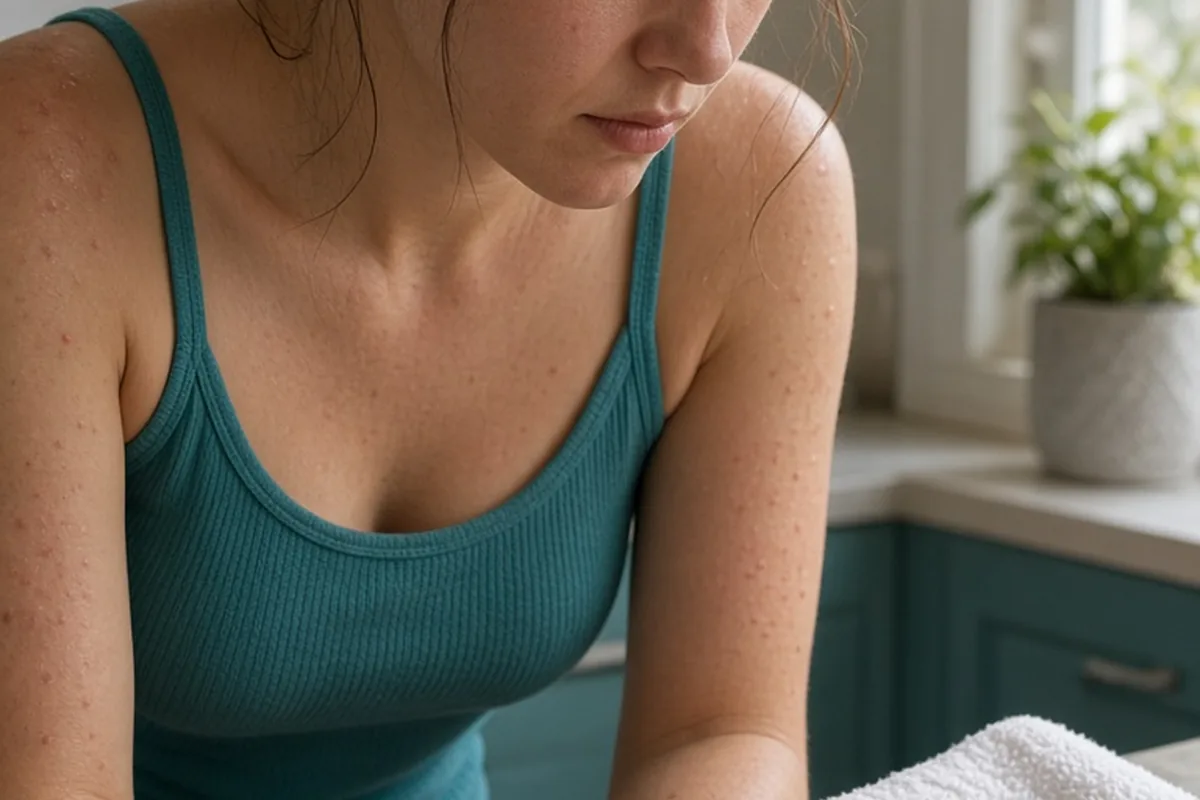
Fungal acne is not true acne but an overgrowth of Malassezia yeast inside hair follicles, clinically termed pityrosporum folliculitis. While regular acne vulgaris involves clogged pores, excess sebum, and Cutibacterium acnes bacteria leading to varied blemishes like blackheads, cysts, and pustules, fungal breakouts appear as uniform, itchy, small red bumps that do not respond to standard acne medications.
Waking up to a sudden cluster of stubborn bumps can be frustrating, especially when standard spot treatments seem to make the irritation worse. Understanding whether your skin is reacting to bacterial congestion or an overgrowth of yeast is the crucial first step toward clearing your complexion safely and effectively.
Malassezia Folliculitis vs Acne Vulgaris: The Biological Difference
To understand why treatments for standard blemishes often fail against fungal breakouts, you have to look at the microscopic environment of the pore. Regular acne, known medically as acne vulgaris, develops when dead skin cells shed irregularly and combine with natural sebum to form a plug inside a sebaceous follicle. In this oxygen-deprived environment, resident Cutibacterium acnes bacteria multiply rapidly, triggering inflammatory pathways that create tender papules, nodules, or pus-filled pustules. The primary drivers are hormonal fluctuations, sebum composition, and follicular hyperkeratinization.
In contrast, what is colloquially called fungal acne is actually an inflammatory condition named Malassezia folliculitis or pityrosporum folliculitis. Malassezia is a genus of lipid-dependent yeasts naturally present on human skin as part of a healthy microbiome. When environmental conditions such as heat, occlusion, humidity, or compromised barrier function allow these organisms to proliferate excessively inside the hair follicle, they break down fatty acids in sebum and produce irritating metabolites. The immune system responds with acute localized inflammation, producing clusters of follicular bumps that mimic acne vulgaris despite having a completely different biological root.
Further reading: American Academy of Dermatology: Acne
Visual Clues: Identifying Uniform Bumps Versus Mixed Blemishes
One of the clearest distinctions between fungal acne and regular acne lies in the visual appearance and symmetry of the lesions. Fungal folliculitis presents as monomorphic eruptions, meaning almost all the bumps look nearly identical in shape, diameter, and color. They typically emerge as small, pinpoint papules or tiny superficial pustules measuring between one and two millimeters across, often sitting in close clusters like a fine rash. You will rarely see deep-seated nodules or changing stages of lesions in a purely fungal breakout.
Acne vulgaris is polymorphic, presenting a diverse mixture of blemish types simultaneously across the affected area. On any given day, someone with regular acne might have open comedones (blackheads), closed comedones (whiteheads), inflamed red papules, and deeper, painful cysts. The lesions vary widely in size and progress through different stages of development, from initial congestion to inflammatory swelling and eventual resolution. If your breakout features varied blemish sizes alongside comedones, acne vulgaris is far more likely.
Further reading: American Academy of Dermatology: Acne
The Role of Itching and Upper Body Distribution in Breakouts
Sensation provides another critical diagnostic clue that separates yeast-driven inflammation from traditional bacterial acne. Fungal acne is frequently accompanied by noticeable, persistent pruritus (itching) or a mild stinging sensation, particularly when the skin becomes warm, sweaty, or trapped beneath tight clothing. While regular inflammatory acne lesions can feel sore, throbbing, or tender to the touch, they rarely itch in the rapid, crawling manner characteristic of follicular yeast overgrowth.
Distribution patterns also differ significantly between the two conditions. While acne vulgaris predominantly targets the central facial regions, such as the T-zone, jawline, and chin where sebaceous glands are most dense, Malassezia folliculitis shows a strong preference for the perimeter of the face, hairline, forehead, upper chest, shoulders, and upper back. Breakouts that cluster along sports-bra lines, sweat bands, or heavy collar zones often point toward yeast proliferation fueled by warmth and moisture.
Further reading: American Academy of Dermatology: Acne
Why Benzoyl Peroxide and Salicylic Acid Fail on Fungal Breakouts
A hallmark frustration for people dealing with Malassezia folliculitis is the lack of improvement—or outright worsening—after using gold-standard acne remedies. Benzoyl peroxide works primarily by introducing oxygen into the pore to kill anaerobic Cutibacterium acnes bacteria, while salicylic acid exfoliates inside the pore lining to clear sticky lipid buildup. Because neither of these actives functions as a dedicated antifungal agent, they do little to suppress Malassezia populations directly.
Furthermore, aggressive use of traditional anti-acne products, drying astringents, and oral or topical antibacterial treatments can inadvertently exacerbate fungal folliculitis. Broad-spectrum topical or oral antibiotics diminish beneficial bacterial colonies on the skin surface that normally keep yeast populations in check, clearing ecological space for Malassezia to surge. Additionally, over-stripping the moisture barrier with harsh drying agents induces barrier impairment, prompting the skin to produce compensatory sebum that further nourishes lipid-dependent fungi.
Further reading: American Academy of Dermatology: Acne
Topical Antifungals and Cleansers: What Works on Malassezia
Managing suspected fungal acne requires shifting the treatment strategy from antibacterial agents to active ingredients that control yeast proliferation. Over-the-counter options commonly include topical antifungal cleansers containing zinc pyrithione, ketoconazole, or selenium sulfide. Applying a mild medicated lather to the affected area and leaving it in place for three to five minutes before rinsing allows the active compound sufficient contact time to disrupt fungal cell membranes without excessively stripping the surrounding skin.
When introducing these targeted washes into a routine, moderation is essential to prevent secondary irritation. Using a medicated wash two to three times per week rather than twice daily helps maintain the skin barrier while steadily curbing yeast density. In clinical settings, a dermatologist may also prescribe targeted topical azole creams or short courses of oral antifungal medications when widespread body areas or deep follicular involvement make topical washes alone insufficient.
Skincare Ingredients, Fatty Acids, and Ferments That Feed Yeast
Unlike bacteria, Malassezia yeasts lack the biochemical machinery to synthesize their own fatty acids, relying entirely on external lipids with carbon chain lengths between 11 and 24 to survive and reproduce. Consequently, many nourishing skincare staples—such as plant oils (coconut, jojoba, argan, rosehip), fatty acids (lauric, palmitic, stearic, oleic acids), and fatty acid esters (isopropyl myristate, glyceryl stearate)—can inadvertently fuel fungal flare-ups when applied to susceptible areas.
In addition to heavy lipids, fermented skincare ingredients like galactomyces and bifida ferment lysates may occasionally aggravate active fungal folliculitis by altering the local microflora. When building a routine for fungal-prone skin, individuals often benefit from minimalist, oil-free hydrators featuring ingredients that yeast cannot consume, such as squalane oil, mineral oil, glycerin, and hyaluronic acid. Always verify full ingredient listings on light gel formulations, as product textures alone do not guarantee an absence of ester-bound fatty acids.
Environmental Triggers: Humidity, Occlusion, and Sweat Trapping
Environmental conditions and daily physical habits heavily dictate the severity and recurrence of Malassezia overgrowth. Yeast thrives in warm, humid microclimates where perspiration becomes trapped against the epidermis. Wearing synthetic workout apparel, delaying post-exercise showers, leaving damp clothing on after training, or sleeping in poorly ventilated bedrooms can create optimal incubation zones across the back, chest, and hairline.
Mitigating these environmental triggers involves adopting simple structural habits alongside skincare adjustments. Switching to breathable, moisture-wicking natural fabrics, changing out of damp garments immediately following strenuous exercise, and using a gentle shower rinse to remove sweat residue can significantly reduce the frequency of body breakouts. Those living in sub-tropical climates or practicing high-intensity athletics should focus on rapid sweat clearance rather than heavy occlusive body balms.
When to See a Board-Certified Dermatologist for a Definite Diagnosis
Because several distinct skin conditions present with small, uniform red bumps—including gram-negative folliculitis, steroid acne, rosacea, and contact dermatitis—self-treating based on visual assumptions carries limitations. If your breakout fails to improve after two to three weeks of gentle, focused care, or if the skin develops intense pain, crusting, or widespread redness, scheduling a formal clinical evaluation is the most reliable next step.
A board-certified dermatologist can perform in-office diagnostic evaluations, such as examining the skin under a Wood's lamp, performing a simple scraping for potassium hydroxide (KOH) fungal preparation microscopy, or taking a superficial culture. These non-invasive tests identify the exact microbial culprit, preventing the trial-and-error cycle of buying incompatible skincare products and ensuring you receive the appropriate prescription treatment if necessary.
Further reading: American Academy of Dermatology: Acne
Illustrative Scenarios
Resolving Misidentified Breakouts Along the Hairline and Back
A regular gym-goer noticed clusters of tiny, uniform, itchy red bumps developing across their forehead and upper back during the humid summer months. Assuming it was standard acne caused by sweat, they applied a high-strength salicylic acid cleanser and benzoyl peroxide gel daily for four weeks, but the bumps became increasingly itchy and red without clearing. After consulting a dermatologist who confirmed Malassezia folliculitis, they switched to a zinc pyrithione wash three times weekly, paused their heavy plant-oil hair serums, and showered promptly after training.
Key point: Drying antibacterial agents cannot resolve yeast-driven conditions; identifying the underlying organism and eliminating lipid-heavy triggers is essential for sustained skin clearance.
Frequently asked questions
Can you have fungal acne and regular acne at the same time?
Yes, it is entirely possible to experience both conditions simultaneously. Someone might have standard hormonal acne vulgaris with comedones on their lower jawline while simultaneously experiencing Malassezia folliculitis across their upper forehead, chest, or back.
Can I use anti-dandruff shampoo as a face wash for fungal acne?
Ketoconazole or zinc pyrithione shampoos are frequently used off-label as short-contact cleansers for fungal breakouts. However, because hair shampoos contain strong surfactants and fragrances, apply them only as a short-contact mask for a few minutes two to three times weekly, and follow with a gentle, barrier-supporting moisturizer.
Does fungal acne leave permanent scars?
Because fungal folliculitis is a relatively superficial follicular inflammation that lacks the deep tissue destruction of cystic acne, it rarely creates atrophic or ice-pick scars. It can, however, leave lingering post-inflammatory hyperpigmentation or erythema, which gradually fades once the yeast overgrowth resolves.
How quickly does fungal acne clear once treated correctly?
When treated with an appropriate topical or oral antifungal regimen alongside trigger elimination, Malassezia folliculitis often shows noticeable improvement within one to two weeks. Complete resolution typically occurs over two to four weeks depending on the severity and whether routine factors like sweaty clothing are managed.
Your next step
Examine whether your breakouts are itchy and uniform or mixed and tender, simplify your routine by removing heavy plant oils, and consult a dermatologist if your bumps do not respond within two weeks.