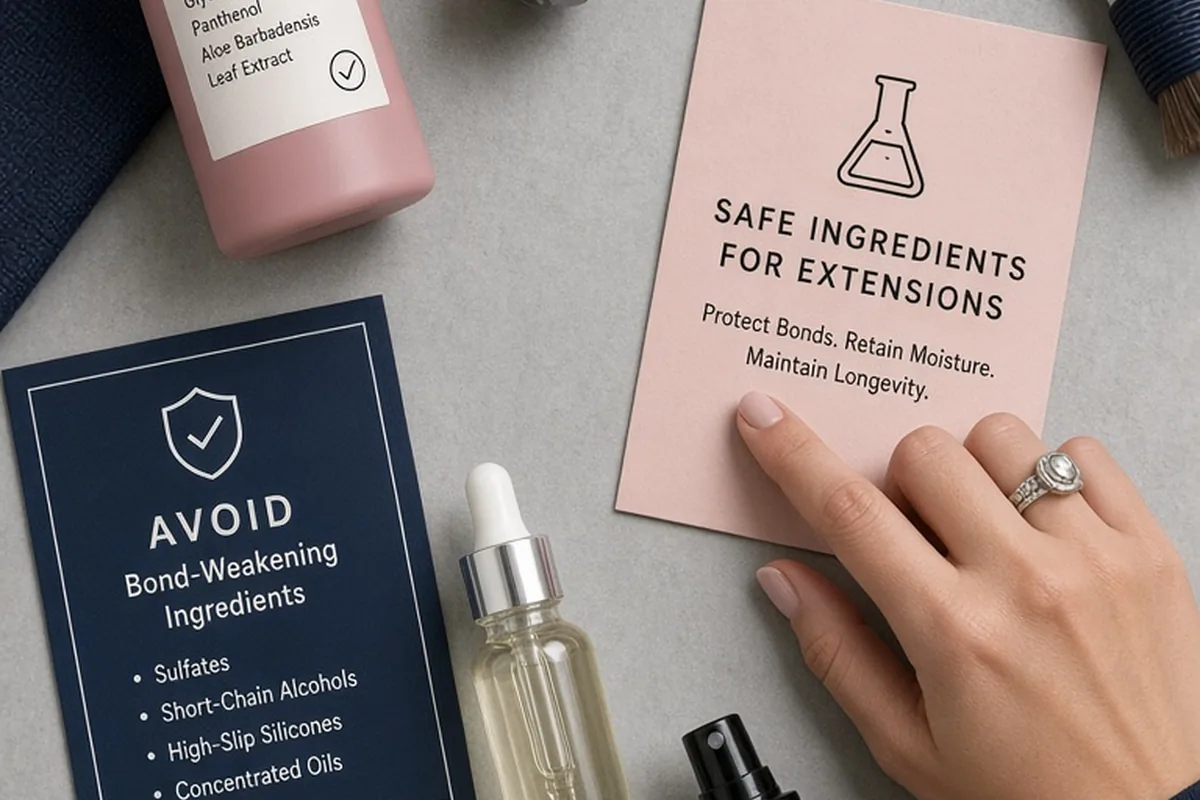
During a hair extensions consultation, reviewing product ingredients ensures your daily wash and styling routine will not degrade attachment bonds, loosen tape tabs, or dehydrate extension hair. Your stylist evaluates existing shampoos, conditioners, oils, and styling aids to flag bond-weakening ingredients like heavy sulfates, short-chain alcohols, high-slip silicones, and concentrated oils, replacing them with extension-safe formulations tailored to your scalp type and attachment method.
Investing in professional hair extensions involves more than choosing a shade match and application method. The longevity of your installation depends heavily on the chemical compatibility of the products you apply to your scalp, wefts, and natural strands every day.
Why Ingredient Audits Protect Your Hair Extensions Investment
Natural hair receives a continuous supply of protective lipids and sebum directly from your scalp follicles. This natural nourishment travels down the hair shaft, keeping native hair pliable, conditioned, and resilient against daily friction and environmental exposure. Extension hair, even when sourced as premium remy human hair, is mechanically detached from that biological nutrient pathway. Because it cannot self-hydrate or produce natural oils, extension hair behaves very differently from natural growth and reacts more severely to drying or stripping cosmetic ingredients.
At the same time, the physical points of attachment—whether polyurethane tape adhesives, keratin polymer bonds, micro-ring silicone cushions, or woven nylon threads—are chemically vulnerable to specific cosmetic compounds. Applying products that contain degrading solvents, heavy occlusives, or harsh clarifying surfactants directly over these attachment zones can cause adhesives to liquefy, keratin to soften prematurely, and wefts to slip down the hair shaft. A thorough ingredient consultation bridges the gap between salon installation and home maintenance by establishing a product regimen that preserves both bond integrity and hair texture.
Surfactants and Cleansers: Evaluating Shampoos During Consultation
Cleansing agents represent the first major category to analyze during an extension consultation. Traditional clarifying shampoos frequently rely on aggressive anionic surfactants such as Sodium Lauryl Sulfate (SLS) and Ammonium Lauryl Sulfate. While these ingredients efficiently remove sebum, styling build-up, and environmental residues, their harsh cleansing action strips processed extension strands of essential surface moisture. Over time, repeated washing with aggressive sulfates causes cuticles to lift, leading to severe tangling, mid-shaft friction, and dullness.
A stylist during consultation will generally recommend shifting to milder amphoteric or non-ionic surfactants, such as Cocamidopropyl Betaine, Sodium Cocoyl Isethionate, or Decyl Glucoside. These gentler cleansing agents effectively cleanse the scalp without dissolving the adhesive polymers found in tape tabs or weakening keratin bonds. However, clients must also distinguish between everyday gentle cleansers and pre-installation clarifying washes; stylists use a residue-free clarifying cleanser immediately prior to application to remove all natural sebum, ensuring bonds adhere firmly to bare hair.
Silicones, Quats, and Slippage Risks Around Attachment Zones
Silicones and quaternary ammonium compounds (quats) provide excellent slip, combability, and surface shine for natural hair, but their chemical behavior around extension attachments requires careful management. Non-soluble silicones like Dimethicone, Dimethiconol, and Cetearyl Methicone form a persistent hydrophobic film over hair fibers. When these substances migrate toward tape adhesives or keratin fusion bonds, the slippery film prevents the bonding agent from gripping the natural hair, causing rapid slippage or uneven shedding.
During your consultation, your stylist will clarify how to use silicones strategically rather than banning them entirely. Water-soluble silicones, such as Dimethicone Copolyol or PEG-modified silicones, wash away easily without building up around attachment rings or weft tracks. For rich conditioning formulas containing heavier silicones and quats like Behentrimonium Chloride, the critical rule is zonal application: applying rich conditioners exclusively from the mid-lengths to the ends, keeping all heavy conditioning agents at least two inches away from the root bonds.
Navigating Botanical Oils, Heavy Butters, and Protein Treatments
Natural oils and botanical butters are celebrated for deep conditioning, but their lipid profile can be catastrophic when applied near extension attachment sites. Pure plant oils, such as coconut oil, argan oil, jojoba oil, and castor oil, act as natural release agents for adhesive polymers. In fact, many professional extension removal solutions are formulated using concentrated oil bases to gently dissolve tape adhesives and break down fusion bonds without pulling natural hair. Allowing concentrated oils or shea butter to touch your roots will quickly recreate this removal process at home.
Protein additives require a balanced approach during consultation. Hydrolyzed wheat protein, keratin, and amino acid complexes strengthen compromised natural hair, but extension hair is prone to protein overload. Because extensions cannot process excess protein through biological renewal, frequent use of protein-heavy masks can cause the fibers to become stiff, brittle, and prone to snapping. Your stylist will assess your natural hair elasticity alongside your extension texture to decide whether your routine should focus primarily on hydrating humectants like glycerin and panthenol or occasional light protein support.
Alcohol Carriers in Styling Sprays, Dry Shampoos, and Heat Protectants
Not all alcohols in hair products perform the same function, and your extension consultation will help you differentiate between damaging drying agents and beneficial fatty alcohols. Short-chain, volatile alcohols—such as Ethanol, Alcohol Denat, SD Alcohol 40, and Isopropyl Alcohol—are commonly used in quick-drying hairsprays, texturizing sprays, and aerosol dry shampoos. These compounds evaporate rapidly, drawing moisture out of the extension fibers and creating microscopic fissures along the synthetic adhesives holding tape-ins together.
Conversely, long-chain fatty alcohols like Cetyl Alcohol, Stearyl Alcohol, and Cetearyl Alcohol are derived from plant lipids and function as emollients that soften the hair shaft and stabilize formulations. During your consultation, your stylist will review your styling products to ensure leave-in heat protectants and styling creams rely on fatty alcohols or bond-safe polymers (such as Polyquaternium compounds) rather than high concentrations of denatured alcohol. For dry shampoo, non-aerosol powders applied sparingly to the crown—avoiding the tracks—prevent adhesive degradation and chalky buildup.
How Attachment Methods Dictate Specific Formulation Rules
Different hair extension installation techniques possess unique chemical vulnerabilities that dictate customized product restrictions. Tape-in extensions rely on medical-grade acrylate or polyurethane adhesives, making them highly sensitive to alcohol-based styling aids, high-temperature heat protectants applied at the roots, and oil-based serums. Keratin fusion bonds (K-tips) withstand gentle washing well but soften and dissolve when exposed to acidic bond-builders or heavy oil treatments left to sit near the scalp.
Sew-in wefts and hand-tied rows do not rely on chemical adhesives, but they present mechanical hygiene challenges. Dense creams, non-clarifying cowashes, and thick butters can become trapped within the thread tracks and tightly sewn weft headers. If these rich formulations are not rinsed completely, trapped product residue holds moisture against the scalp, leading to bacterial irritation, scalp odor, and matting around the anchor braids or micro-beads. I-tip and beaded installations require formulations that will not soften the inner silicone lining of the crimped beads, which would cause strands to pull loose during brushing.
Conducting a Practical Product Audit With Your Stylist
To make the most of your consultation, take an inventory of every product currently in your bathroom cabinet, including shampoos, conditioners, scalp scrubs, leave-in serums, dry shampoos, and heat sprays. Taking clear photos of the ingredients list (INCI label) on the back of each bottle allows your stylist to quickly scan for high-risk solvents, harsh surfactants, or incompatible silicones before your installation appointment.
Your stylist will help you divide your products into three clear groups: products that are safe for all-over use, products that must be restricted strictly to the mid-lengths and ends, and products that must be removed from your routine while wearing extensions. If you have an underlying scalp condition such as seborrheic dermatitis or dry scalp, this audit allows your stylist to select gentle, active ingredients like zinc pyrithione or salicylic acid that treat the scalp without degrading your extension bonds.
Frequently asked questions
Can I use purple or toning shampoo on my hair extensions?
You can use toning shampoos on blonde hair extensions, but only with extreme caution and reduced frequency. Because extension hair is more porous than natural growth, it absorbs purple and blue pigments very quickly, which can result in patchy or over-toned violet spots. Consult your stylist about diluting toning shampoo with a gentle sulfate-free cleanser and applying it strictly to the mid-lengths and ends.
Are all sulfate-free shampoos automatically safe for hair extensions?
Not every sulfate-free shampoo is automatically safe for extensions. Some sulfate-free formulations replace standard cleansing agents with heavy botanical oils or dense conditioning polymers that leave a coating on the scalp and loosen adhesive bonds. Always check that your sulfate-free cleanser is also lightweight, clarifying-safe, and free of heavy oil concentrations near the top of the ingredient list.
What ingredient should I look for in an extension-safe heat protectant?
Look for heat protectants formulated with lightweight silicones like Cyclomethicone or protective polymers such as Hydrolyzed Silk, Polyquaternium-55, or Dimethicone Copolyol. Avoid protectants where SD Alcohol 40 or Alcohol Denat appears in the first three ingredients, as the rapid evaporation pulls vital moisture from extension strands during heat styling.
Your next step
Take photos of the full ingredient lists on the back of your current hair care products and bring them to your extension consultation for a personalized compatibility review.