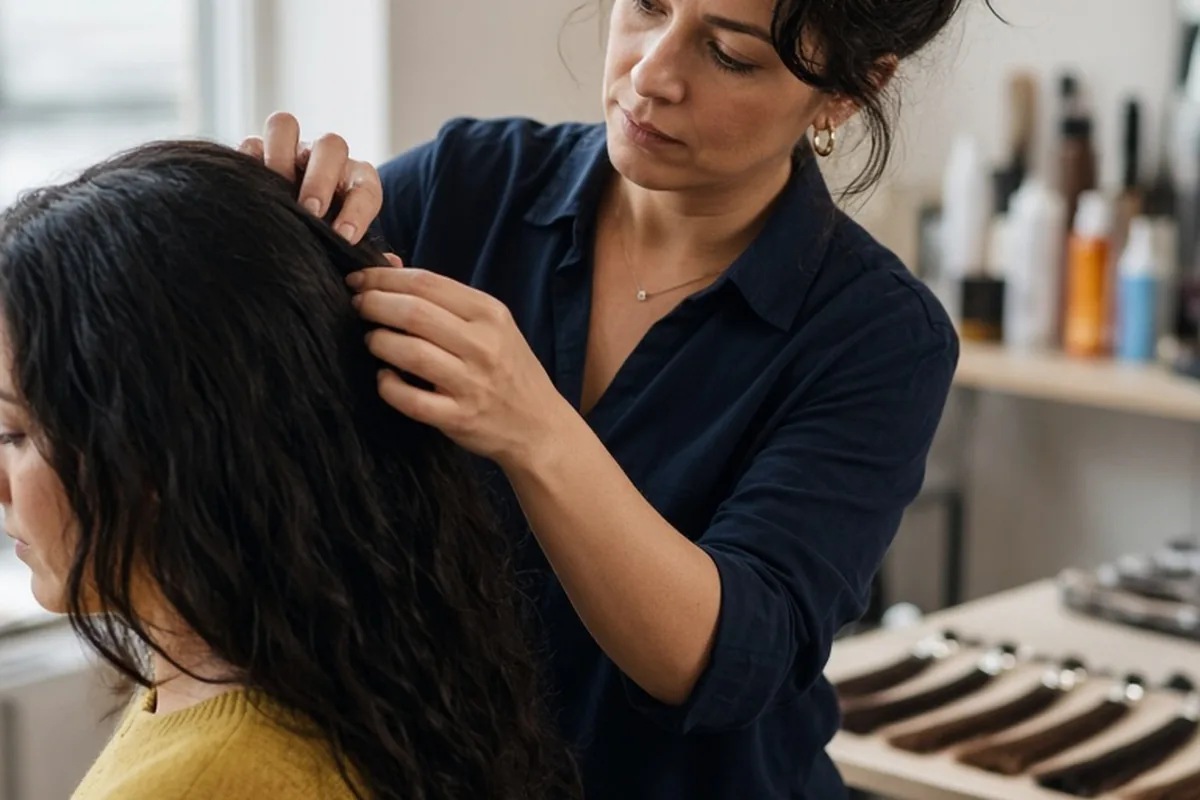
To protect your natural hair during an extension consultation, arrive with clean, product-free hair in its natural texture so the specialist can accurately evaluate your density, strand elasticity, and scalp condition. Discuss your daily styling habits, workout routines, and past chemical treatments honestly. Ask the stylist to demonstrate how specific attachment methods distribute weight across your roots, and confirm exact maintenance schedules, home care requirements, and safe removal protocols before booking an installation.
A thorough consultation serves as the safety check between achieving your desired length or volume and compromising your natural hair integrity. Booking an initial assessment gives you the opportunity to evaluate a stylist's technical knowledge, examine real hair swatches, and determine whether your scalp and natural density can comfortably support added weight over several months.
Preparing Your Natural Hair and Scalp Before Walking into the Salon
How you present your hair on the day of your consultation directly influences the accuracy of the stylist's assessment. Arrive with your hair freshly washed, completely dry, and styled in its everyday natural state without heavy leave-in conditioners, edge controls, or styling waxes. Heavy oils and silicone-based smoothing serums create artificial slip and mask fine textures, making it difficult for an installer to gauge your actual strand diameter and cuticle condition. If you routinely wear your hair wavy or curly, avoid flat-ironing it smooth prior to the appointment, because the professional needs to see your genuine shrinkage pattern, cowlicks, and perimeter density.
Take time before the visit to compile an honest history of your chemical treatments over the past twelve to eighteen months. Inform the technician about recent bleaching sessions, permanent hair color, keratin smoothing treatments, chemical relaxers, or permanent waves, even if those services were performed months ago and seem grown out. Chemically processed strands often have altered porosity and reduced tensile strength, meaning they may require lighter anchor points or alternative attachment styles to avoid localized breakage at the root.
Scalp Health and Strand Elasticity Checks to Request During the Evaluation
A qualified hair extension technician should conduct a physical inspection of your scalp and root area before talking about colors or lengths. Ask the stylist to part your hair in multiple zones, paying special attention to the crown, temples, and the fragile hair along your hairline and nape. During this examination, the stylist should look for active scalp conditions such as seborrheic dermatitis, psoriasis plaques, excessive redness, or localized follicle inflammation. Applying mechanical weight or adhesive tabs over irritated skin can exacerbate inflammation and trigger traction-related shedding.
Request a manual elasticity check across different sections of your head. The practitioner should take a small group of damp or dry strands and gently stretch them to observe if the hair rebounds smoothly or snaps under light tension. If the hair at your crown is brittle from heat styling while the hair at your occipital bone is strong and resilient, your installation plan must reflect those differences. A reputable specialist will adjust section sizes or avoid placing heavy bonds in fragile quadrants entirely.
Matching Extension Attachment Methods to Your Hair Density and Texture
Different attachment methods exert varying degrees of mechanical tension on natural follicles, making it critical to align the extension system with your specific density and lifestyle. Hand-tied and machine-sewn wefts distribute weight evenly along horizontal beaded tracks, which works well for medium to high-density hair, provided the track sizing matches the natural row strength. In contrast, fine or sparse hair often struggles under dense beaded tracks if too few natural hairs are gathered into each anchor bead to support the weft.
Individual strand methods, such as keratin fusion bonds (k-tips) or micro-beads (i-tips), allow for 360-degree natural movement and customized micro-placements around thin perimeters. However, they require precise sectioning to ensure each extension strand weighs slightly less than or equal to the natural anchor section. Tape-in extensions provide flat, wide surface-area distribution that sits flush against the scalp, making them a discreet choice for finer textures, though they require strict avoidance of oil-based products near the adhesive polyurethane tabs.
Crucial Questions to Ask the Stylist About Application Tension and Sizing
During the consultation, ask the stylist specifically how they balance the weight ratio between the extension piece and your natural anchor hair. A common cause of traction damage is an unbalanced anchor, where a heavy swatch of extension hair is secured to an undersized section of natural hair. Clarify how far from the scalp the attachments will be secured; bonds or beads should sit slightly off the root to allow natural movement and prevent sharp directional pulling when your head rests on a pillow.
Ask to see photographic examples of their work from the root level, not just the finished, curled perimeter. Reviewing close-up photos of clean, grid-like sectioning lines demonstrates whether the stylist takes pride in neat, uniform partings. Inquire about their formal certification in the specific method you are considering, as manufacturer-certified training generally requires supervised instruction on tension control and safe removal procedures.
Reviewing Daily Upkeep, Brushing Techniques, and Product Compatibility
Maintaining natural hair health while wearing extensions requires adapting your home care routine. During your consultation, request a detailed walkthrough of the necessary daily maintenance tools and approved product formulations. You will need a specialized loop brush or soft-bristle nylon extension brush designed to glide over attachment points without catching beads or tearing weft threads. Clarify the proper brushing sequence, which involves supporting the root bond with one hand while gently detangling the mid-lengths and ends with the other.
Review your current shampoo and conditioner lineup with the specialist to identify ingredients that could compromise your wear. Clarifying or sulfate-free cleansers are generally recommended for the scalp, while heavy moisturizing conditioners, styling oils, and silicones must be kept strictly below mid-shaft to prevent adhesive breakdown or bead slippage. You should also discuss your drying habits; allowing wefts or bonds to remain damp for extended periods can trap moisture against the scalp, encouraging microbial growth and weakening the natural hair shaft.
Estimating Appointment Timelines, Move-Up Intervals, and Long-Term Costs
A comprehensive consultation must clarify the full lifecycle and financial commitment of the service beyond the initial installation day. Hair extensions are not a one-time service; as your natural hair grows, the attachment points move downward, altering the center of gravity and increasing the leverage placed on root follicles. Ask the stylist for the exact recommended move-up or reapplication window for your hair type, which typically falls between six to ten weeks depending on your rate of natural growth and strand thickness.
Request an itemized breakdown of the overall investment, separating the initial cost of raw human hair from the application service, regular maintenance visits, and professional removal fees. Ask how many reapplication cycles the hair quality is expected to withstand with proper home care before new hair must be purchased. Clarifying whether move-up appointments include deep-cleansing scalp treatments, bond replacement, or trim services ensures you can budget both time and money responsibly.
Identifying Red Flags During an Initial Extension Consultation
Be alert to warning signs that suggest a stylist may prioritize speed or sales over the long-term health of your natural hair. A major red flag is any stylist who offers a one-size-fits-all recommendation without examining your scalp, parting your hair, or asking about your styling habits. If an installer insists that a heavy, maximum-density set can be safely installed on visibly compromised or severely breaking hair without a recovery period, seek a second opinion.
Another warning sign is a dismissive attitude toward tension discomfort. While mild tightness during the first day or two can occur as you adjust, a consultation provider who tells you that severe pain, persistent throbbing, or red bumps are normal parts of wearing extensions does not understand proper ergonomics. Finally, avoid practitioners who cannot clearly explain their safe removal protocol or who suggest that clients can pull or slide out grown-out attachments at home with retail solvents.
Frequently asked questions
Can I get hair extensions if my hair is already thinning or damaged?
Yes, but you must choose lightweight methods tailored to delicate hair, such as customized micro-bonds or single-weft rows. A responsible stylist will assess your strand elasticity first and may recommend a restorative treatment plan before adding any extensions.
How long does a professional hair extension consultation take?
A standard in-depth consultation lasts between twenty and forty-five minutes. This provides sufficient time for a physical scalp evaluation, strand test, color and texture matching, lifestyle discussion, and pricing breakdown.
Should I color my hair before or after the extension consultation?
It is best to arrive with your hair colored to your intended shade so the stylist can match the extension swatches accurately. If you plan a significant color transformation, schedule that service first or book it in conjunction with your extension specialist.
Is it normal to pay a deposit during an extension consultation?
Yes, salons routinely require a non-refundable deposit if you decide to book an installation. This deposit covers the custom order of high-quality human hair packs tailored specifically to your length, shade, and texture profile.
Your next step
Schedule an in-person consultation with a certified extension specialist, arrive with clean, natural hair, and bring a list of your daily styling routines and chemical history to evaluate the safest attachment method for your scalp.