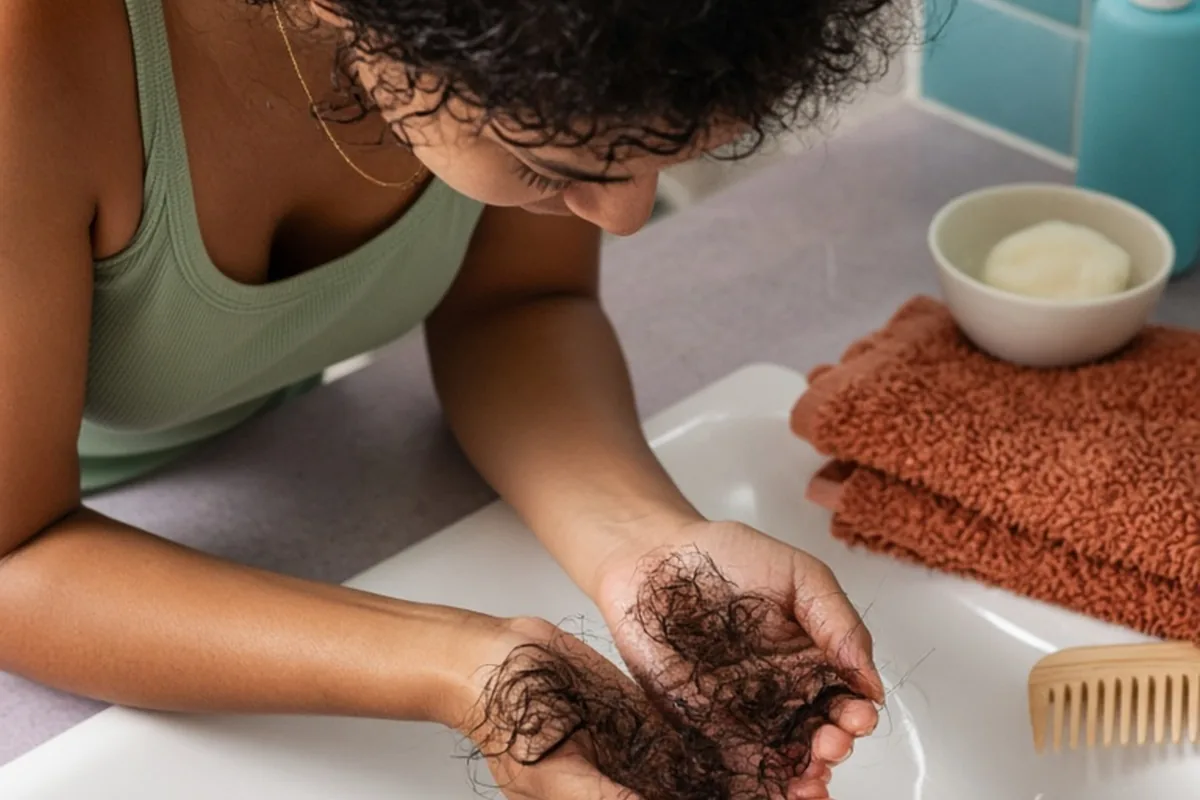
Postpartum hair shedding combined with low porosity hair requires balancing temporary hormonal strand fall at the follicle with moisture-resistant hair cuticles that easily collect product buildup. Because low porosity cuticles lie tightly compacted, heavy oils and thick postpartum growth butters cannot penetrate the shaft; instead, they sit on the scalp, suffocate follicles, and increase mechanical breakage. Recovery centers on gentle scalp cleansing, heat-assisted hydration with lightweight water-based products, protein awareness, and minimal-tension styling.
Welcoming a new baby brings sweeping physiological shifts, and discovering clumps of hair in your shower drain can feel overwhelming when your strands already struggle to absorb moisture and stay manageable.
Postpartum Hair Loss for Low Porosity Hair: Why Shedding and Buildup Collide
During pregnancy, elevated systemic hormone levels prolong the active anagen growing phase of the hair cycle, preventing the regular daily loss of resting strands. After delivery, hormone levels drop back to baseline, prompting those postponed resting hairs to transition rapidly into the telogen shedding phase. This temporary condition, known as postpartum telogen effluvium, is an internal biological response occurring inside the follicle beneath your scalp.
When this hormonal shift occurs in low porosity hair, standard advice often creates unexpected problems. Low porosity hair is structurally characterized by tight, overlapping cuticle scales that form an impermeable barrier along the strand. Common home remedies frequently recommend mass-applying heavy castor oil, raw shea butter, or thick edge-growth pomades to combat postpartum thinning. However, because low porosity hair cuticles resist product absorption, heavy lipids cannot sink into the strand.
Instead of strengthening fragile strands, thick sealants sit on the scalp and hair surface, forming a sticky film that traps natural shed hairs, dead skin cells, and oxidized sebum. When low porosity strands become coated in heavy buildup, they stiffen and tangle together easily. During daily detangling, this mechanical resistance exerts extra drag on roots that are already primed by hormones to release, noticeably increasing the amount of hair coming out in your hands.
Telling the Difference Between Postpartum Telogen Shedding and Cuticle Breakage
Addressing thinning effectively starts with determining whether your loss is happening at the scalp or along the hair fiber itself. Take a close look at the strands collecting on your styling tools or bathroom floor. A hair that has completed its hormonal telogen cycle and shed from the root will feature a tiny, firm, whitish bulb at one end. This bulb confirms that the follicle released the strand normally and will begin preparing for a new growth cycle in due course.
Broken strands look completely different and point to a mechanical or moisture issue rather than a purely hormonal one. Hair breakage produces shorter, uneven fragments without a visible bulb at the end, often showing splintered or frayed tips. Low porosity hair is naturally prone to dry snap breakage when its tight cuticles prevent internal water absorption. If your hair is chronically parched, the shaft loses its elasticity and snaps during basic detangling, giving the illusion of an extreme postpartum shed.
You can evaluate your strand condition with a simple elasticity check on a clean, shed strand. Wet the strand with warm water, hold it between your thumbs, and gently stretch it outward. Hydrated, healthy hair expands slightly under gentle tension and returns toward its original length. If the strand resists stretching entirely and snaps abruptly with minimal force, your hair is suffering from moisture starvation or product brittleness rather than root-level follicle failure alone.
Wash Day Adjustments to Prevent Tangling and Minimize Strand Fall
Your wash routine is the moment where mechanical hair loss is most likely to spike, making thermal control and product choice critical. Cold or cool water causes low porosity cuticles to clamp down even tighter, preventing cleansing agents from lifting grime and keeping moisturizing ingredients from entering the cortex. Wash your hair with warm water to provide the gentle thermal energy needed to relax the cuticle scales, allowing water molecules to hydrate the inner shaft and flush away loose, resting hairs smoothly.
Clarifying must become a regular component of your schedule rather than an occasional afterthought. Low porosity hair rapidly accumulates surface films from conditioning agents, styling gels, and postpartum sweat. A gentle clarifying or chelating shampoo applied directly to the scalp every few washes lifts stubborn residue without stripping the underlying moisture barrier. Keeping the scalp thoroughly clean ensures follicle openings remain clear, reducing localized inflammation that could otherwise compound postpartum shedding.
Detangling should never occur on dry or unconditioned low porosity hair while shedding is active. Before reaching for a comb, saturate your strands with warm water and apply a rinse-out conditioner with high botanical slip, such as formulas featuring slippery elm, marshmallow root, or flaxseed extract. Divide your hair into manageable sections and gently detangle using only your fingers or a flexible, widely spaced detangling brush, working methodically from the very ends up toward the scalp to release shed hairs without snagging.
Hydrating Low Porosity Strands Without Suffocating Sensitive Follicles
Because dense cuticles prevent dense oils from entering the strand, low porosity hair thrives on lightweight, water-based humectants that penetrate without leaving an occlusive layer behind. Look for leave-in conditioners and hydrating sprays featuring glycerin, aloe vera juice, panthenol, and hyaluronic acid. These humectants draw moisture into the hair shaft without coating the scalp in greasy films that smother weakened follicles.
Deep conditioning requires indirect heat to be genuinely effective on low porosity hair. Simply leaving a deep conditioning mask on your head at room temperature accomplishes little, as the formula cannot bypass the closed cuticle layer. Cover your hair with a processing cap and apply indirect warmth using a hooded dryer, a heated gel cap, or a damp towel warmed in the microwave. Ten to twenty minutes of gentle warmth lifts the cuticles safely, letting moisture and fatty alcohols nourish the core of the hair fiber.
Be cautious with protein treatments during this phase. Many commercially marketed anti-hair-loss masks rely heavily on hydrolyzed keratin, collagen, or wheat protein to reinforce damaged hair. On low porosity hair, excessive protein binds aggressively to the outer cuticle, creating an inflexible, brittle exterior that snaps during basic handling. If your hair feels stiff, rough, or resembles dry straw after a treatment, eliminate concentrated protein products from your routine and switch exclusively to softening, moisture-dominant conditioners.
Low-Tension Daily Styling and Nighttime Protection for Postpartum Care
Postpartum hair loss frequently targets the perimeter of the scalp, creating noticeable thinning around the temples, hairline, and crown. Subjecting these vulnerable zones to traction styling accelerates follicle shedding and risks permanent traction damage. Avoid tight high ponytails, slicked-back buns, firm headbands, or heavy braided extensions. Instead, wear hair down loosely, gather it in a soft claw clip, or style it in loose, low two-strand twists that distribute weight evenly across the entire head.
Parenting a newborn involves interrupted, erratic sleep, and frequent head friction against traditional cotton pillowcases pulls out delicate, transitioning hairs. Cotton fibers act like sponges, absorbing essential hydration directly from your hair shafts while generating rough friction that tangles strands. Switch to a 100 percent mulberry silk or high-grade satin pillowcase, or sleep in a loose satin bonnet equipped with a broad, flat, non-elasticized band that does not press against fragile edges.
Keep your daily styling routine as minimal and hands-off as possible to preserve density and save personal energy. Daily restyling, constant brushing, and frequent manipulation place unnecessary physical strain on strands that are structurally loosened at the root. Lightly refresh moisture every couple of days by misting your mid-lengths and ends with warm water or a watery leave-in spray, gently tuck the ends away, and leave your hair alone between weekly wash sessions.
When to Involve a Healthcare Provider for Lingering Hair Loss
While postpartum telogen effluvium is a standard physiological occurrence that resolves on its own as hormone levels balance out, shedding should not continue indefinitely. Hair cycles naturally take time to normalize, but if you experience intense, unyielding shedding that persists past your baby's first birthday, it is time to schedule a medical review. Similarly, sudden patchy round bald spots, localized redness, burning sensations, or painful scalp scaling are not symptoms of ordinary postpartum shedding.
Nutritional depletion often prolongs hair loss after childbirth because pregnancy and lactation place immense demands on maternal micronutrient reserves. Ask your primary care physician or OB-GYN to evaluate your blood work, including a full iron panel with serum ferritin, a complete blood count, and a vitamin D test. Ferritin stores are critical for supporting active follicle cell division, and low iron reserves can stall hair in a dormant resting state long after postpartum hormones have stabilized.
Thyroid health is another critical area to examine. Postpartum thyroiditis is a recognized autoimmune condition that affects thyroid hormone production following delivery, frequently manifesting as either hyperthyroidism, hypothyroidism, or both sequentially. Persistent hair loss accompanied by unexplained weight shifts, chronic exhaustion beyond typical parenting fatigue, heart palpitations, or severe temperature intolerance warrants a full thyroid panel, including thyroid-stimulating hormone (TSH) and free T4 testing.
Frequently asked questions
Can I use rice water treatments on low porosity hair to stop postpartum shedding?
Rice water is extremely rich in surface-coating proteins and starches that can make low porosity hair dangerously stiff and brittle. Because postpartum shedding originates at the follicle level due to internal hormones, topical rice water will not stop root shedding and may worsen breakage along dry hair shafts. If you want to use it, dilute it heavily and follow immediately with a protein-free, heat-activated deep conditioner.
How often should I wash low porosity hair while experiencing postpartum shedding?
Aim to wash your hair roughly once a week or whenever your scalp shows signs of oiliness and residue. Stretching wash days too far apart allows naturally shed telogen hairs to build up in your hair mass, leading to severe tangles and an alarming clump of lost hair on wash day. Regular gentle cleansing with warm water keeps the scalp healthy and prevents mats.
Will massaging heavy castor oil into my scalp help regrow my thinning edges?
Heavy castor oil is generally not recommended for low porosity hair because its dense viscosity blocks pores and creates a tacky surface film that attracts dirt. The physical friction of massaging such a thick oil into fragile, thinning postpartum edges can pull out loose hairs mechanically. If you desire scalp lubrication, choose a few drops of lightweight, non-comedogenic oil such as jojoba or squalane instead.
When will my low porosity hair regain its former thickness after childbirth?
Hair regrowth is a slow biological process because human hair fibers grow at an average rate of about a quarter to half an inch per month. Once excessive shedding subsides, short baby hairs will gradually sprout along your hairline and part. It commonly takes twelve to eighteen months for new regrowth to reach sufficient length to blend seamlessly with the rest of your hair density.
Your next step
Inspect your current hair products today, set aside any thick butters and heavy protein treatments, and replace them with a gentle clarifying shampoo and a lightweight, water-based leave-in to protect your fragile strands from unnecessary mechanical stress.