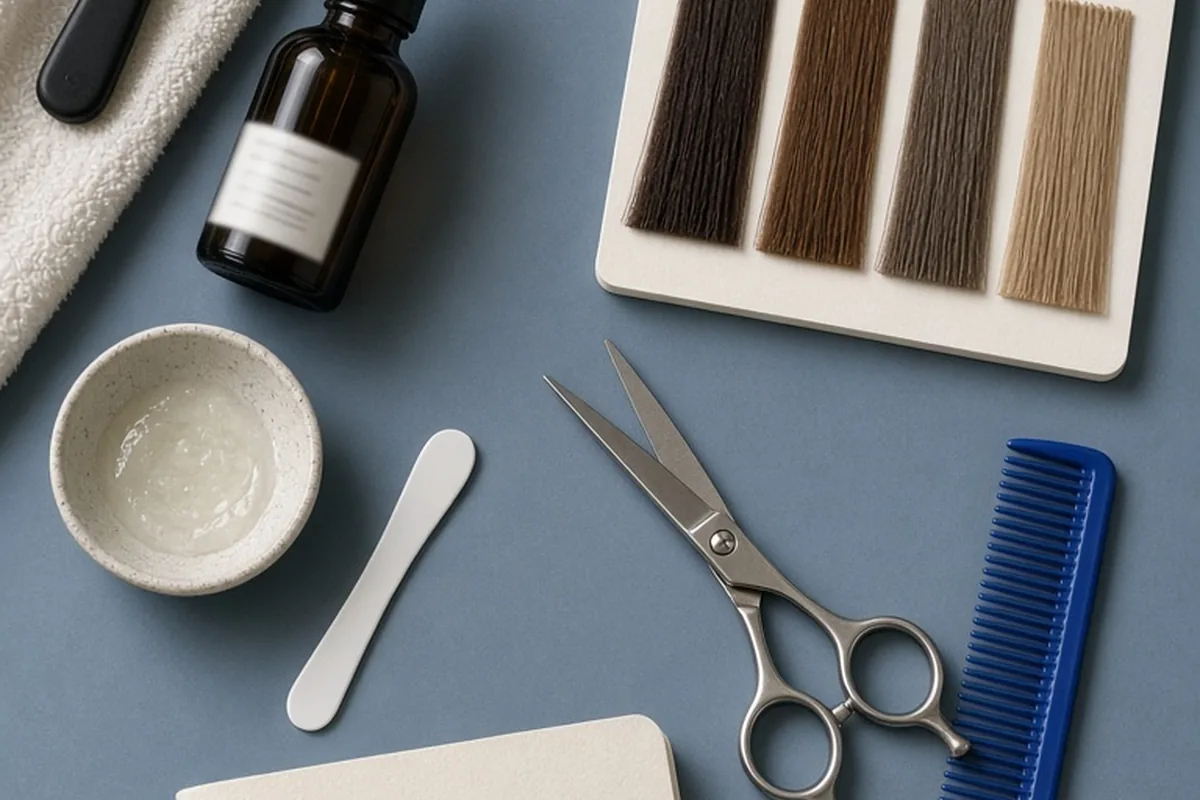
Managing hair loss during menopause usually requires combining consistent home care with targeted salon services. At home, you maintain daily follicle health through gentle cleansing, low-tension styling, and consistent topical scalp care. Salons cannot reverse hormonal thinning, but skilled stylists create immediate optical density using strategic cuts, subtle texturizing, and low-chemical color. For systemic thinning, visit a board-certified dermatologist, while using home habits to preserve strand strength and salon appointments to maximize visual fullness.
Hormonal shifts during perimenopause and menopause can alter your hair texture, diameter, and overall density within a relatively short window. When hair begins shedding more rapidly or parting lines widen, deciding whether to invest in professional salon appointments, overhaul your home bathroom routine, or pursue both simultaneously can feel overwhelming.
What Menopausal Hair Thinning Actually Does to Follicles and Strands
During perimenopause and menopause, declining estrogen and progesterone levels alter the natural ratio between female sex hormones and circulating androgens. In follicles that are genetically sensitive to these shifts, androgen exposure can shorten the active growth phase, known as the anagen phase, while prolonging the resting phase. Over repeated hair cycles, affected follicles undergo miniaturization, producing strands that are noticeably finer in diameter, slower to gain length, and prone to shedding before reaching their previous maximum volume.
At the same time, declining estrogen directly affects the scalp's sebaceous glands, reducing natural sebum output. This drop in protective surface lipids leaves maturing hair strands feeling drier, stiffer, and more susceptible to cuticle chipping. Women often notice that their hair feels rougher along the lengths even as the scalp visible at the crown becomes more exposed. Distinguishing between genuine follicular shedding at the scalp level and mechanical breakage along the mid-lengths is essential, because salon services and home routines address these two challenges in entirely different ways.
What At-Home Routines Handle Best for Menopausal Thinning
Your home environment is the front line for daily strand preservation and low-stress maintenance. Because menopausal hair has diminished elasticity, cumulative daily habits determine whether fragile strands stay intact or snap prematurely. Gentle cleansing habits form the core of home care: washing with lukewarm water rather than hot water protects the lipid barrier of both the scalp and the cuticle. Selecting sulfate-free or mild amphoteric cleansers clears sebum and environmental debris without leaving hair feeling parched or stripped.
Daily manipulation at home requires deliberate gentleness. Detangling should only happen when hair is coated with a slippery conditioner or leave-in slip agent, using a wide-tooth comb or a flexible-bristle brush, starting at the ends and working upward toward the scalp. Switching from standard cotton pillowcases to smooth silk or satin pillowcases minimizes friction during sleep, which prevents mid-strand tangles and morning breakage. Similarly, air-drying partway before using a low-heat dryer setting preserves inner cortex moisture far better than aggressive daily round-brush blowouts.
Home is also where topical treatments require strict, unhurried consistency. Over-the-counter scalp solutions, botanical extracts, peptide blends, and gentle scalp massage routines require continuous daily or weekly application over several months before any visual shift occurs. Salons cannot provide this daily regularity; establishing an unhurried, low-manipulation bathroom routine is something only you can control, forming the durable foundation for any cosmetic improvements you explore elsewhere.
What Professional Salons Can and Cannot Do for Thinning Hair
A knowledgeable salon stylist is a cosmetic sculptor rather than a medical provider. Salons cannot stimulate dormant follicles to produce new biological growth if hormonal miniaturization has taken hold, nor can a salon deep conditioning mask cure internal endocrine changes. Where salons excel is in engineering the immediate illusion of density. Through intentional perimeter lines, weight distribution, and precise parting placements, a seasoned stylist can make a thinning head of hair look substantially fuller the moment you leave the chair.
Haircuts for menopausal thinning demand specific technical adjustments that differ from general styling. Traditional long, heavily texturized cuts or razor cuts often backfire on thinning hair by leaving the ends looking wispy, transparent, and separated. Skilled stylists counter this by establishing strong, blunt perimeter baselines, such as structured bobs, soft lobs, or textured pixie silhouettes. They incorporate internal micro-layering around the crown to build lift without hollowing out the bottom perimeter, giving fine hair structural support that resists collapsing flat against the scalp.
However, salons carry potential risks if you land with a stylist unfamiliar with fragile, maturing hair. Aggressive tension during blowouts, high heat from round metal barrel brushes, rough backcombing, and chemical processing can snap weakened menopausal strands at the root. When visiting a salon, communicating that your hair is experiencing hormonal fragility is critical so the stylist adjusts their handling tools, tension, and heat settings accordingly.
Comparing In-Salon Color Techniques with At-Home Dyeing
Coloring thinning hair presents a delicate balance between camouflaging exposed scalp and protecting fragile shafts from chemical compromise. At home, standard box dyes utilize standardized, high-volume developer formulations designed to penetrate coarse, resistant hair universally. On fragile menopausal strands, these uniform chemical concentrations frequently cause over-processing, making delicate hair brittle, dry, and prone to breaking near the root, which severely amplifies the appearance of thinning.
In a professional salon, a skilled colorist customizes formulations to protect structural integrity while creating optical depth. By applying a demi-permanent or low-ammonia base that closely matches your natural undertone slightly deeper at the root, known as root shadowing or root tapping, the colorist diminishes the visual contrast between pale scalp skin and dark hair shafts. This optical reduction of scalp visibility makes the crown look noticeably denser without placing heavy bleach on fragile zones.
Salons can also incorporate dimensional multi-tonal highlights using soft balayage techniques painted away from the root rather than tightly packed foil packets that apply mechanical tension to the scalp. If you choose to color at home to manage budgets, you should opt for deposit-only glosses or ammonia-free root touch-up sprays rather than applying full-strength permanent dye across your entire head every few weeks.
Professional Salon Treatments vs At-Home Deep Conditioning Masks
Salons frequently market scalp facials, clarifying detox rituals, and professional deep-conditioning or bond-building treatments to clients worried about hair loss. Understanding the real difference between these salon chair services and home masking prevents wasted money. In-salon bond-building services work on a molecular level to cross-link broken disulfide bonds inside hair that has been compromised by heat or color. These treatments temporarily fortify the shaft tensile strength, reducing breakage along the lengths, though they do not alter scalp follicle production.
Salon scalp rituals often use professional steam machines, gentle exfoliating salicylic or glycolic scalp solutions, and targeted suction or massage to remove stubborn product buildup and dead skin around follicle openings. While this creates a remarkably clean, invigorated scalp environment, you can replicate much of this benefit at home for a fraction of the ongoing expense. Using a gentle clarifying shampoo once or twice a month, paired with a soft silicone scalp brush during your shower, safely prevents buildup without paying luxury salon service markups.
When it comes to deep conditioning, menopausal hair needs a careful balance of moisture and lightweight protein. Heavy in-salon keratin treatments that involve flat-ironing chemicals at extreme temperatures should generally be avoided, as the intense heat can scorch already fine strands. At home, regular use of lightweight, rinse-out ceramide or amino acid masks preserves strand flexibility without coating the scalp in heavy silicones that weigh down delicate roots.
Cosmetic Enhancements: Salon Toppers and Extensions vs Home Styling Aids
When hair thinning at the central part or vertex progresses beyond what haircutting tricks can disguise, cosmetic enhancement pieces become a viable solution. Salons specializing in hair replacement can custom-cut, blend, and color professional hair toppers made of human hair. A topper sits comfortably over the crown, clipping into areas where your hair remains dense, providing complete scalp coverage and immediate fullness that blends seamlessly into your natural perimeter.
However, caution is paramount with standard salon hair extensions. Traditional bonded extensions, tape-ins, and tight sew-in weaves place persistent mechanical traction on natural hair roots. For women with menopausal follicle miniaturization, this physical pulling can trigger traction alopecia, permanently damaging the very follicles you are trying to preserve. If you explore extensions, halo-style pieces that rest gently on the head via a thin, invisible wire without anchoring to your natural hair are far safer than glued or clamped options.
At home, simple cosmetic camouflage tools offer reliable, non-damaging daily control. Keratin hair-building fibers electrostatically bond to existing fine strands, instantly concealing wide parts and diffuse vertex thinning. Tinted mineral root powders applied with a dense makeup brush matte the scalp and eliminate light reflection that makes hair look thin under bright room lights. These home tools wash out easily with shampoo, pose zero risk of traction damage, and cost substantially less than salon hairpieces.
Cost, Time, and Maintenance: Weighing Home Regimens Against Salon Services
Evaluating the trade-offs between salon appointments and home care requires looking honestly at long-term financial commitments and daily time investments. High-end salon visits that include customized cuts, glossing, bond treatments, and professional blowouts require significant ongoing expenditures every four to six weeks. If you incorporate custom salon toppers, initial custom fittings and recurring maintenance checks add substantial recurring costs to your personal care budget.
Conversely, home care represents a higher commitment of personal discipline but a much lower financial threshold over the course of a year. Purchasing high-grade gentle cleansers, leave-in thermal protectants, scalp massage tools, and cosmetic scalp powders involves a modest initial outlay, with products typically lasting several months. The primary investment at home is patience: you must build the daily habit of gentle handling, meticulous detangling, and consistent topical application without expecting instant overnight transformation.
A practical, cost-effective hybrid strategy is often the most sustainable approach for women navigating menopause. You can rely on an experienced stylist twice or three times a year for a precise, blunt structural haircut and subtle dimensional gloss, while keeping all washing, conditioning, root touch-up concealing, and scalp stimulation entirely within your home routine. This limits expensive salon appointments while retaining the cosmetic benefits of a professional cut that works with your texture.
When to Step Outside the Salon and Home: The Medical Care Threshold
Neither your bathroom mirror nor your stylist's chair is equipped to diagnose the biological triggers of hair loss. While menopausal androgen shifts are common, hair thinning can also stem from or be exacerbated by concurrent conditions such as thyroid dysfunction, nutritional deficiencies, ferritin depletion, autoimmune conditions like alopecia areata, or high-stress episodes triggering telogen effluvium. Relying solely on salon visits or retail cosmetic serums when an underlying systemic issue is present delays proper treatment.
If you notice sudden widespread shedding in clumps, patchy bald spots, burning, redness, or itching along the scalp, you should bypass cosmetic services and schedule an appointment with a board-certified dermatologist. A physician can perform a scalp dermoscopy, order comprehensive blood panels to check vitamin D, zinc, iron storage, and thyroid hormones, and evaluate whether medical interventions are appropriate.
Clinical therapies such as prescription oral or topical medications, targeted hormone therapy managed by an endocrinologist or gynecologist, or in-office medical procedures fall strictly under healthcare regulation. Viewing salon professionals as cosmetic illusionists and home care as protective hygiene allows you to keep clinical medicine in its proper place: identifying and managing the internal drivers of your hair health.
Frequently asked questions
Can a hair salon treatment stop menopausal hair loss completely?
No, salon treatments cannot stop or reverse hormonal hair loss. Salons provide cosmetic improvements like strategic haircuts, scalp cleansing, and dimensional color that create the visual appearance of thicker hair, but they cannot alter follicle miniaturization caused by hormonal changes.
How often should I wash thinning menopausal hair at home?
Most women with menopausal hair thinning find that washing two to three times a week works best. Washing too frequently can strip natural protective oils from dry strands, while waiting too long can allow sebum and product debris to accumulate around follicle openings.
Are salon hair extensions safe to use if my hair is thinning from menopause?
Glued, taped, or tightly woven extensions carry significant risks of traction alopecia for thinning menopausal hair because delicate roots cannot handle continuous pulling tension. If you want cosmetic volume, lightweight clip-in toppers or halo extensions that rest on your head without gripping fragile roots are much safer choices.
What is the best haircut to ask for at a salon when dealing with menopausal thinning?
Ask for a blunt cut with strong perimeter lines, such as a blunt bob or a collarbone-length lob, with minimal, soft interior layering at the crown. Avoid razor cuts or heavy thinning shears, as removing too much weight makes thinning ends appear transparent.
Your next step
Assess your current hair routine today, switch to a low-tension detangling practice on wet hair, and schedule an appointment with a dermatologist before spending money on costly salon treatments.