The most damaging hair salon consultation mistakes include bringing uncurated reference photos without explaining what you like about them, concealing past chemical or home box dye treatments, relying on subjective terms like ashy or just a trim, and failing to discuss maintenance budgets upfront. A successful consultation requires transparent communication about your hair history, concrete visual benchmarks, and mutual agreement on daily styling expectations before any service begins.
A hair consultation is not a polite formality or casual small talk before the cape goes on; it is the blueprint for your entire service. When miscommunications happen in the chair, they rarely stem from a stylist's lack of technical skill. More often, they trace back to assumptions, unspoken chemical histories, or mismatched terminology exchanged during the first ten minutes of the appointment.
Bringing Misleading Reference Photos Without Explaining Specific Details
Visual references bridge the gap between hairdressing terminology and client expectations, but relying on photos without context is a frequent trap. Clients often present heavily edited social media images that rely on ring lights, filters, digital saturation, and hidden clip-in hairpieces. If you show a picture of voluminous, dimensional balayage without noting whether you are drawn to the base tone, the placement of the highlights, or the barrel-curled blowout, your stylist must guess which element you actually want on your head.
A common oversight is presenting photos of models whose natural hair density, texture, and wave pattern are fundamentally different from your own. A razor-cut blunt bob on fine, straight hair behaves completely differently on dense, coarse, or curly strands. When you bring an inspiration picture, separate the cut from the styling. If the image features a cut that only works when heat-styled for thirty minutes, yet you prefer air-drying, the photograph is setting an unsustainable expectation.
To make reference imagery work effectively, limit yourself to two or three targeted photos. Rather than showing a full gallery of disparate hairstyles, point out precise elements on each image: tell the stylist that you appreciate the face-framing layers in the first photo, the contrast of the highlights in the second, and the overall length of the third. Pointing out what you dislike in a photograph is equally illuminating, as negative boundaries help eliminate assumptions just as quickly as positive ones.
Withholding Past Chemical Services and Home Color Treatments
One of the most consequential missteps in the consultation chair is failing to disclose previous chemical work. Clients often assume that because dark brown box dye or a gloss was applied eight months ago and has visibly faded, it no longer matters. Hair retains a biological and chemical memory of every product applied to it until that portion of the strand is physically cut off. Pigments from vegetable dyes, henna, metallic salts, perms, and over-the-counter boxed colors remain embedded inside the hair shaft long after the surface hue shifts.
When professional bleach or high-lift color interacts with hidden metallic salts or stubborn synthetic pigments, the chemical reaction can cause rapid heat generation, severe breakage, chemical melting, or unpredictable banded color patterns. A stylist formulating a formula based on virgin hair assumptions will choose a developer strength and lightener type that is unsafe for compromised strands. Full disclosure protects the structural integrity of your hair and gives your colorist the opportunity to formulate safely.
Provide a comprehensive, chronological timeline of everything applied to your hair over the past two to three years, depending on your hair length. Mention keratin treatments, at-home root touch-up sprays, hard water exposure, swimming routines in chlorinated pools, and any use of semi-permanent color deposits. If you are unsure whether old chemical residue remains on your ends, ask the stylist to conduct a strand test on a discreet underside section before proceeding.
Relying on Subjective Terminology Instead of Visual Boundaries
Words such as natural, ashy, caramel, warm, or short have entirely subjective meanings that shift dramatically between individual clients and licensed professionals. For instance, many clients use ashy to describe any shade that is not bright orange, whereas a colorist views ash as a cool green, blue, or violet base that absorbs light and makes hair appear darker and flatter. Similarly, asking for a warm honey tone might mean soft beige to you, but to a colorist, it means deliberately emphasizing golden, yellow-orange undertones.
Length descriptions are equally prone to misunderstanding. Asking for two inches off or just a dusting can result in disappointment if your perception of two inches differs from a measured ruler. Factors like head posture, shrinkage on textured or wavy hair, and growth whorls at the crown alter how length sits once dry. A measurement taken on wet hair will naturally shorten as moisture evaporates, particularly on loose waves and tight curls.
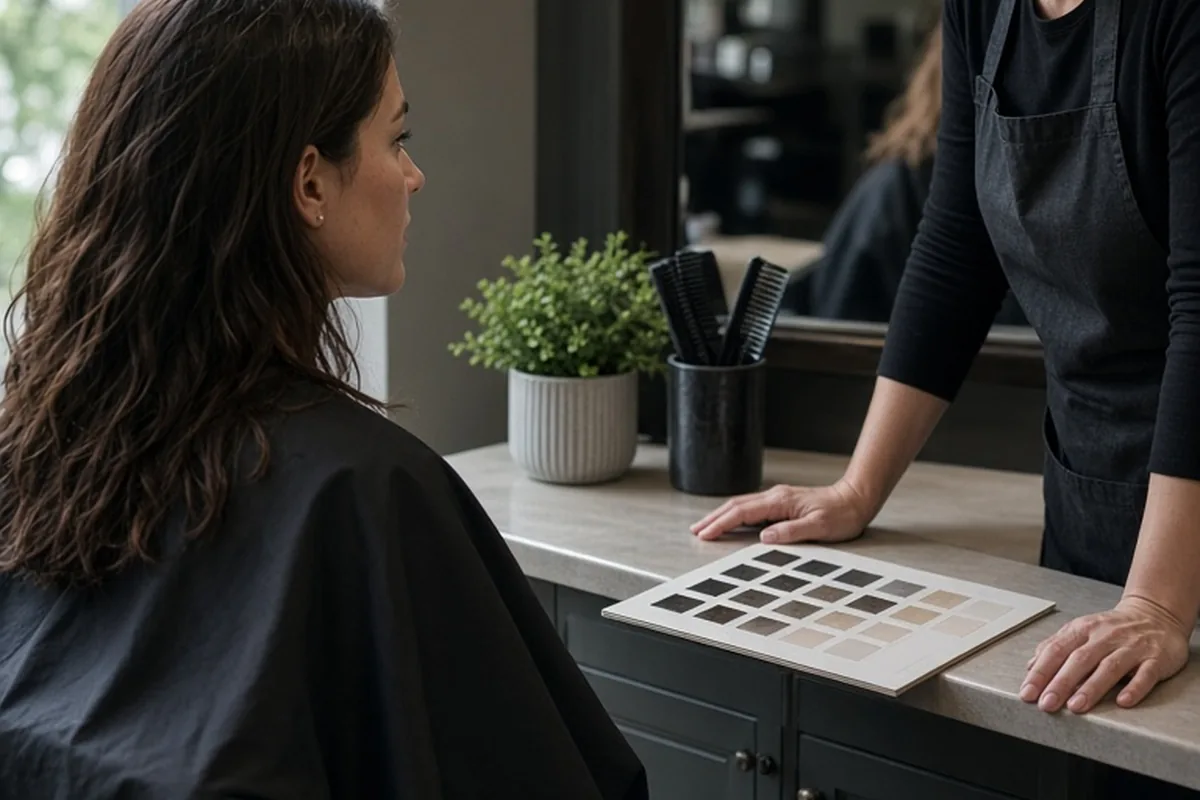
Replace subjective adjectives with physical benchmarks and visual samples. Use your collarbone, shoulders, chin, or jawline to indicate precise boundaries for your cut, both when your head is upright and when looking downward. When discussing hair color, point to physical swatches in a salon swatch book or select photos under neutral salon lighting to demonstrate the exact depth, lightness, and tonal reflect you have in mind.
Overlooking Your Daily Styling Habits and Home Maintenance Capacity
A haircut or color transformation does not exist in isolation; it lives inside your daily routine. Agreeing to an intricate, precision fringe, a shattered pixie, or high-contrast platinum highlights without factoring in your morning time commitment creates immediate friction. If your typical routine consists of rolling out of bed, running a comb through your strands, and tying your hair into a topknot, a style requiring round-brush tension, smoothing serums, and daily heat tools will leave you frustrated within forty-eight hours.
Home maintenance also encompasses financial and calendar upkeep. Vivid colors, heavy bleach retouches, and structured perimeter cuts require salon appointments every four to six weeks to avoid demarcation bands and maintain balance. Conversely, lived-in balayage, soft interior layers, and natural root tapers can often stretch three to four months. Glosses, bond-repair treatments, specialized sulfate-free cleansers, and purple toners are vital investments required to preserve salon results at home.
Be completely upfront about your lifestyle constraints during the consultation. Tell your stylist how many minutes you are willing to spend on styling each morning, what tools you comfortably use, and how frequently your schedule and budget permit salon visits. An experienced stylist will gladly adjust graduation angles, highlight placements, and textural thinning to accommodate an air-dry routine or extended maintenance schedules.
Staying Silent During Price Discussions and Service Adjustments
Hesitating to discuss service costs upfront is a frequent source of consultation distress. Hair salon pricing has evolved significantly, with many modern establishments charging by the hour, charging per bowl of lightener or color used, or adding separate line items for glosses, bond-reinforcing additives, blowouts, and deep-conditioning masks. Assuming that a base quote covers every supplementary product used throughout a multi-hour appointment often leads to unexpected checkout shock.
Financial transparency is a routine professional boundary, and professional stylists respect clients who ask for clear cost breakdowns before services begin. When an appointment requires corrective steps—such as lifting out uneven patches, filling porous sections, or using double applications of toner—the price can escalate quickly. Staying silent when a stylist mentions adding an intensive treatment leaves you vulnerable to unexpected financial commitments.
Ask direct questions before the cape is secured: confirm what the base service includes, whether styling and finishing are priced separately, and what the anticipated total will be based on the initial assessment. If the quote exceeds what you intended to spend, state your budget openly. This allows the stylist to re-engineer the service plan—such as prioritizing a partial foil instead of a full head, or focusing on an essential structural haircut while postponing dimensional color for a subsequent visit.
Hair Salon Consultation Mistakes During the Physical Scalp and Strand Assessment
A proper consultation requires physical examination, not just verbal discussion across a styling mirror. A major error occurs when clients arrive with hair styled in tight buns, pinned under heavy headwear, or heavily coated with dry shampoo, scalp oils, and styling powders. These products mask your natural growth direction, conceal cowlicks, and alter hair texture, preventing the stylist from assessing your true density, elasticity, and scalp health.
Equally problematic is passively allowing a stylist to skip the dry evaluation altogether by rushing directly to the shampoo bowl. Touching dry hair allows the professional to evaluate structural integrity: how your hair stretches, whether the ends snap under tension, where thinning exists along the hairline, and how growth whorls at the crown dictate natural volume. Chemical services applied to compromised strands or an irritated scalp can trigger severe breakage or dermatological discomfort.
Arrive at your consultation with your hair freshly washed within twenty-four hours, dry, and styled in your standard, everyday manner. Let your stylist run their hands through your dry hair to check porosity levels and parting tendencies. If your stylist attempts to begin a chemical transformation without checking dry elasticity or examining your scalp, speak up and ask them to assess the hair's structural readiness and perform a test strand.
Failing to Establish a Realistic Multi-Session Timeline
Expecting an instant, dramatic hair transformation in a single session is a recipe for damaged hair and unmet expectations. Moving from dyed black or rich espresso hair to cool blonde or pastel shades requires lifting through multiple underlying warmth stages, including deep red, orange, and pale yellow. Attempting to force hair through all those pigment levels in one three-hour appointment risks permanently destroying the cuticle, resulting in severe breakage and chemical burns along the shaft.
When clients do not map out a progressive timeline, they often leave an initial corrective session feeling discouraged by intermediate brassy tones or warm caramel undertones. A multi-session plan requires clear mutual benchmarks: you must understand what stage one looks like, what condition your hair must remain in to qualify for stage two, and how many weeks of rest and protein rebuilding are required between appointments.
During your consultation, ask your colorist what is achievable today while preserving hair health, and what steps will require future appointments. Request an honest appraisal of intermediate phases so you know what color to expect in the transition. Establishing a phased roadmap guarantees that every appointment systematically builds toward your final aesthetic goal without sacrificing strand elasticity.
Illustrative Scenarios
Resolving Conflicting Descriptors and Hidden Pigment
A client arrived seeking an ashy mushroom-brown balayage, showing photos of high-contrast cool-toned hair on a model with dense, wavy texture. During the verbal consultation, the client mentioned wanting an easy air-dry routine and revealed she had used a dark brown box color six months prior that appeared completely faded. The stylist touched the dry hair, noted fine density and high porosity on the ends, and explained that lifting old box dye would reveal stubborn red-orange underlying pigment that could not achieve a cool ash tone in a single gentle session without significant breakage. Rather than proceeding blindly, they reviewed swatches under neutral light, defined safe length boundaries, and agreed to a phased warm-mocha dimensional color that complemented her air-dried texture.
Key point: Transparently disclosing past home color and testing dry strand elasticity allows the stylist to adjust formulas, set realistic tone expectations, and prevent unexpected chemical damage.
Frequently asked questions
How long should a thorough hair salon consultation take?
A standard consultation for a recurring haircut usually takes five to ten minutes, while an initial consultation for a major transformation, corrective color, or a new stylist should last fifteen to thirty minutes. Never rush this step, as it establishes the technical formulas and safety boundaries for the appointment.
Should I wash my hair right before attending a hair salon consultation?
It is best to wash your hair roughly twelve to twenty-four hours before your appointment, allowing it to dry naturally in your normal everyday style. Avoid heavy dry shampoos, hair fibers, or tight elastic buns, which can conceal your natural texture, growth patterns, and true scalp health.
What should I do if my stylist seems dismissive during the consultation?
If a stylist dismisses your questions, refuses to discuss pricing, or begins mixing chemicals before agreeing on your goals, pause the service immediately. You always have the right to decline the service before work begins if clear communication and safety checks have not been established.
Your next step
Take two clear photos of your hair in natural daylight today, write down every chemical and dye product used on your strands over the past two years, and bring that written log directly to your next stylist consultation.