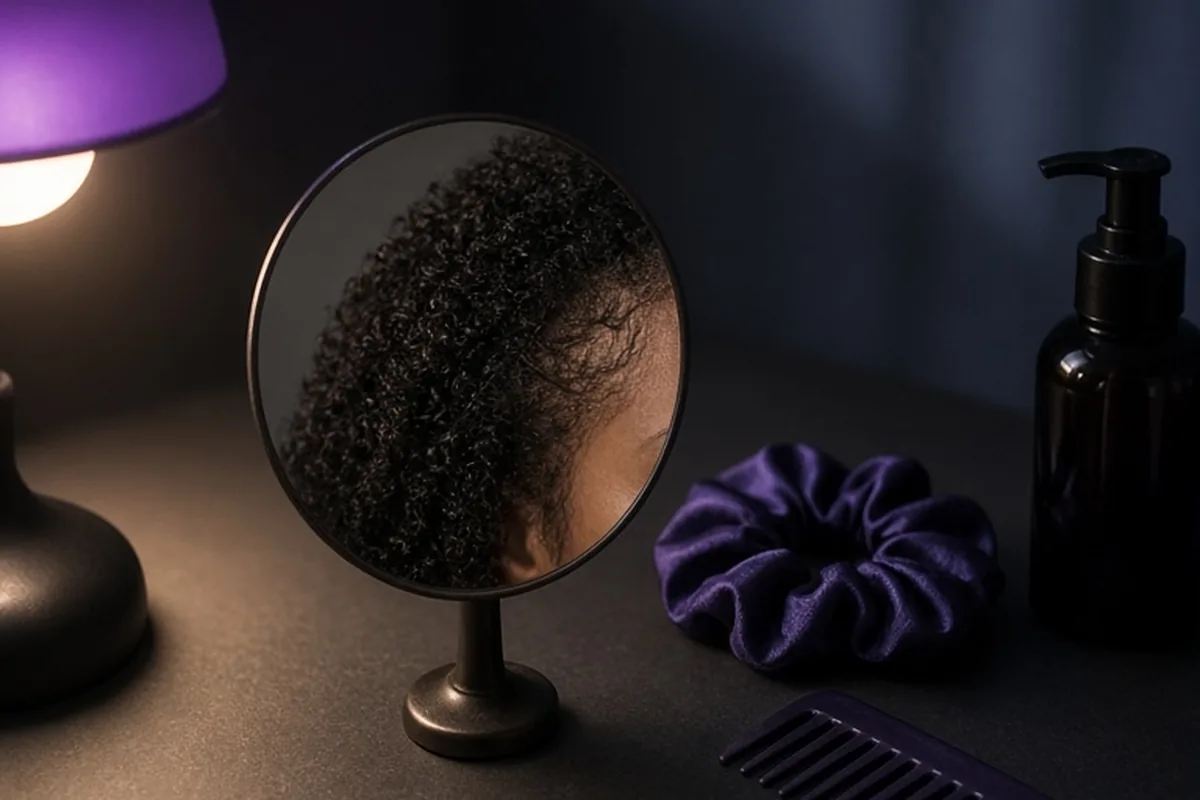
Hair thinning at the temples in women with textured hair typically results from prolonged mechanical tension, harsh styling products, hormonal shifts, or underlying scalp conditions. Because temple hair follicles are inherently finer and have curved roots, they are especially susceptible to breakage and traction. Recovery involves eliminating high-tension styles, reducing heavy edge-taming products, establishing a gentle scalp-cleansing routine, and consulting a dermatologist if thinning persists or shows signs of scarring.
Experiencing thinning along the temples and hairline can feel frustrating and deeply personal, particularly when caring for type 3 curls or type 4 coils. Understanding the specific physical and biological factors influencing your hairline is the first step toward making informed, supportive choices for your hair health.
The Unique Vulnerability of Coiled Follicles at the Hairline
Textured hair features an elliptical or oval cross-section and grows in an asymmetrical, spiral pattern beneath the surface of the scalp. While this unique architecture creates beautiful volume, curl definition, and structural bounce, it also means that the hair strand has natural points of variation along each curve. At the temples and perimeter of the hairline, the hair fibers are naturally finer in diameter and possess a shallower follicle depth compared to the hair located at the crown or occipital region. Consequently, these delicate perimeter strands have less structural anchoring to withstand repetitive pulling, heavy styling products, or environmental stressors.
The skin around the temporal zone is also thinner and contains a dense network of sensitive nerve endings and micro-capillaries. When curly or coily hair at the temples is subjected to continuous friction from pillowcases, hats, or tight bands, the fragile outer cuticle layer can become abraded. Once the protective cuticle is compromised, the inner cortex loses moisture rapidly, leading to localized breakage near the root that frequently mimics hair shedding. Recognizing that temple hair requires a gentler baseline level of handling is essential for maintaining its integrity over time.
Differentiating Tension Damage from Hormonal and Scalp Conditions
Thinning at the temples can stem from several distinct causes, and identifying the correct underlying driver determines the appropriate path forward. The most frequent mechanical cause among women wearing protective or sleek styles is traction alopecia, which begins as mild tenderness, redness, or small bumps around the follicles before progressing to visible recession. In its early stages, traction alopecia is generally reversible once tension is eliminated. However, if chronic pulling continues unabated over long periods, the follicle can develop fibrotic tissue, leading to permanent loss.
Conversely, internal factors such as androgenetic alopecia, telogen effluvium, or hormonal fluctuations during postpartum recovery and perimenopause can also cause temporal thinning. In these instances, the thinning is often diffuse across the frontal region or accompanied by a wider center part rather than localized purely to areas of mechanical strain. Autoimmune or inflammatory scalp conditions, including frontal fibrosing alopecia or central centrifugal cicatricial alopecia, present with persistent itching, burning, scaling, or a smooth, shiny appearance along the hairline. Because treatments for inflammatory conditions differ significantly from mechanical care routines, careful symptom monitoring is critical.
Auditing Styling Habits: Braids, Weaves, and Edge Control Gels
Protective styles such as knotless braids, traditional box braids, twists, and weaves are popular methods for reducing daily manipulation of textured hair. However, when extensions are installed too tightly or worn with excessive added hair weight, they create continuous pulling forces on the delicate temporal roots. Furthermore, styles that pull the perimeter back into taut ponytails, high buns, or slicked-updos exert concentrated directional stress precisely where the hair is weakest. Even seemingly benign habits, such as applying tight elastic bands or rigid headband wraps repeatedly along the same line, can cause gradual friction-induced thinning.
Styling products designed for edge control and sleek styling can also contribute to temple hair loss if used improperly. Many firm-hold gels, pomades, and edge tamers rely on drying alcohols, heavy waxes, or strong polymers to maintain sleekness. When applied daily without regular cleansing, these formulas accumulate around the follicular openings, causing product buildup that can trigger localized contact dermatitis or folliculitis. Brushing down edges with stiff-bristled brushes while the hair is stiffened by dry gel creates mechanical snapping of the hair shafts, rapidly thinning the hairline.
Constructing a Low-Manipulation Edge Recovery Routine
Implementing a low-manipulation recovery period is the most immediate way to relieve stress on weakened temple follicles. This process starts by pausing all tight, high-tension installations and opting instead for loose, free-hanging hairstyles, loose twists, or gently pinned styles that do not pull at the perimeter. If you choose to wear protective styles, request that your stylist leave your delicate baby hairs and temple boundaries completely free from the braids or base rows. Ensure that any style feels comfortable immediately upon completion; if you feel throbbing, tightness, or pain, the installation is too tight and should be adjusted immediately.
Nighttime protection should be tailored to protect fragile edges from abrasive friction. Swap traditional cotton pillowcases for high-grade mulberry silk or satin covers, and use loosely tied satin bonnets or scarves that sit behind the hairline rather than compressing directly over the temples. When washing or styling the rest of your hair, avoid aggressive brushing, rough towel drying, or fine-toothed combs along the perimeter. Instead, use your fingertips or a soft baby brush lightly misted with water and a leave-in conditioner to gently shape the hair without stretching it.
Nourishing the Hairline: Cleansing, Moisture, and Scalp Care
A healthy scalp environment is the foundation for supporting optimal hair growth cycles at the temples. Clarifying the hairline regularly is just as important as washing the rest of your scalp. Use a gentle, sulfate-free moisturizing shampoo to thoroughly dissolve sweat, sebum, and leftover styling products from the perimeter at least once a week. Removing this debris ensures that follicular openings remain unblocked and reduces the risk of inflammation or microbial imbalances that impede healthy strand emergence.
Following cleansing, replenish moisture to the temple area with water-based leave-in conditioners containing hydrating ingredients like aloe vera, glycerin, or panthenol, followed by a light layer of non-comedogenic oil such as jojoba or squalane to seal in hydration. Avoid thick, petroleum-heavy ointments directly on the scalp if you are prone to clogged pores or scalp bumps. Incorporating a daily two-minute fingertip massage along the temples using light circular motions can help maintain comfortable blood circulation to the region without pulling the hair fibers.
Clinical Evaluations: When to Consult a Dermatologist or Trichologist
While routine adjustments can successfully address early-stage mechanical breakage, persistent thinning requires professional medical evaluation. A board-certified dermatologist, particularly one experienced in managing textured hair and ethnic dermatology, can perform specialized diagnostic procedures. These may include a close examination using a dermatoscope (trichoscopy) to visualize follicular openings, a gentle hair pull test, or a small punch biopsy to determine whether active inflammation or follicular miniaturization is present.
Medical evaluation is especially urgent if you observe symptoms such as persistent scalp tenderness, burning sensations, visible scaling, pimple-like bumps along the hairline, or an unusually smooth skin surface where follicle pores are no longer visible. A clinical specialist can differentiate between non-scarring and scarring conditions, suggest evidence-based topical treatments or anti-inflammatory therapies if warranted, and help you establish a targeted management plan tailored to your overall health, nutritional profile, and lifestyle.
Illustrative Scenarios
Adjusting Protective Styling Habits
Maya noticed noticeable thinning and small bumps along her temples after wearing tightly braided extensions continuously for six months. Her initial response was to apply extra edge-control gel and use a stiff brush to slick the thinning areas into high ponytails to hide the loss. After learning about mechanical tension, she switched to wearing loose, natural twists without added hair, kept her perimeter entirely out of the style, and replaced stiff edge brushes with gentle fingertip smoothing.
Key point: Attempting to conceal thinning with tight styling and heavy gels exacerbates follicle damage, whereas reducing tension allows the perimeter to rest.
Addressing Postpartum Thinning and Friction
Kendra experienced sudden temple shedding five months after giving birth. She initially assumed the thinning was solely caused by her elastic wig grip and friction from wearing tight synthetic wigs daily. Upon consulting a board-certified dermatologist, she learned that hormonal shifts had triggered telogen effluvium, which was further irritated by wig-band friction. By switching to a gentle, satin-lined cap and allowing her hairline to breathe, she minimized mechanical loss while her natural growth cycle stabilized.
Key point: Systemic factors and physical friction often overlap, making a combined medical and low-tension approach the most effective strategy.
Frequently asked questions
How long does it typically take to see regrowth at the temples?
Because hair grows in cyclical phases at a rate of approximately one-quarter to one-half inch per month, visible recovery typically requires three to six months of consistent low-tension care. If follicles have experienced severe scarring, regrowth may not occur naturally, making early intervention critical.
Can edge control products permanently damage temple hair follicles?
Edge control products do not permanently destroy follicles on their own, but chronic buildup paired with harsh brushing and alcohol-induced dryness can lead to severe breakage and localized folliculitis. Cleansing the perimeter regularly and using gentle formulas prevents long-term harm.
What is the difference between traction alopecia and standard shedding at the hairline?
Traction alopecia is directly associated with areas of physical tension, often accompanied by localized soreness, redness, or bumps near the pulled root. General shedding, such as telogen effluvium, typically occurs more uniformly across the head without scalp irritation or mechanical pulling.
Are wigs safe to wear while recovering from temple thinning?
Wigs can be worn safely if they are installed without harsh glues, adhesives, or tight elastic bands that sit directly on the fragile temple area. Choose loose-fitting caps, secure them behind the hairline with soft velvet or satin-lined grips, and remove them at home to allow the scalp to rest.
Your next step
Take a clear photograph of your temples in natural light today to establish a baseline, and pause any tight styling, heavy edge gels, or high-friction headwear for the next eight weeks.