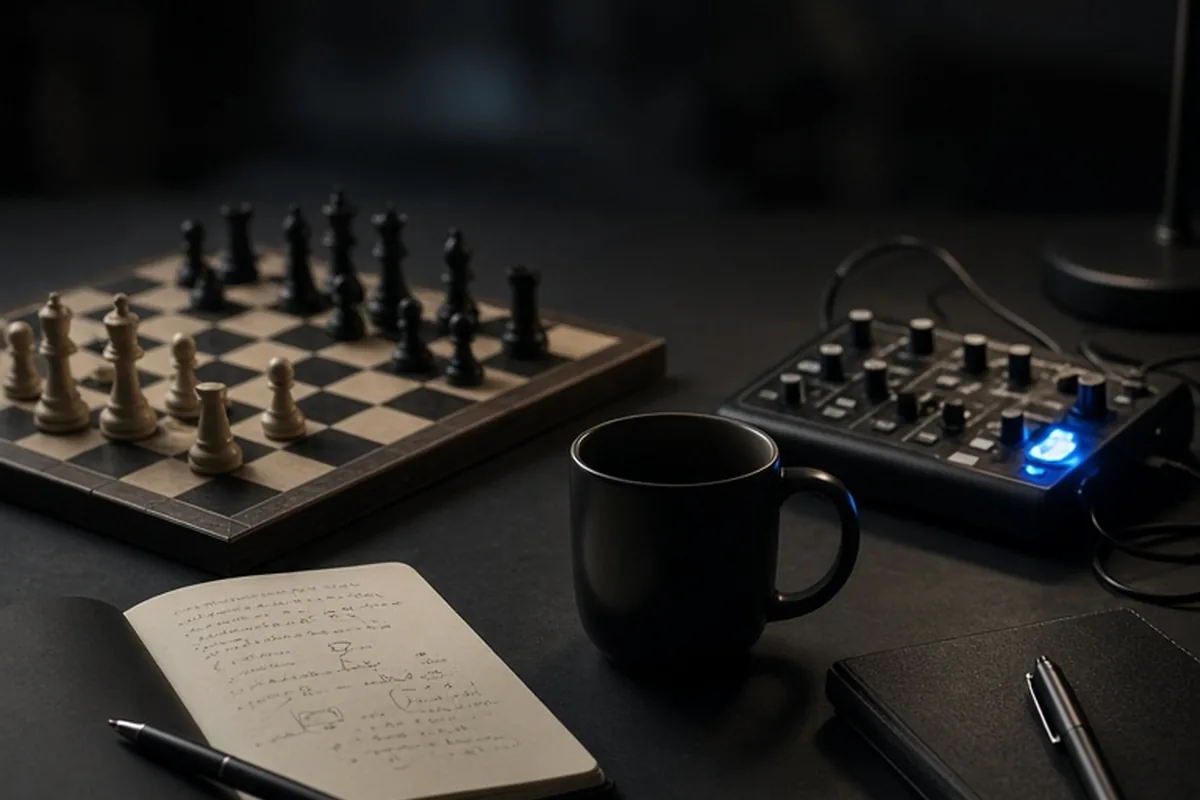
The best hobbies for an INTJ personality typically emphasize autonomy, deep strategic analysis, continuous mastery, and creative problem-solving. INTJs often thrive in pursuits that allow them to build complex mental models or tangible systems with minimal social friction. Engaging pastimes include strategic board games, programming personal software tools, solo endurance sports, precision woodworking, digital music production, and architectural photography, all of which reward focused dedication without unnecessary interruptions.
Finding meaningful leisure as an INTJ often means avoiding superficial pastimes in favor of activities with genuine depth. While conventional advice frequently pushes loud group activities or passive entertainment, an INTJ usually finds rest through structured curiosity, focused experimentation, and the satisfaction of gradually refining a complicated discipline.
Complex Strategy and Analytical Gaming
Strategic gaming provides an intellectual arena where long-term planning and contingency forecasting yield direct rewards. For someone with an INTJ personality, games like Go, chess, abstract strategy board games, or complex deck-building simulations offer a closed system where rules are transparent and outcomes depend primarily on foresight and tactical discipline. The appeal lies not simply in winning, but in discovering elegant patterns, stress-testing hypotheses, and diagnosing the root cause of errors after a match concludes. Analyzing recorded games to identify systemic blunders turns every session into a self-contained learning laboratory.
To make this category truly sustainable, choose formats that align with your preferred pacing and social tolerance. Turn-based asynchronous platforms allow for deep calculation without the social friction or time pressure of rapid live play, while dedicated local clubs can provide intellectually stimulating sparring partners who appreciate serious study. For instance, an INTJ might spend a month learning the structural nuances of a specific chess opening, tracking win rates across various pawn structures to measure improvement empirically.
A common pitfall in competitive strategy is the frustration that arises when interacting with casual or erratic opponents. If other players act without adhering to logical principles, it can disrupt theoretical frameworks and lead to unnecessary irritation. Setting clear expectations by viewing erratic moves as novel computational puzzles rather than flaws in the game helps keep strategic gaming rewarding rather than mentally taxing.
Independent Coding and Systems Architecture
Building software tools, scripting automations, and designing personal databases allow INTJs to channel their preference for systematic efficiency into practical utility. Unlike collaborative workplace software engineering, which often involves compromises, meetings, and legacy codebases, personal programming projects offer total architectural autonomy. An INTJ can design a system from the ground up according to first principles, establishing clean abstractions, optimal data structures, and streamlined workflows tailored specifically to their daily needs.
Practical starting points include writing command-line scripts to automate repetitive file management, configuring custom personal knowledge management environments, or assembling a private home server that handles local media and data backups. For example, building a customized personal budgeting application that automatically parses bank statements and categorizes expenditures provides both immediate utility and the intellectual puzzle of designing a reliable data pipeline.
The primary challenge in technical side projects is managing perfectionism and scope creep. Because INTJs naturally see potential improvements and secondary features, a straightforward weekend script can quickly metastasize into an overly ambitious, multi-tier software project that remains half-finished. Setting strict functional constraints, releasing a bare-bones version first, and deliberately ignoring non-essential optimizations are vital strategies for bringing self-directed digital projects to completion.
Precision Craftsmanship and Physical Making
Physical crafting and precision making provide an essential balance to the abstract, purely cognitive work that often dominates an INTJ's thoughts. Disciplines such as fine woodworking, leatherworking, custom mechanical keyboard assembly, and additive manufacturing translate theoretical planning into physical objects. The requirement to understand material properties—such as the grain orientation of hardwood or the thermal dynamics of extruded polymers—demands meticulous planning while grounding the practitioner in tangible reality.
Engaging in craft hobbies involves breaking down an ambitious build into a sequence of precise, interdependent steps. Consider the process of constructing a custom hardwood desktop: an individual must draft exact schematics, calculate tolerance allowances, select stable lumber, perform joinery cuts with calibrated equipment, and execute a multi-stage finishing schedule. Each milestone requires technical accuracy and patience, offering an immense sense of closure when the physical artifact matches the original mental blueprint.
However, working with physical media introduces natural variables that cannot be easily solved with pure logic. Wood expands with humidity, solder joints fail unexpectedly, and tools require ongoing maintenance and calibration. Accepting that physical materials carry inherent flaws and that manual dexterity requires deliberate, slow practice prevents the perfectionist frustration that can otherwise cause beginners to abandon the workbench prematurely.
Solo Endurance Athletics and Quantifiable Training
Physical fitness pursuits that emphasize individual endurance and measurable data tracking align exceptionally well with INTJ temperaments. Activities like road cycling, distance running, rowing, and structured powerlifting remove the chaotic interpersonal dynamics of team sports, replacing them with systematic physiological progression. The participant operates as both the athlete and the coach, designing periodized training cycles, monitoring performance indicators, and optimizing recovery protocols to achieve quantifiable personal bests.
Implementing this approach involves using objective metrics to guide effort rather than relying solely on subjective feelings. By tracking training metrics such as heart rate variability, power output, pace per mile, or total volume lifted over a twelve-week training block, an INTJ can analyze physiological adaptations over time. For example, preparing for a solo metric century bike ride by progressively building weekly aerobic base mileage and dialing in carbohydrate intake turns physical exertion into a structured, self-regulated experiment.
The main risk with quantifiable athletics is becoming overly rigid in following the plan. When data tracking becomes dogmatic, it is easy to ignore subjective bodily cues like joint soreness, accumulated nervous system fatigue, or subtle illness. Maintaining long-term orthopedic health requires treating training spreadsheets as adaptable frameworks rather than unyielding mandates, incorporating deload weeks and rest days whenever recovery markers deteriorate.
Curated Research, Historical Archiving, and Writing
Autonomous research, historical analysis, and analytical writing offer deep intellectual satisfaction for minds driven by curiosity and synthesis. Rather than skimming high-level summaries, INTJs typically enjoy taking deep dives into niche historical eras, economic theories, urban planning dynamics, or obscure scientific subjects. Collecting primary sources, cross-referencing differing historical accounts, and organizing findings into structured syntheses allow an INTJ to build comprehensive mental models of complex phenomena.
A practical way to organize this pursuit is through interconnected digital note-taking systems, such as building a private knowledge wiki or writing long-form exploratory essays. For instance, an individual intrigued by the development of maritime trade routes might spend several months mapping out ancient shipping corridors, studying commodity flows, and drafting a synthesis paper analyzing how geography constrained regional naval power. This structured synthesis transforms passive reading into active, analytical production.
A frequent pitfall of autonomous research is the trap of endless consumption without producing any tangible output. Without a clear deliverable, research projects can become sprawling rabbit holes that consume extensive time without delivering a sense of completion. Defining specific end products—such as a ten-page whitepaper, a documented visual timeline, or an annotated reading list—ensures that investigative curiosity leads to satisfying closure.
Technical Arts and Creative Engineering
Creative expression becomes far more appealing to an INTJ when it incorporates rigorous technical systems and high standards of craft. Hobbies such as architectural photography, digital audio synthesis, and complex vector illustration merge creative intuition with strict formal rules. Rather than relying on spontaneous, unstructured emotional expression, these creative fields reward understanding the underlying mathematics, geometry, and physics that govern aesthetic results.
In architectural photography, for example, achieving a compelling image requires calculating perspective correction, managing focal lengths, understanding how directional sunlight interacts with building materials, and utilizing precise digital post-processing curves. Similarly, building original sounds with modular synthesizers requires navigating signal routing, envelope filtering, and low-frequency oscillation. In both cases, technical expertise serves as the direct vehicle for creative execution.
The common difficulty in technical art forms is overemphasizing mechanical precision at the expense of creative spontaneity. An INTJ may spend hours dialing in perfect optical sharpness or calibrating synthesizer harmonic frequencies while neglecting composition, narrative, or aesthetic mood. Balancing rigorous technical setup with an openness to organic experimentation ensures that the final work remains artistically expressive rather than merely technically competent.
Frequently asked questions
How can an INTJ avoid abandoning a hobby once the basics are mastered?
INTJs often lose interest when initial learning plateaus into routine practice. To maintain engagement, introduce self-directed constraints, tackle advanced edge cases, or shift from basic execution to building full-scale projects that require combining multiple disciplines.
What is the best way for an INTJ to handle social interaction in hobbies?
Choose activity-focused groups rather than purely social meetups. Environments like structured game clubs, maker collectives, or specialized workshops allow you to connect over shared technical challenges and substantive ideas without the exhaustion of mandatory small talk.
Are budget-friendly hobbies viable for analytical personality types?
Yes, many analytical pursuits require little to no financial investment. Learning open-source programming languages, studying chess on free tactical servers, distance running, and conducting deep research in public archives all offer immense intellectual depth at minimal cost.
How many active hobbies should an INTJ pursue at one time?
Most INTJs thrive by focusing deeply on one primary long-term craft and one secondary low-friction outlet. Limiting active pursuits to two prevents fragmented attention and ensures sufficient cognitive energy for meaningful skill acquisition and project completion.
Your next step
Choose one pursuit from this guide that solves an intellectual or creative itch, set up a dedicated two-hour practice block this week, and establish a tangible first milestone to test whether its depth matches your analytical goals.