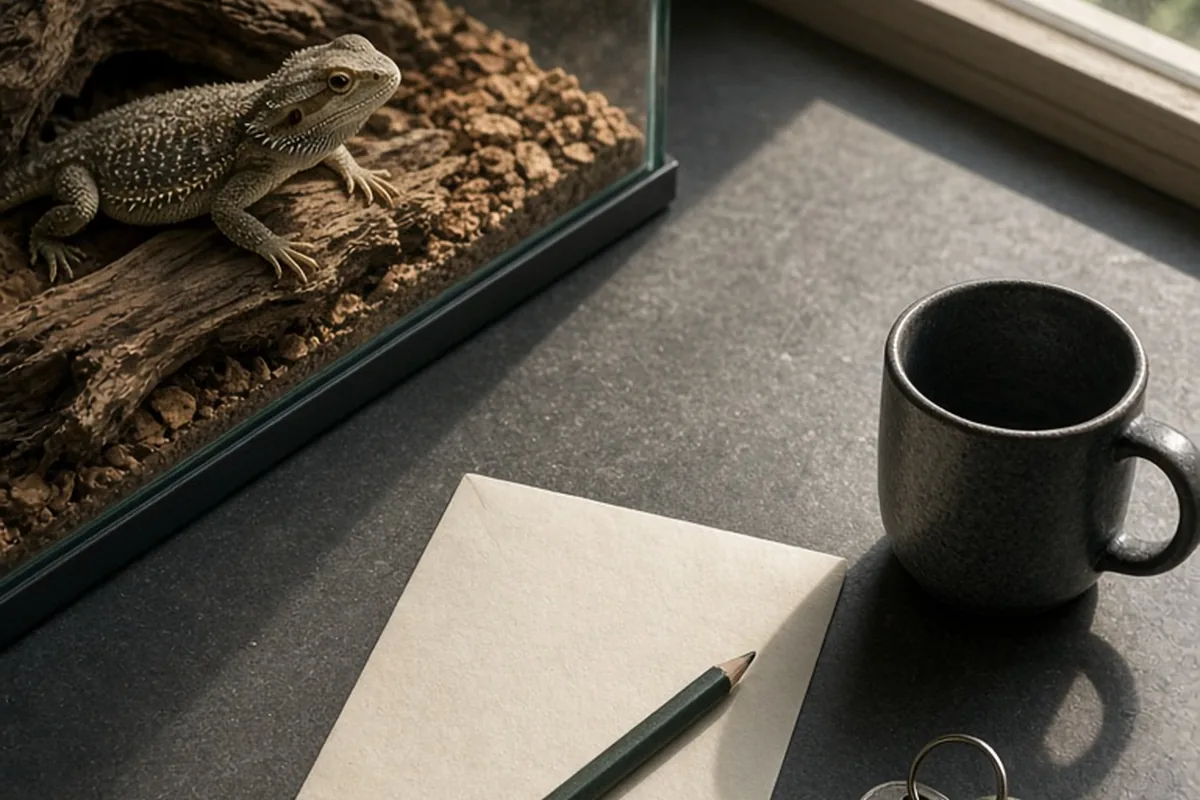
Most adult female central bearded dragons grow to between 16 and 20 inches in total length from snout to tail tip, weighing roughly 300 to 500 grams. While slightly smaller and narrower in head and tail base than males, individual growth depends heavily on genetics, daily diet, UVB lighting, and adequate enclosure space during their first eighteen months.
Welcoming a female bearded dragon into your home brings the unique joy of raising an inquisitive, calm reptile companion. To ensure she lives a comfortable life, understanding her mature body measurements allows you to prepare the right physical environment, feeding routine, and long-term care strategy before she reaches full size.
Average Adult Dimensions and Body Proportions
A typical adult female central bearded dragon (Pogona vitticeps) measures between 16 and 20 inches from the tip of her snout to the end of her tail. In terms of mass, healthy adult females generally weigh between 300 and 500 grams once they reach two years of age. Tail length represents roughly half of their total body length, meaning a 18-inch lizard typically has a body length of around 9 inches and a tail of equivalent measurement.
Body shape differences are also noticeable as females mature. Females often possess a slightly more slender head profile, a narrower tail base, and a broader torso compared to males of the same lineage. However, individual variation is common. Genetics play a substantial baseline role, so a female from larger bloodlines may easily reach 20 to 22 inches, whereas a female from smaller lineage may remain healthy at 16 inches. Observing body composition rather than chasing arbitrary numbers ensures you focus on actual vitality.
Visual and Morphological Differences Between Genders
While length differences between male and female bearded dragons can be subtle, morphological cues become distinct as reptiles reach sexual maturity around 8 to 12 months of age. Male bearded dragons frequently feature broader heads, thicker beards, and noticeably wider tail bases designed to house hemipenes. In contrast, females tend to have a smoother taper at the underside base of the tail and a less prominent jawline.
Femoral pores along the underside of the hind thighs also provide physical clues. In female dragons, these pores are typically smaller, flatter, and produce far less waxy secretion than the pronounced, raised pores seen on mature males. When determining size potential, keep in mind that a female may look slightly stockier across her midsection while maintaining a leaner neck and tail structure. Knowing these nuances helps keepers avoid mistaking natural female geometry for underdevelopment or excess weight.
Key Growth Stages from Hatchling to Adulthood
Bearded dragons experience their most rapid skeletal and muscular development during the first year of life. When hatching, baby dragons measure a mere 3 to 4 inches and weigh around 3 to 5 grams. By 3 to 6 months of age, during the juvenile stage, they frequently double in length, reaching 8 to 12 inches as their metabolic rate peaks.
Between 7 and 12 months, the growth rate moderates slightly into the sub-adult phase, where dragons lengthen to 14 to 18 inches and begin developing adult muscle mass. By 18 to 24 months, skeletal growth virtually ceases, and the lizard reaches final structural maturity. Tracking growth during these windows helps identify stalls early, allowing keepers to adjust heat gradients, calcium supplementation, or insect volume before developmental windows close.
Essential Nutrition Requirements for Steady Development
The nutritional profile required by a growing female dragon shifts dramatically between her youth and adult life. Hatchlings and young juveniles thrive on a diet comprising roughly 70 to 80 percent live, gut-loaded feeder insects and 20 to 30 percent fresh leafy greens to support swift cell replication and bone formation. Suitable feeder insects include appropriately sized dubia roaches, black soldier fly larvae, and crickets dusted regularly with calcium and vitamin D3.
As a female approaches maturity around 18 months, her metabolic demands shift toward maintenance, requiring an inversion of that ratio to approximately 75 to 80 percent dark leafy greens and only 20 to 25 percent insect protein. Offering daily salads containing collard greens, mustard greens, dandelion leaves, and squash prevents sudden obesity while supplying essential hydration and trace minerals. Overfeeding protein to a mature adult can trigger rapid weight gain and place unnecessary stress on liver and kidney function.
Terrarium Sizing and Spatial Needs for Adult Females
To accommodate a female dragon reaching up to 20 inches, enclosure size must allow for full thermoregulation and regular physical movement. The modern standard minimum enclosure for a fully grown adult is a 120-gallon terrarium, which measures 48 inches long, 24 inches wide, and 24 inches high. Enclosures of this volume give the reptile room to turn comfortably without bending her spine or tail against glass walls.
Adequate vertical and floor space also enables the creation of distinct environmental zones. An adult female requires a basking area with surface temperatures between 100 and 105 degrees Fahrenheit, alongside a cool retreat measuring 75 to 80 degrees Fahrenheit. If an enclosure is too cramped, creating this thermal gradient becomes nearly impossible, leading to chronic digestive sluggishness, reduced appetite, and restricted mobility that can shorten lifespan.
Environmental Factors Influencing Ultimate Adult Size
Beyond genetic blueprint, ultraviolet lighting represents the most critical external catalyst for proper bone growth and full size attainment. High-output linear UVB lamps (such as T5 fixtures spanning at least half the terrarium length) enable dragons to synthesize vitamin D3, which facilitates calcium absorption from food. Without adequate UVB exposure, dragons risk metabolic bone disease, resulting in stunted skeletal structure, soft jaws, and bowed limbs.
Hydration and parasite management also dictate how effectively a dragon converts nutrients into body mass. Routine health checks through microscopic fecal exams help identify common intestinal parasites like coccidia or pinworms, which can siphon calories during vital juvenile growth phases. Providing shallow water dishes, misting fresh greens, and occasional supervised soaks ensures the hydration needed for smooth skin shedding and healthy cellular development.
Egg-Laying Demands and Weight Management
An important biological reality for female bearded dragons is that they can produce clutches of infertile eggs even without male presence. Folliculogenesis and egg production demand substantial amounts of calcium and stored bodily fat. A healthy female preparing to lay will temporarily gain noticeable abdominal mass, followed by a dramatic drop in weight once the clutch is deposited.
Keepers must distinguish between healthy egg-bearing weight, natural adult muscularity, and sedentary obesity. A well-conditioned female possesses firm fat pads on the crown of her head and a moderately full tail base without excessive rolls of loose fat at the armpits or chest. Providing a dedicated dig box filled with moist play sand and organic soil allows gravidity to resolve naturally, keeping the female fit and preventing dangerous egg binding.
Illustrative Scenarios
Adjusting Care for a Slow-Growing Rescue Dragon
A pet keeper adopted a ten-month-old female dragon that measured only 11 inches and appeared lethargic in a compact 20-gallon starter tank equipped with a weak screw-in compact UVB bulb. Recognizing that inadequate lighting and restricted movement were limiting her development, the keeper upgraded the setup to a 120-gallon habitat with a dedicated T5 10.0 linear UVB fixture, a reliable basking spot of 102 degrees Fahrenheit, and a structured diet of gut-loaded roaches dusted with calcium alongside dandelion greens. Over the subsequent six months, the dragon underwent multiple full sheds, grew an additional five inches, gained 140 grams of healthy muscle, and developed normal adult activity patterns.
Key point: Providing proper linear UVB lighting, thermal gradients, and roomy enclosures can trigger significant catch-up growth and vitality in sub-adult female bearded dragons.
Frequently asked questions
At what age do female bearded dragons stop growing?
Most female bearded dragons finish their primary skeletal growth between 18 and 24 months of age. While they may fill out in body width and muscle density slightly after two years, their total length remains permanent.
Are female bearded dragons significantly smaller than males?
Females are generally only one to two inches shorter than males and carry slightly narrower heads and tail bases. However, size ranges overlap substantially, meaning a well-nourished female can easily match or exceed an average male.
How often should I weigh and measure my female dragon?
Weighing your dragon bi-weekly on a digital gram scale during her first year helps confirm steady development. Once she reaches adulthood, monthly weigh-ins are sufficient to monitor general body condition and detect unexpected weight loss or egg development.
Your next step
Measure your adult terrarium space and check your linear UVB lighting fixture today to ensure your female bearded dragon has the exact environmental support needed to reach her full natural size.