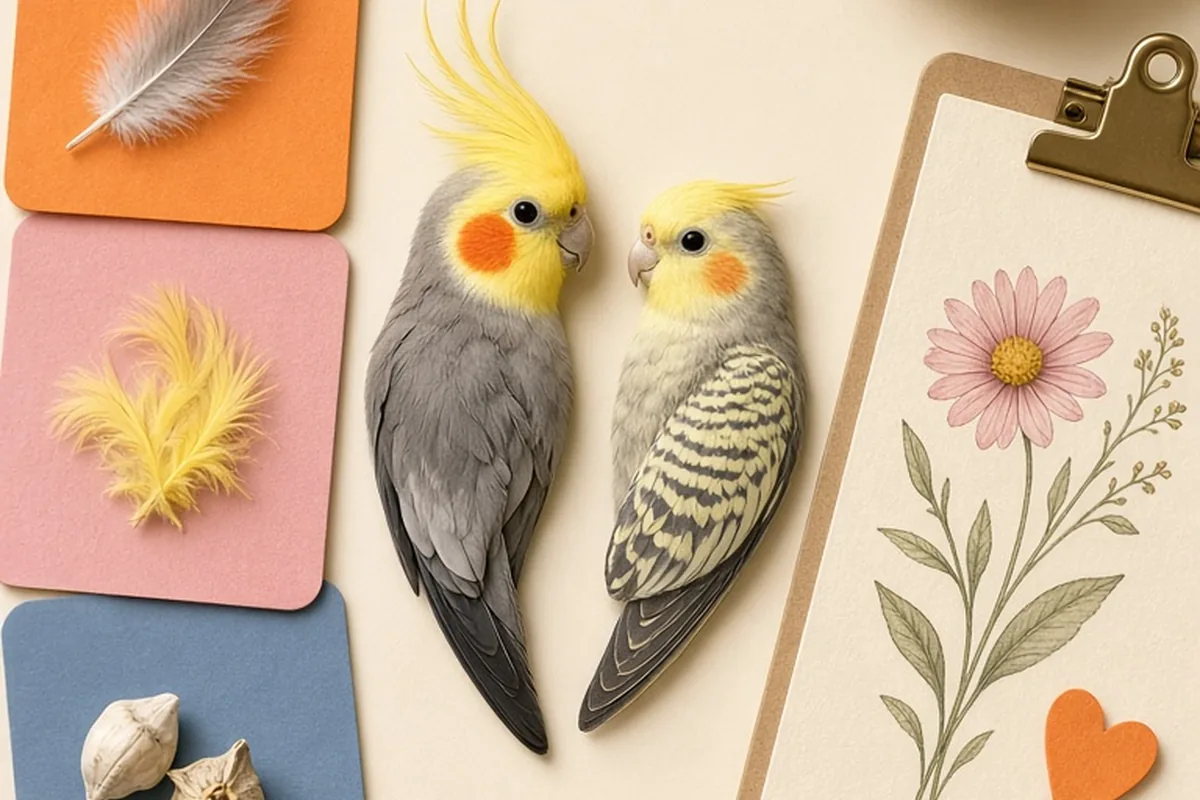
You can tell a male cockatiel from a female primarily by plumage, behavior, and testing. Adult normal grey males display bright yellow faces, vivid orange cheek patches, and solid dark undertails, whereas adult females keep muted greyish faces and yellow barring under their wings and tails. In color mutations or juvenile birds under nine months old, distinct vocal mimicry or an avian DNA feather test provides the most reliable confirmation.
Bringing home a cockatiel often comes with curiosity about whether your companion is male or female. While casual guesses based on personality are common, accurate identification involves specific physical markers, developmental timelines, and species-specific behaviors. Knowing your bird's biological sex helps you anticipate hormonal shifts, structure a healthy habitat, and identify sex-specific health issues such as chronic egg laying.
Visual Plumage Differences in Normal Grey Cockatiels
In wild-type or normal grey cockatiels, visual sexing is relatively straightforward once the bird reaches full maturity. Adult males develop a prominent mask of bright, solid yellow facial feathers contrasted against vivid, circular orange cheek patches. The underside of an adult male's tail feathers is a uniform, solid dark charcoal or slate grey without any lines, spots, or bands. This striking coloration evolved in the wild to help males attract mates and communicate across open Australian grasslands.
Adult female normal grey cockatiels retain the camouflage-heavy appearance of juveniles. A mature female's face remains primarily grey or brownish-grey, occasionally dusted with a subtle wash of soft yellow, and her cheek patches are noticeably paler or more muted orange than those of a male. Most distinctly, the underside of a female's tail feathers features prominent horizontal yellow or white barring, sometimes called a herringbone or striped pattern. In addition, spreading the underside of an adult female's primary wing feathers reveals a series of light yellow or white oval spots that mature males lose entirely after their first adult molt.
Navigating Color Mutations Where Visual Sexing Fails
Selective aviculture breeding has produced dozens of color mutations that override natural feather patterns, making visual sexing difficult or impossible. In Pied cockatiels, for example, the genetic mutation randomly disrupts melanin distribution, causing irregular blotches of clear and dark feathers across the body. As a result, a male Pied cockatiel might keep juvenile-like barred tail feathers for life, while a female Pied cockatiel might display a completely yellow face, rendering traditional visual rules obsolete.
Other mutations require specific visual tricks or genetic knowledge. In the Pearl mutation, birds possess delicate scalloped markings across their wings and backs; female Pearls retain these patterns for their entire lives, whereas male Pearls gradually lose their pearl markings with each molt until they resemble normal greys. Lutino cockatiels, which lack dark melanin entirely, present pale yellow bodies and orange cheeks in both sexes. To sex a Lutino visually, owners often must hold the bird under bright natural light or a blacklight to detect faint, ghost-like yellow barring on the underside of the female's wings and tail.
Vocal Patterns and Courtship Displays
Behavioral cues offer strong indicators of sex, particularly as cockatiels enter sexual maturity between six and twelve months of age. Male cockatiels are famously vocal, expressive, and musical. They frequently whistle complex tunes, mimic household sounds like ringtones or doorbells, and practice rhythmic vocal cadences. Alongside vocalizations, males engage in courtship displays: they strut along perches, drop their heads to tap their beaks rhythmically against wood or food bowls, and hold their wings slightly outward in an arched silhouette known as heart wings.
Female cockatiels tend to be much quieter and less inclined toward vocal mimicry. While a female can produce loud contact calls when separated from her flock or human caregiver, she rarely strings together melodic whistles or imitates speech patterns. Instead, female body language during hormonal periods often involves lowering the body flat against the perch, tilting the tail upward, and emitting soft, rhythmic peeping or chirping sounds to signal receptivity to a mate. While an occasional female may learn a brief tune, sustained musical whistling almost always points to a male.
The Timeline of the Juvenile Molt
Attempting to determine the sex of a cockatiel chick younger than six months based on feather appearance is a frequent source of error. All juvenile cockatiels, regardless of genetic sex, leave the nest looking like adult females. They possess dull facial feathers, pale cheek patches, barred undertails, and spotted flight feathers. This shared juvenile plumage provides protective camouflage against predators while young birds learn to fly and forage.
The first juvenile molt typically begins between six and nine months of age and can take several months to complete. During this molting cycle, a young male will shed his juvenile tail and flight feathers, growing in solid dark tail feathers and losing his underwing spots. His facial feathers will also molt out, replaced by vibrant yellow plumage. If a bird retains its barred tail and underwing spots after reaching twelve to fourteen months of age, it is almost certainly female, provided the bird is a normal grey or sex-linked mutation.
Physical Exam Myths Versus Biological Realities
A widespread myth among pet owners is that physical examination of the pelvic bones can reliably determine a cockatiel's sex. Proponents of pelvic sexing suggest that feeling the spacing between the pubic bones on the bird's underside reveals wide bones in females and narrow bones in males. In reality, pelvic bone flexibility fluctuates depending on a bird's age, dietary calcium levels, overall physical condition, and whether an individual female is actively preparing to lay. Manual palpation is subjective, frequently inaccurate, and causes unnecessary stress or risk of internal injury to the bird.
The only unequivocal physical confirmation of a female cockatiel without laboratory testing is the act of laying an egg. Female cockatiels can and do lay unfertilized eggs without the presence or involvement of a male bird. If your solitary companion produces an egg in her cage bottom or nesting area, biological sex is permanently confirmed. Knowing this allows you to monitor her calcium intake, manage artificial lighting hours, and prevent potential reproductive complications such as egg binding.
Avian DNA Testing and Professional Confirmation
When physical patterns and behaviors leave room for doubt, avian DNA testing provides definitive, laboratory-grade confirmation. Unlike mammals, birds possess ZZ chromosomes for males and ZW chromosomes for females. Commercial avian laboratories analyze the DNA extracted from a small biological sample to identify these specific sex chromosomes, yielding an accuracy rate generally exceeding ninety-nine percent.
DNA sexing can be performed using either a freshly plucked chest feather containing active pulp cells at the base or a single drop of blood collected from a clipped toenail. The procedure is inexpensive, widely accessible through mail-order testing kits, and can be completed safely by a bird owner or an avian veterinarian during an annual health examination. DNA testing is especially recommended for owners of heavily pied birds, young chicks, or those planning to manage a multi-bird aviary where managing breeding behavior is essential.
Frequently asked questions
At what age can you accurately determine the sex of a cockatiel?
Visual sexing is only reliable after the bird completes its first major molt between six and twelve months of age, as all young chicks initially resemble females. If you need confirmation earlier, an avian DNA test can be performed safely at any age.
Can a female cockatiel lay an egg without a male present?
Yes, female cockatiels can lay unfertilized eggs completely on their own if triggered by warm temperatures, long daylight cycles, or dark nesting spots. If your solitary bird lays an egg, you have definitive confirmation that she is female.
Do female cockatiels ever sing, talk, or whistle tunes?
While female cockatiels can produce loud contact calls and occasionally learn a short sound, complex whistling and melodic mimicry are predominantly male behaviors. Most females express themselves through simple single-note chirps or defensive hissing.
Is cheek patch brightness enough to identify a cockatiel's sex?
Cheek color intensity is only a dependable indicator in mature, wild-type normal grey cockatiels after their first molt. In many color mutations like Lutino or Pied, both males and females can display identically vibrant orange patches.
Your next step
Check the underside of your adult bird's tail for bars and observe daily vocalizations, or order an avian DNA feather test if your cockatiel has a color mutation.