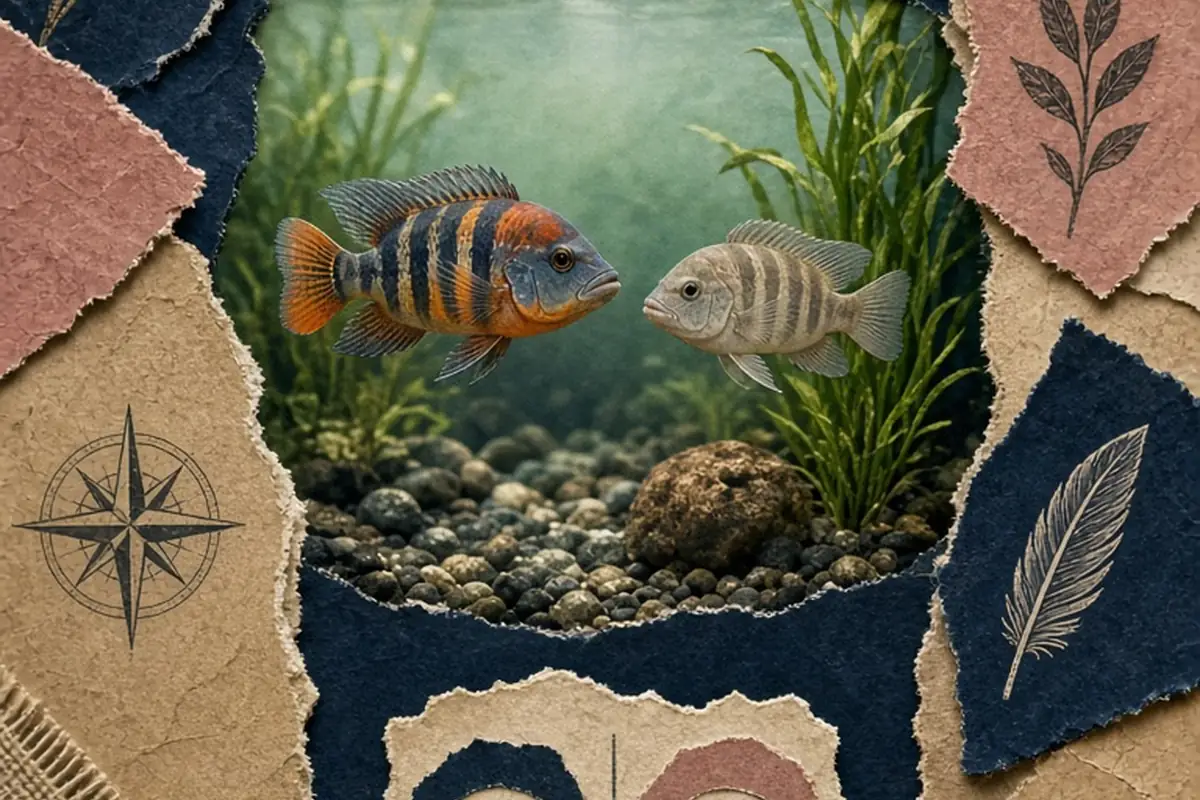
To tell male from female cichlids reliably, inspect the genital papillae through venting. A male displays two equal-sized openings, while a mature female has a distinctly larger second pore for egg laying. Secondary traits like brighter coloration, pointed dorsal and anal fins, egg spots, and territorial displays often suggest sex in adult fish, but venting remains the only definitive visual method across most species.
Cichlids represent one of the most diverse and vibrant families in the aquarium hobby, yet managing their social dynamics requires knowing the biological sex of your fish. Because cichlid aggression often stems from territory disputes and breeding pressure, correctly identifying males and females helps aquarists balance sex ratios, curb tank violence, and create conditions where every fish can thrive.
The Venting Method: The Gold Standard for Accurate Identification
Venting involves turning an adult fish over to inspect the vent and genital papilla located on its underside just in front of the anal fin. While observing colors and fins provides educated guesses, physical venting is the most dependable non-surgical technique for determining biological sex. Every cichlid has two distinct openings in this region: the anus, which sits closer to the head, and the genital pore, positioned closer to the tail. In males, these two openings are roughly identical in size and shape, often described by aquarists as looking like two small, matching circles or an 'o o' configuration.
In contrast, sexually mature females develop an enlarged genital pore to accommodate the passage of eggs. When inspecting a female, the anus appears small while the reproductive opening behind it is significantly broader and slightly raised, producing a recognizable 'o O' pattern. To vent safely, net the fish gently, cradle it in a wet, soft microfiber cloth or aquarium-safe specimen container, and use a bright directional light and a small magnifying glass. Keep the fish moist at all times and limit air exposure to no more than twenty to thirty seconds.
While venting is exceptionally reliable for mature fish, it has clear limitations. Attempting to vent juveniles under two to three inches long often yields inconclusive results because the reproductive tract is not yet fully differentiated. In addition, handling fish inevitably introduces stress and risks dislodging protective slime coats. Aquarists should reserve physical venting for situations where visual cues fail or when accurate sex ratios are vital for stocking plans.
Coloration Patterns and Sexual Dimorphism
In many cichlid species, coloration serves as the most immediate indicator of sex, a phenomenon known as sexual dimorphism. In the wild, male cichlids frequently display brilliant, saturated hues to attract mates and signal territorial dominance to rivals, whereas females often sport muted, mottled, or earthy tones designed to blend into rocky crevices or sandy substrates. This dynamic is especially visible among Lake Malawi peacock cichlids (Aulonocara), where adult males flaunt radiant blues, yellows, and metallic sheens while females retain a uniform brownish-gray shade.
Color indicators extend to New World species as well, though the patterns shift depending on genus. In German Blue Rams (Mikrogeophagus ramirezi), females reveal a distinct pink or magenta blush across their bellies, particularly when conditioning to spawn, and the black spot on their flanks often contains scattered iridescent blue scales. Adult male rams, by contrast, lack the pink belly wash, display solid black lateral patches without reflective blue flecks, and exhibit more intensely saturated yellow and blue tones across their heads.
Relying solely on color carries significant trade-offs, however. Subdominant males in community setups frequently suppress their coloration to look like females, allowing them to evade the wrath of the tank's dominant alpha male. Once moved to a separate aquarium, an apparent female may suddenly color up into a vibrant male within days. Furthermore, commercial captive breeding has produced synthetic color morphs and hormone-treated juveniles that obscure natural dimorphism, making color an unreliable standalone metric in young stock.
Fin Shape, Length, and Egg Spot Development
Fin morphology provides another valuable visual tool when assessing mature specimens. Across a wide variety of cichlid genera, males tend to develop longer, more tapered dorsal and anal fins that trail backward into sharp points. In species such as Angelfish (Pterophyllum scalare) and Severums (Heros severus), these extensions can become quite pronounced. Mature females, on the other hand, generally display shorter, more rounded dorsal and anal fins that curve smoothly toward the caudal peduncle without extending far past the tail base.
Egg spots, or ocelli, represent a specialized fin marking found on the anal fins of many African mouthbrooders, particularly Mbuna and Peacocks. These circular yellow, orange, or reddish spots mimic actual fish eggs. During courtship, the female attempts to pick up these dummy eggs with her mouth, allowing the male to fertilize the real clutch she has already gathered. Traditionally, hobbyists viewed egg spots as an exclusive male trait, noting that males often feature numerous vivid, well-defined spots ringed with a dark halo.
Nevertheless, relying on fin characteristics requires caution. Modern breeding lines and wild variation mean that many female Mbuna also carry faint or even prominent egg spots, dispelling the myth that spots guarantee a male fish. Furthermore, physical conflict within crowded aquariums frequently leads to nipped, shredded, or regenerating fins, which can temporarily distort the natural silhouette and mislead the observer about whether a fin edge is naturally rounded or mechanically damaged.
Cranial Morphology and Body Proportions
Physical proportions and body contours often separate males from females as cichlids reach full maturity. Males typically develop deeper bodies, broader foreheads, and a more robust overall skeletal frame. A prominent example of this distinction is the nuchal hump, a fatty cranial deposit that develops directly above the eyes. While seen in extreme forms in hybridized Flowerhorns, natural nuchal humps appear in wild species such as Cyphotilapia frontosa, Midas cichlids (Amphilophus citrinellus), and Lionhead cichlids (Steatocranus casuarius).
In species displaying this trait, males grow significantly larger humps that project outward as a sign of breeding maturity and status. Female Frontosa or Midas cichlids may display a slight forehead curve or minimal swelling, but their profiles remain flatter and more hydrodynamic. Similarly, female cichlids across most species feature a fuller, rounder abdominal curve, especially when carrying mature roe, giving their lower torso a plump appearance compared to the more streamlined, athletic taper of males.
The primary limitation of judging cranial contours and body depth is timing. Nuchal humps and distinct abdominal swelling rarely develop in young fish, often appearing only after twelve to eighteen months of careful feeding and stable water conditions. In addition, an overweight male cichlid can easily be mistaken for a gravid female, while an aging, dominant female may develop a slight cranial bump, blurring the morphological line in older aquariums.
Behavioral Patterns and Territorial Dynamics
Watching how individual fish interact with their environment and tankmates provides crucial clues about sex. Male cichlids tend to establish defined territories early, spending considerable energy defending a patch of rocks, a flat slate, or a dug-out sand pit. Males perform ritualized displays to showcase their vitality, flaring their gills, locking jaws with rivals, and shivering their bodies in front of passing females. They are also relentless diggers, frequently moving large mouthfuls of gravel to construct spawning pits or clear surfaces.
Female behavior tends to be more conservation-minded outside of active spawning periods. In maternal mouthbrooding species, females reveal their identity through brooding actions. After spawning, a female scoops fertilized eggs into her buccal cavity, causing her lower jaw and throat area to drop into a noticeable pouch. A holding female stops eating or takes only minute food particles, hovering in quiet, sheltered regions of the aquarium to protect her brood while remaining guarded against harassment.
Despite these general patterns, behavioral sexing can be deceptive. When a dominant male is absent from a community, the most assertive female in the tank will often adopt male-typical territorial behaviors, claiming caves and chasing subordinates. Conversely, subordinate males frequently suppress aggressive displays entirely, lingering near the surface or swimming peacefully among females to avoid being attacked, which can cause an aquarist to misidentify their temperament.
Species-Specific Exceptions: When the Usual Rules Flip
While broad guidelines assist with many species, cichlid diversity includes fascinating exceptions where traditional gender markers are completely reversed. The most famous example is the Kribensis (Pelvicachromis pulcher), a dwarf cichlid native to West Africa. In typical cichlid species, the male is the brightly colored showpiece, but in Kribensis, the female displays the most vivid coloration. During courtship, female Kribensis develop intense cherry-red or purple bellies, a golden dorsal sheen, and a compact, rounded body that outshines the longer, more subtly shaded male.
Another distinct category involves monomorphic species where males and females look practically identical to the human eye. In Discus (Symphysodon) and many Central American riverine species, both sexes share the same patterning, fin morphology, and color saturation. Even experienced breeders struggle to separate male and female Discus visually until the fish actively pair off, clean a vertical surface, and drop their breeding tubes during oviposition. In these species, waiting for an egg-laying event is often the only non-invasive verification available.
Recognizing these species-specific variations prevents costly stocking mistakes. Assuming that the brightest fish in a tank is always male can lead an aquarist to introduce incompatible specimens, skew breeding projects, or exacerbate tank violence. Always research the precise taxonomic group or lake of origin for your specific cichlid before applying general visual rules.
Structuring Balanced Tank Ratios for Long-Term Peace
Accurately sexing cichlids is rarely just an academic exercise; it forms the foundation of tank harmony. In many popular African setups, particularly with polygynous mouthbrooders from Lake Malawi, keeping a one-to-one male-to-female ratio is a recipe for disaster. An eager male will continually pursue a single female, stressing her to exhaustion or physical injury. Instead, experienced hobbyists use visual sexing and venting to build harem groups containing one male to three, four, or more females, diffusing male attention across several individuals.
For pairing species like South American Severums, Convicts, or Firemouths, the objective is often securing a compatible bonded pair. Introducing two males by mistake frequently results in relentless combat until one claims the entire tank, while introducing two females may lead to unfertilized egg clutches that spoil and foul water parameters. Knowing how to tell sexes apart allows you to rehome surplus males or introduce properly matched females before irreversible territory damage occurs.
When managing community tanks, regular monitoring is necessary because social dynamics change as fish grow. A subdominant fish identified as a female six months ago may mature into a secondary male as tank demographics shift. By routinely observing fin development, checking behavior during feeding, and confirming suspect individuals through venting, aquarists can intervene early with tank dividers or stock adjustments before territorial conflicts cause physical harm.
Frequently asked questions
At what age or size can you accurately determine a cichlid's sex?
Most cichlids can be sexed visually once they reach sexual maturity, which typically occurs between six and twelve months of age or at roughly two and a half to three inches in length. Attempting to sex fry or small juveniles using fins or color is largely guesswork because their reproductive systems and secondary sexual traits have not yet developed.
Do female cichlids ever display egg spots on their anal fins?
Yes, female cichlids in many African mouthbrooding species can develop egg spots on their anal fins. While female spots are generally fewer in number, smaller, and less brilliantly defined than those on dominant males, their presence alone does not confirm that a fish is male.
Can a cichlid change its biological sex in the aquarium?
True cichlids are not known to change biological sex; an individual is genetically determined as either male or female from fertilization. However, subdominant males can suppress their color and mimic female behavior to avoid aggression, leading aquarists to mistakenly believe a sex change occurred when the fish later colors up.
What should I do if two cichlids of unknown sex are constantly fighting?
Intense fighting often indicates two males disputing territory or an aggressive male targeting an unreceptive female. You should temporarily separate the fish using an aquarium divider, verify their sex through careful venting, and rearrange the tank decor to break established territories before reuniting them.
Your next step
Inspect your adult cichlids during routine maintenance by comparing fin sharpness, color intensity, and underbelly venting pores to adjust your tank ratios and maintain a peaceful aquarium community.