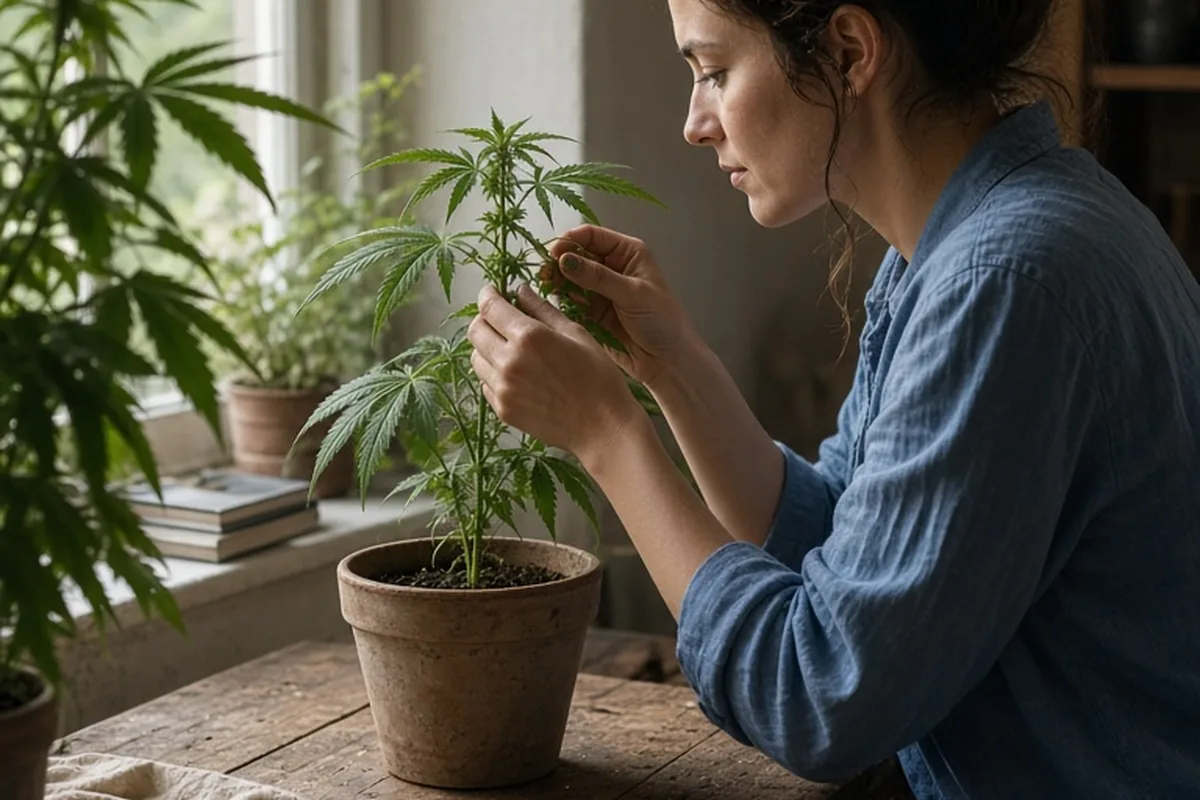
To tell male from female pot plants, inspect the nodes where branches meet the main stem during early flowering. Female plants develop teardrop-shaped calyxes that produce two slender, white hair-like pistils. Male plants form smooth, round pollen sacs that hang downward in small clusters like tiny balls, with no white hairs. Identifying these structures early allows you to isolate or remove males before pollen releases.
Sexing cannabis plants accurately is a foundational skill for home growers who want to produce resinous, unseeded flowers. Because male plants release pollen that causes females to redirect energy toward seed development, catching anatomical markers early protects your crop quality and overall garden yield.
Locating Nodes and Understanding Pre-Flower Development
Identifying the sex of a cannabis plant begins with knowing where to inspect the plant structure. Pre-flowers, the earliest visible signs of a plant sex, emerge at the nodes along the main stalk and primary branches. A node is the exact junction where a fan leaf stem and an auxiliary branch connect to the central stem. These regions act as the primary developmental hubs where hormonal shifts trigger reproductive organ growth once the plant reaches physiological maturity.
To inspect these sites effectively, examine the upper third of the plant canopy where new growth develops first, usually starting between the fourth and sixth week of the vegetative stage. Using a standard ten-times or thirty-times jeweler loupe or a handheld magnifying glass allows you to distinguish microscopic tissue variations before they become obvious to the naked eye. Inexperienced eyes often confuse stipules, which are tiny, pointed green leaflet growths naturally present at every node on both sexes, with actual reproductive organs. True pre-flowers emerge directly behind or beside the base of the stipule tucked right into the node crook.
A practical limitation during this early phase is that some slow-maturing strains will show vague swelling that looks ambiguous for several days. Attempting to force an early diagnosis on an indistinct node can lead to accidentally removing a healthy female plant. When in doubt, waiting four to seven days for the structure to elongate or show hair-like pistils provides definitive confirmation without creating any risk of premature pollination.
Visual Characteristics and Anatomy of Female Plants
Female cannabis plants are cultivated primarily because they produce large, resin-coated floral clusters known as buds. When a female plant enters the pre-flowering stage, it produces a small, tear-shaped or pear-shaped structure called a bract or calyx. At the apex of this calyx, two distinct, wispy white hairs called stigmas or pistils will emerge and push outward. These delicate white hairs serve the biological purpose of catching airborne pollen grains to initiate seed production.
As the flowering cycle progresses, these calyxes multiply rapidly along the stems, clustering tightly together at the internodes and branch terminals to form dense colas. The presence of vibrant white stigmas standing upright or curling slightly outward is the single most reliable confirmation that a plant is female. Over time, as unpollinated female flowers mature, these pistils will gradually shift from crisp white to amber, red, or golden brown, while the surrounding bracts swell with aromatic trichome glands.
For example, a grower inspecting a six-week-old plant under bright, clean white light will see two bright white hairs protruding outward like a tiny V from a green seed pod structure. A common point of confusion is mistaking new vegetative shoot tips for pistils. Vegetative shoots are solid green, segmented, and wider at the base, whereas stigmas are fine, translucent or milky-white, and have a fuzzy, thread-like texture along their entire length.
Visual Characteristics and Growth Habits of Male Plants
Male cannabis plants serve the reproductive function of manufacturing and dispersing pollen. Instead of calyxes with white stigmas, male plants develop smooth, rounded pre-flower pods that resemble miniature spheres or tiny footballs. These structures are technically called staminate flowers or pollen sacs. In their earliest stages, they appear as small, stemless green balls nestled against the node, lacking any hairs, fuzz, or white filaments.
As male pre-flowers develop, they begin to form miniature stalks or stems called pedicels that cause the sacs to dangle slightly downward in loose clusters. These clusters closely resemble tiny bunches of miniature grapes. Inside each individual sac, anthers produce fine powdery pollen. When the sacs reach full maturity, the exterior petals split open into a bell shape, releasing millions of microscopic pollen grains into the surrounding air currents.
Beyond their nodal anatomy, male plants frequently exhibit distinctive overall growth habits. They tend to grow taller and more rapidly than females during the late vegetative phase, developing thinner stems, fewer lateral branches, and sparser foliage. This vertical elongation is an evolutionary adaptation designed to elevate pollen dispersal above the surrounding canopy. However, relying exclusively on plant height or stature is unreliable; physical verification of pollen sacs at the nodes remains the only definitive visual test.
Recognizing Hermaphrodite Characteristics and Dual Sex Traits
Cannabis is a naturally dioecious species, meaning individual plants are typically distinctly male or female. However, under certain conditions, a plant can express monoecious traits by developing both male and female reproductive organs, a state commonly referred to as a hermaphrodite or hermie. Hermaphroditism usually occurs when a female plant undergoes environmental stress, such as light leaks during the dark cycle, irregular watering, severe nutrient burn, or excessive heat.
There are two primary visual forms of hermaphroditic growth. In the first form, true male pollen sacs and female calyxes appear concurrently at different nodes across the plant. In the second form, often called anthers or nanners, small, yellow, banana-shaped pollen-producing structures push directly out from the center of swelling female bud clusters without forming a protective outer sac. These exposed anthers can release pollen immediately without needing to open normally.
When managing hermaphrodites, practical decisions depend on the extent of the development. If a plant displays only one or two isolated nanners late in the flowering cycle, carefully plucking them with sterilized tweezers dipped in water can sometimes salvage the harvest. However, if a plant exhibits widespread pollen sac formation across multiple branches, removing the entire plant is the safest course of action to prevent extensive seed formation across the entire grow area.
Timing, Light Cycles, and Early Sexing Methods
Understanding the timeline of plant maturation allows you to prepare for sex identification before pollen becomes an active hazard. Photoperiod cannabis plants generally remain in a purely vegetative state under eighteen hours or more of daily light. Many photoperiod varieties will naturally display faint pre-flowers after four to six weeks of vegetative growth as they reach sexual maturity, even while remaining under an eighteen-hour light schedule.
When indoor growers flip the lighting cycle to twelve hours of uninterrupted darkness and twelve hours of light, flowering hormones rapidly surge. Male plants almost always reveal their sex first, typically showing distinct pollen sacs within three to seven days after the lighting switch. Female plants usually follow shortly after, displaying clear white stigmas within seven to fourteen days. Autoflowering cultivars follow an internal chronological clock rather than light changes, typically revealing their sex automatically around three to four weeks from germination.
For growers who need earlier certainty, alternative methods exist. Some growers take a small cutting from a vegetative plant, root it in water or a starter plug, and place that isolated clone under a twelve-hour light cycle in a separate room to force early sex expression within ten days. Additionally, commercial genetic testing laboratories can analyze a small leaf punch from a two-week-old seedling to determine plant sex via DNA assays, though this introduces added testing costs.
Safe Removal and Pollen Containment Protocols
Once a plant is confirmed as an unwanted male, removing it safely without contaminating the surrounding space requires deliberate care. Immature pollen sacs are tightly closed and completely harmless, but mature sacs can rupture easily if bumped, shaken, or exposed to strong airflow. Cannabis pollen is exceptionally lightweight and can travel on draft currents or cling to clothing, potentially pollinating females dozens of yards away outdoors or throughout an indoor grow room.
To remove a male plant safely, begin by turning off all oscillating fans, exhaust systems, and intake blowers in the room to eliminate air movement. Gently mist the entire male plant with plain tap water from a spray bottle. Water instantly neutralizes and clumps viable pollen, rendering it unable to travel or fertilize female stigmas. Next, slowly slip a large plastic trash bag over the top of the plant, drawing it downward all the way to the base of the container before sealing the opening around the main stalk.
Sever the main trunk below the sealed bag near the soil line and carry the bagged plant out of the growing area immediately. After disposal, thoroughly wash your hands, change your clothes, and wipe down your grow space walls and tools with a damp towel before working with your remaining female plants. Taking these precautions ensures that stray pollen does not compromise your unseeded crop.
Frequently asked questions
Can you determine the sex of a cannabis seed just by looking at it?
No, it is impossible to determine the sex of a cannabis plant by inspecting the physical appearance, shape, color, or markings of the seed. Seed sex is determined genetically and can only be identified through laboratory DNA testing or by observing anatomical pre-flowers as the plant matures.
How long do you have to remove a male plant before it pollinates females?
You generally have between one to two weeks from the first appearance of male pre-flowers before the pollen sacs mature, swell, and burst open. Checking your plants daily during the first two weeks of the flowering cycle ensures you can spot and remove males long before any pollen is released.
What happens if a male plant pollinates a female cannabis plant?
When a female plant is pollinated, it shifts its metabolic energy from producing floral mass and cannabinoid-rich resin toward developing hard seeds within the calyxes. This results in smaller, lower-potency buds that are filled with seeds, which crackle and produce harsh smoke if combusted.
Do male cannabis plants produce any usable flower buds?
No, male cannabis plants do not produce floral buds or colas. They exclusively form clusters of pollen sacs that dry up and shed pollen, containing only trace levels of cannabinoids compared to unfertilized female flowers.
Your next step
Inspect the upper stem nodes of your plants daily under bright light during the first two weeks of the flowering cycle, and gently bag, cut, and discard any plant that forms round, hairless pollen sacs.