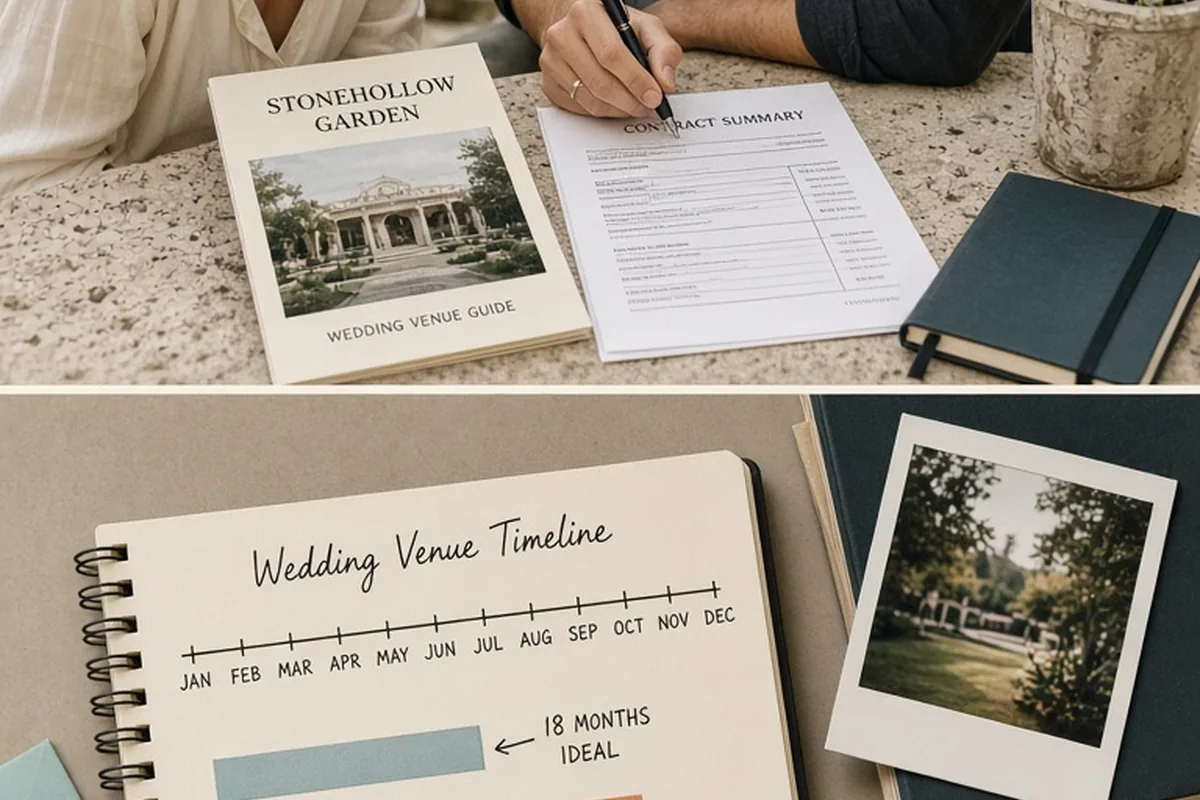
Couples generally book a wedding venue between nine and eighteen months before their target wedding date to secure preferred days and lock in current contract rates. Booking within this window prevents rush surcharges and gives you sufficient leverage to review the contract for unlisted expenses, such as administrative service fees, mandatory vendor buyouts, setup and breakdown hourly rates, security minimums, and unexpected corkage or plating charges.
Securing a wedding venue is often the largest single contractual commitment in wedding planning, yet the listed rental rate rarely reflects the final balance on the master invoice. Knowing both when to initiate the reservation process and how to audit every line item in the contract allows couples to protect their overall budget before committing nonrefundable deposits.
Ideal Booking Timelines and Seasonality Considerations
The ideal timeline for reserving a wedding venue depends on geographic demand, seasonal popularity, and day-of-week preferences. Prime weekend dates during peak wedding seasons—typically late spring through early autumn in temperate climates—frequently book out over a year in advance. Securing your venue early not only guarantees your date but also locks in pricing terms, protecting your budget against scheduled annual rate increases that venues implement between calendar years.
Conversely, couples planning during off-peak seasons, such as mid-winter, or considering non-traditional celebration days like Thursdays, Fridays, or Sundays, often find greater availability closer to their event date. While booking with a shorter lead time can occasionally open opportunities for date-specific discounts or waived room rental fees, it significantly reduces your negotiating leverage regarding mandatory package add-ons and leaves less time to vet secondary vendors whose requirements might trigger venue-specific fees.
Decoding Administrative Charges and Mandatory Venue Fees
A common point of confusion on venue billing statements is the administrative fee or house service charge. Many couples mistake this percentage charge for an automatic gratuity intended for service staff, only to discover later that it functions as general venue overhead and operational revenue. Because this fee does not replace staff tips, couples end up paying both the house administrative fee and separate gratuities for event managers, bartenders, and banquet servers.
When reviewing initial proposals, ask the venue coordinator to define precisely where the administrative fee is allocated and whether tips are legally included. Furthermore, verify whether state or local sales taxes apply solely to food and beverage items or to the administrative fee and overall space rental as well. In several jurisdictions, service charges and production fees are taxable, which compounds the final total well beyond the base figure listed in promotional brochures.
Catering Restrictions, Plating Costs, and Outside Food Penalties
Venues that require the use of an in-house culinary team or an exclusive catering partner list often tie couples to preset per-person spending minimums. If your guest count drops below initial projections, you remain financially responsible for meeting the agreed food and beverage minimum, which may require upgrading menu selections, adding late-night stations, or funding an expanded bar package to avoid paying for unserved meals.
If a property permits outside catering, it frequently attaches logistical fees to offset the loss of internal food revenue. These costs can include kitchen rental fees, trash hauling charges, plating fees per guest for outside desserts, and mandatory cleaning fees assessed if the outside crew does not return the prep space to a baseline standard. Request a full breakdown of kitchen access rules, refrigeration limits, and culinary cleanup obligations before deciding between an all-inclusive and an open-vendor property.
Beverage Policies, Bartender Staffing, and Corkage Terms
Bar service terms contain several operational expenses that rarely appear on standard marketing sheets. Venues providing in-house alcohol service often charge per-bartender hourly rates, bar setup fees, barback support charges, and mandatory security officer fees once guest counts exceed specified thresholds. Clarify whether your quoted package includes glassware, ice, garnishes, and standard mixers, or if those elements are billed as supplementary line items.
Venues that permit hosts to supply their own alcohol typically assess a corkage fee for every bottle opened on site. While bringing your own wine and spirits can offer significant savings on wholesale costs, a high per-bottle corkage fee can eliminate those financial advantages entirely. Ensure you understand whether corkage is billed per opened bottle, per total bottle delivered, or as a flat per-person beverage service charge.
Access Windows, Setup Constraints, and Overtime Penalties
The total duration of your contracted rental window is just as critical as the start time of the ceremony. Contracts frequently specify an overall rental period that must encompass florist setup, band or sound system load-in, decor arrangement, guest arrival, the reception, and complete breakdown. If your decorative or production setup requires four hours but the venue only grants two hours of access prior to guest arrival, you will face early-access hourly fees.
Overtime provisions at the conclusion of the evening carry some of the steepest penalty rates in the event industry. If guests linger past the agreed curfew, or if teardown crews require additional time to load equipment into transport vehicles, venues routinely charge substantial fractions of an hour or full-hour overtime rates. Review load-in and load-out access schedules directly with your coordinator, florist, and entertainment providers before signing to ensure the contracted access window matches the physical scope of your event.
Technical Infrastructure, Power Needs, and AV Surcharges
Historic properties, outdoor estates, private ranches, and raw industrial spaces frequently lack the commercial electrical infrastructure required to power professional sound systems, theatrical lighting rigs, photo booths, and commercial warming equipment simultaneously. Venues may require couples to hire an on-site facilities technician or contract an external power generator to prevent tripped circuits during the reception.
Additionally, properties equipped with built-in audiovisual systems often charge an integration or patch fee for external disc jockeys or bands to connect into the venue's house speakers. Ask the venue management for an electrical distribution map and a schedule of technical service fees to share with your entertainment and production teams during initial vendor consultations.
Insurance, Security Minimums, and Municipal Noise Compliance
Many venues mandate that couples purchase a single-event general liability insurance policy that names the property owner as an additional insured party. Some locations also require host liquor liability riders and proof of commercial insurance from every independent vendor stepping onto the property. Confirming these requirements early ensures you can factor policy premiums and vendor compliance checks into your overall budget plan.
Local municipal ordinances and residential zoning laws often dictate strict sound curfews and security personnel minimums. If a venue is situated near residential areas, outdoor music amplification may be prohibited after a specific evening hour, forcing you to move guests indoors or arrange silent-disco solutions. Furthermore, contracts may require one dedicated security guard for every specified increment of guests, with the labor billed directly back to your final master invoice.
Contract Audit and Payment Schedule Verification
Before delivering an initial deposit, request a fully itemized pro-forma invoice that models your expected guest count and service choices with every tax, house fee, and potential mandatory add-on applied. Reviewing this comprehensive mock invoice highlights discrepancies between initial brochure estimates and the legal reality of the contract, giving you clear points of negotiation before executing the agreement.
Pay careful attention to the payment milestone schedule, nonrefundable deposit terms, and cancellation policies. Clarify what happens to advance payments if an unexpected emergency forces a date change, whether deposits can transfer to a future open date, and how damage deposits are held and returned. Securing written clarification on deposit refund timelines and dispute resolution terms protects your funds throughout the planning lifecycle.
Frequently asked questions
Is an administrative fee on a venue contract the same as a tip for the staff?
No. In most event contracts, administrative or house fees are retained by the venue management to cover administrative overhead, facility maintenance, and business operations. Unless your contract explicitly states that the service charge is distributed directly to banquet captains, bartenders, and servers, plan to budget separately for staff gratuities.
What questions should I ask a venue about setup and breakdown time?
Ask specifically how many hours before the event start time your vendors can access the space, and how much time is allocated for clean-up after the event ends. Clarify whether early load-in or late load-out is permitted and what hourly rates apply if your decorators, florists, or musicians exceed the allotted window.
Can I negotiate unlisted fees off a venue contract before signing?
Yes. Before signing the contract and paying a deposit, you have the greatest negotiating leverage. You can request waivers for cake-cutting fees, corkage charges, extra setup hours, or outside vendor buyout fees, especially when booking non-peak dates or dates with lower general demand.
Why do some venues charge outside vendor buyout fees?
Venues charge outside vendor fees to compensate for the lost revenue or commission they would normally receive from their preferred partner network. These fees also account for the additional coordination required when working with vendors unfamiliar with the venue's rules, electrical setup, and loading policies.
Your next step
Request a complete, itemized draft invoice with all administrative charges, mandatory staffing fees, and estimated local taxes applied before submitting your initial venue deposit.