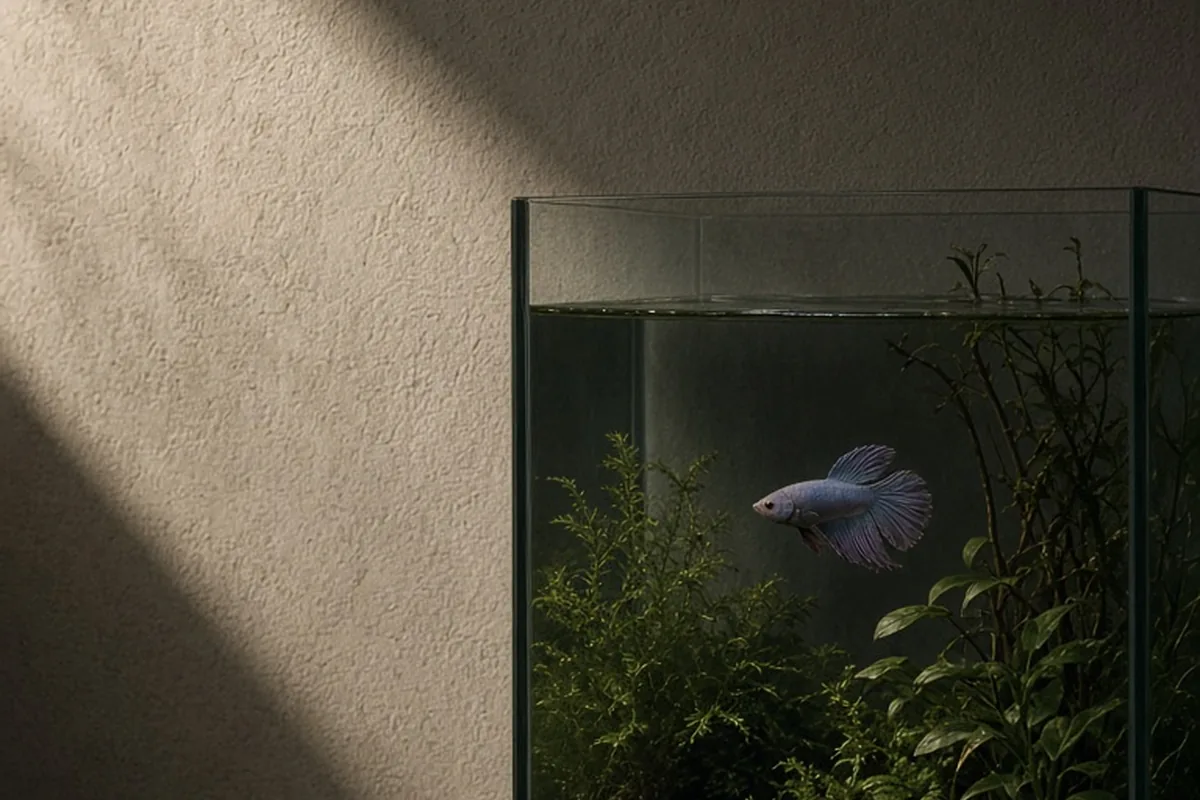
You should keep only one female betta in a 5-gallon tank. While female bettas are often perceived as peaceful community fish, they are still territorial and will fight if confined together. Creating a female group, known as a sorority, requires a much larger setup of at least 20 to 30 gallons with heavy plant cover to safely disperse natural aggression.
Setting up a compact aquarium offers a rewarding way to care for aquatic life, but stocking decisions directly determine the long-term health and stability of your ecosystem. Understanding how fish behavior interacts with tank volume ensures you build an environment where your pet can thrive rather than merely survive.
The Biological and Territorial Realities of Five-Gallon Tanks
A 5-gallon aquarium provides an excellent home for a single female betta, but it does not have the physical footprint or water capacity to house more than one. In aquatic environments, territory is defined not just by gallons, but by horizontal swimming space, broken sightlines, and established grazing zones. In a 5-gallon tank, which typically measures roughly 16 inches long by 8 inches wide, there is simply no space for two fish to establish independent territories. Any fish placed in this volume will constantly cross paths with the other, triggering defensive posturing and territorial disputes.
Beyond behavioral constraints, biological waste management is tightly limited in small volumes. A single female betta generates a modest bioload that a mature biological filter can easily process. Adding a second or third fish doubles or triples the organic waste, leading to rapid accumulations of ammonia and nitrite. Because small water volumes experience faster chemical fluctuations than larger systems, crowding creates an unstable environment where water quality can plummet in hours, putting every occupant at severe risk of respiratory distress and systemic infection.
Understanding Female Betta Temperament and Social Hierarchy
A widespread misconception in the aquarium hobby is that female bettas lack the aggressive instincts of their male counterparts. While males are notoriously intolerant of other males, female Betta splendens also possess strong territorial drives and an innate need to establish a dominance hierarchy. When female bettas are kept together, they do not simply coexist in harmony; they actively compete for dominance through flaring, chasing, fin nipping, and physical displays until an order is set.
In a spacious natural setting or a large aquarium, a subordinate female can retreat beyond the dominant female's field of vision to signal submission and avoid harm. In a 5-gallon tank, escape is impossible. The dominant fish will continually harass the subordinate, preventing her from resting, exploring, or reaching the surface for food and atmospheric air. Over time, the subordinate fish will suffer chronic exhaustion, loss of color, clamped fins, and physical injuries, while the dominant fish experiences continuous stress from defending an unmanageable space.
Health Risks Associated with Crowding Small Aquariums
Housing multiple bettas in an undersized aquarium triggers severe physiological stress that suppresses their immune systems. When fish are subjected to chronic conflict, their bodies release elevated levels of cortisol, which dampens their natural disease resistance. Even minor physical damage from nipping can quickly become infected by opportunistic pathogens that naturally exist in aquarium water, turning mild scuffles into life-threatening illnesses.
Common outcomes of crowded small tanks include bacterial fin rot, columnaris, and parasitic outbreaks such as ich. Columnaris is especially dangerous because it spreads rapidly through damaged tissue and warm water, often wiping out every fish in a confined tank within days. Treating these conditions in a shared, unstable 5-gallon system becomes extraordinarily difficult because many medications further compromise the beneficial bacteria in your filter, creating secondary ammonia spikes that compound the initial disease.
Designing the Ideal Five-Gallon Habitat for a Single Female
When kept individually, a female betta can live an active, enriched life in a 5-gallon setup. To support her welfare, equipment selection is critical. Bettas require warm water, ideally maintained between 78 and 80 degrees Fahrenheit (25.5 to 26.5 degrees Celsius), which necessitates an adjustable 25-watt or 50-watt aquarium heater. Filtration must be gentle, as bettas possess delicate labyrinth organs and struggle against turbulent water movement. A small sponge filter driven by an adjustable air pump or a baffled low-flow internal filter provides ideal biological filtration without pushing the fish around.
Aquascaping plays an essential role in enrichment. While female bettas generally have shorter fins than long-finned males and swim more actively, they still appreciate structural complexity. Incorporate live plants such as Anubias, Java Fern, and floating species like Amazon Frogbit to soften incoming light and provide resting spots near the surface. Add smooth driftwood or ceramic caves with no sharp edges to give your betta places to explore and claim. This rich single-occupant environment allows her natural curious personality to flourish without fear or conflict.
Safe Alternative Tankmates for a Five-Gallon Setup
If you want visual variety in your 5-gallon tank without risking fish-on-fish aggression, certain peaceful invertebrates make viable companions. A single Nerite snail is one of the most effective choices because it consumes algae, produces minimal waste, and possesses a flat, heavily armored shell that prevents curious bettas from nipping its soft tissue. Mystery snails are also popular, though their larger adult size and longer antennae can occasionally attract unwanted attention from an assertive female betta.
Dwarf freshwater shrimp, such as Amano shrimp or adult Cherry shrimp, can also share the space if your individual betta has a mild temperament. However, there is an inherent trade-off: bettas are opportunistic carnivores, and some will view small shrimp as live food. If you choose to introduce shrimp, ensure the tank is densely planted with fine-leafed flora like Java Moss or Christmas Moss, which creates micro-refuges that adult shrimp can enter but the betta cannot reach. Always monitor interactions closely during the first few days after introduction.
Proper Space and Requirements for Keeping a Betta Sorority
If your long-term goal is to keep multiple female bettas together, you must transition from a nano tank to a dedicated sorority aquarium. A safe sorority requires a minimum tank size of 20 to 30 gallons, with long horizontal dimensions prioritized over tall vertical designs. The group should consist of at least five to seven females introduced simultaneously. Having a larger group diffuses aggression across the entire population, preventing any single fish from bearing the brunt of a dominant female's territorial behavior.
A successful sorority setup demands extensive preparation and careful ongoing maintenance. The tank must be heavily aquascaped with dense thickets of stem plants, tall driftwood branches, and multiple visual barriers that break direct lines of sight across the aquarium. Furthermore, keepers must maintain one or more cycled backup tanks on standby, because individual temperaments vary widely. If a particular female proves persistently hyper-aggressive or excessively timid, she must be permanently separated into her own independent aquarium to preserve the safety of the entire group.
Frequently asked questions
Can I use a tank divider to keep two female bettas in a 5-gallon tank?
Using a divider in a 5-gallon tank reduces each fish's usable space to only 2.5 gallons, which is too small for stable heating, filtration, and swimming enrichment. Additionally, the constant scent and visual presence of another betta through the divider causes chronic low-grade stress.
Are female bettas less aggressive than male bettas?
Female bettas are generally less aggressive toward different species than males, but they are still territorial toward their own kind. When kept in close quarters, females will fight, nip fins, and enforce hierarchies just as vigorously as males.
How often should I change the water for one female betta in a 5-gallon tank?
In a fully cycled, filtered, and heated 5-gallon tank, you should perform a 20 to 25 percent water change once per week using a gravel siphon and dechlorinated water. Regular testing with a liquid test kit ensures ammonia and nitrites remain at zero while keeping nitrates below 20 ppm.
What are the early signs that a betta is stressed or being bullied?
Stressed bettas often exhibit horizontal stress stripes across their bodies, clamped fins held tight against the body, pale coloration, and a reluctance to eat. They may also spend excessive time hiding near the substrate or gasping for air near the filter output.
Your next step
Focus on optimizing your 5-gallon aquarium for a single female betta by installing a reliable heater, gentle sponge filter, and live plants to provide a peaceful, healthy environment.