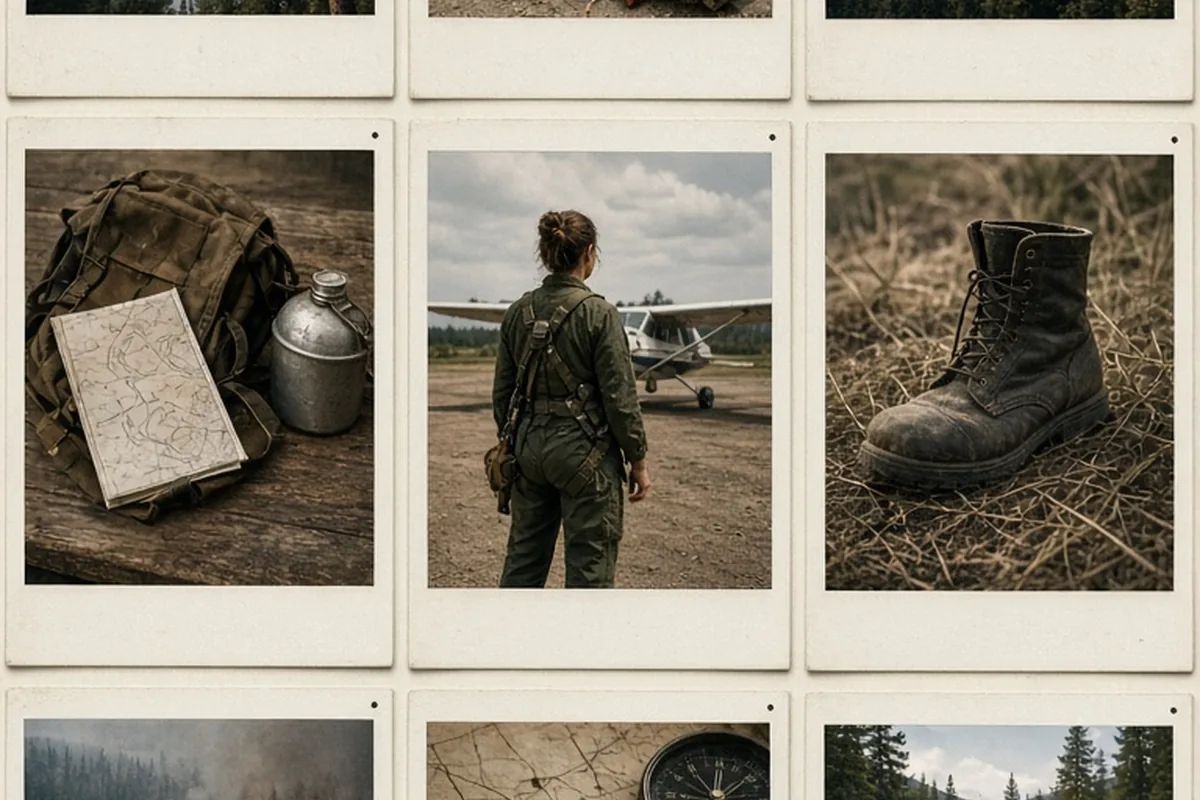
Nationwide, approximately thirty to forty women serve as active smokejumpers during a typical wildfire season, representing roughly six to eight percent of the estimated 400 to 450 total active personnel across federal agencies. Since the first woman qualified in 1981, fewer than one hundred women have ever earned smokejumper certification, reflecting intense physical demands, rigorous prerequisite requirements, and long-standing historical underrepresentation in aerial wildland firefighting.
Smokejumping represents one of the most physically demanding and logistically specialized operational roles in the entire natural resource sector. Firefighters in this discipline parachute directly into remote, inaccessible backcountry areas to establish containment lines on wildfires before they grow into unmanageable blazes. While women have jumped fires for over four decades, their presence in this high-risk discipline continues to highlight the realities of physical endurance, specialized tradecraft, and progressive institutional shifts across federal wildland agencies.
Current Ranks and Agency Distribution Across the United States
Active smokejumpers in the United States operate primarily under two federal land management entities: the United States Forest Service, which maintains seven bases across the American West, and the Bureau of Land Management, which operates two primary bases located in Alaska and Idaho. Across these nine operational jump bases, total active personnel numbers generally hover between 400 and 450 individuals each year. Within this pool, active female smokejumpers typically number between thirty and forty at any given time, with roster counts fluctuating seasonally based on rookie qualifications, career transitions, injuries, and operational deployments.
While a representation rate of six to eight percent might seem exceptionally modest when compared to broader workforce demographics, it closely parallels gender ratios found across other specialized wildland fire operations, such as Type 1 Interagency Hotshot Crews. Because smokejumping demands years of prior fireline experience before an individual is even considered for rookie training, the intake pool is inherently limited by the number of women already working within primary wildland firefighting ranks. Consequently, annual recruitment of women into smokejumper rookie classes typically ranges from one to three candidates per base in a given year, meaning that shifts of even a few departures or retirements can noticeably alter total national percentages.
Trailblazers in Aerial Firefighting: From 1981 to Today
The historical integration of women into smokejumping began in 1981 when Deanne Shulman successfully completed rookie training at the McCall Smokejumper Base in Idaho for the U.S. Forest Service. Her entry into the discipline came after navigating administrative resistance and initial institutional skepticism regarding whether women possessed the structural durability to withstand heavy parachute landings and arduous backcountry pack-outs. Shulman's qualification established an important operational precedent, confirming that technical parachute mastery and physical stamina were grounded in individual capability rather than gender.
In the decades following Shulman's historic rookie season, progress occurred at a measured pace. The Bureau of Land Management welcomed its first female smokejumper, Charlotte Larson, in 1986. Over the subsequent four decades, fewer than one hundred women in total have earned smokejumper pins across all bases combined. Today, female smokejumpers serve not only as initial attack crewmembers but also as spotters, squad leaders, loft technicians, and base managers. These professionals direct operational drops, coordinate fixed-wing aerial logistics, and help shape wildland fire leadership nationwide, permanently shifting the culture of the community from novelty to established professional peers.
The Physical Demands: Gear, Body Mass, and the Pack-Out
Smokejumpers must satisfy uncompromising standardized physical requirements regardless of sex or background. Candidate screening requires performing pull-ups, push-ups, sit-ups, and a 1.5-mile run within strict time thresholds, followed immediately by an arduous 110-pound gear pack-out over three miles of undulating terrain. While cardiovascular endurance and upper-body strength are essential, the pack-out creates a unique physiological challenge. A 110-pound load often represents a significantly higher percentage of total body weight for a lighter individual, demanding tremendous posterior-chain strength, core stability, and hip resilience to avoid debilitating musculoskeletal strain.
Parachuting mechanics also impose rigid physical parameters. Jump agencies enforce body weight limits, typically requiring candidates to weigh between 120 and 200 or 210 pounds stripped of equipment. Lighter jumpers fall closer to the lower threshold where high surface winds can cause canopy drift or canopy collapse, while heavier jumpers risk exceeding structural limits of standard ram-air or round parachutes. For female jumpers, landing on boulder-strewn slopes, timbered ridges, and uneven scree while carrying heavy protective gear requires calculated parachute maneuvering and exceptional lower-extremity bone density to absorb rapid ground impacts safely.
- Standard fitness battery: minimum of 7 strict pull-ups, 25 push-ups, 45 sit-ups, and an arduous 1.5-mile run in 11 minutes or less.
- The pack-out evaluation: carrying a full 110-pound gear bag across 3 miles of rough terrain within 90 minutes.
- Body weight compliance: maintaining an operational mass between agency-mandated limits to ensure canopy stability and safe descent rates.
Equipment Ergonomics and Technical Parachute Lofts
Historically, the gear utilized in aerial wildland firefighting was designed around the average physical dimensions of a 180-pound male firefighter. Heavy canvas jump suits, chest-mounted reserve chutes, and harness webbings often fit smaller-framed jumpers poorly, creating ergonomic vulnerabilities during tree landings or hard canopy openings. Over recent years, base parachute lofts—where smokejumpers fabricate, inspect, and repair their own jump suits, harnesses, and operational packs—have increasingly emphasized custom tailoring. Customizing the placement of harness riser points, leg straps, and internal pack frame stays allows jumpers of all statures to optimize load distribution across their skeletal structure.
Technical innovation has also shifted standard operating equipment. Many smokejumper bases have transitioned from traditional round parachutes to ram-air square canopies, which provide greater forward speed, exceptional maneuverability in mountain winds, and softer landing characteristics. This change has improved precision landings in tiny backcountry drop zones, reducing the rate of high-impact landing injuries across all crew members while allowing lighter jumpers better directional control when descending into complex alpine thermal airflows.
Crew Culture, Remote Autonomy, and Team Dynamics
Operational life at a smokejumper base differs substantially from traditional municipal firefighting or standard engine operations. Smokejumpers work in self-sufficient teams of two, four, or eight, parachuting into wilderness regions where external support may be days away. Once on the ground, firefighters must extinguish the wildfire using hand tools, chainsaws, and crosscut saws, rationing their own food and water while operating in continuous heat and smoke. Within this context, operational competence, communication efficiency, and situational awareness supersede personal identity. Respect is earned through technical precision, dependable tool work, and calm decision-making under duress.
Navigating historically male-dominated base cultures nevertheless requires resilience and boundary setting. While overt institutional barriers have diminished, female jumpers frequently note that being one of only two or three women on a fifty-person roster creates an involuntary visibility. A misstep can sometimes feel magnified under collective scrutiny, whereas achievements are viewed as validation for the entire demographic. Overcoming this dynamic relies on cultivating mutual trust, sharing relentless camp work equally, and relying on experienced mentors who reinforce accountability and inclusive operational standards without patronizing exceptions.
The Career Pathway: From Handcrews to Rookie Camp
Aspiring smokejumpers cannot simply apply out of civilian life or basic training; the position requires extensive previous wildland firefighting tenure. Prospective candidates typically spend three to six years cutting fireline on Type 1 Interagency Hotshot Crews, working on initial-attack engine modules, or serving on helitack crews. This foundational experience ensures candidates arrive with intuitive fire behavior comprehension, advanced chainsaw certifications, wilderness medical training, and extensive experience living in primitive backcountry conditions for weeks at a time.
Once accepted to a smokejumper base, candidates undergo four to six weeks of rookie training, often considered among the most grueling initial training curricula in the civilian federal service. Training includes extensive parachute ground school, tower drops, simulated parachute malfunctions, tree-climbing rescues, and daily physical PT sessions followed by loaded pack-outs. Rookie attrition is common across all demographics, as instructors deliberately test mental composure, spatial awareness, and physical endurance under sleep deprivation and sustained stress to confirm an individual will perform reliably when dropped onto an active ridge fire.
Career Longevity, Health Considerations, and Life After Jumping
The cumulative physical toll of smokejumping limits career duration for many practitioners, regardless of sex. Repeated parachute landings on steep mountain slopes, combined with carrying packs weighing over one hundred pounds out of roadless wilderness areas, cause wear and tear on lumbar joints, knees, and ankles. Jumpers actively manage longevity through off-season structural resistance training, dedicated mobility routines, and proactive injury management. For female jumpers, seasonal wildland schedules can also complicate family planning, leading some professionals to transition into related incident command or aviation management roles during different phases of their lives.
Retiring from the jump list does not mean exiting wildland fire leadership. Former smokejumpers frequently advance into influential administrative positions, serving as Fire Management Officers, District Rangers, Air Attack supervisors, and Incident Commanders on Type 1 and Type 2 Incident Management Teams. The operational discipline, risk assessment capability, and cross-agency collaborative skills developed while smokejumping provide female fire professionals with an exceptional leadership platform that shapes national forest policy and wildland safety management for decades.
Illustrative Scenarios
Illustrative Scenario: Preparing for the 110-Pound Pack-Out
Elena, an experienced hotshot firefighter weighing 135 pounds, set a goal of earning a spot in an upcoming smokejumper rookie class. While she consistently scored at the top of her crew during long-distance endurance runs and calisthenics, carrying a 110-pound pack over mountain trails presented a significant mechanical risk because the load represented over eighty percent of her total body mass. Recognizing this risk, she spent her winter off-season executing a progressive structural strength program centered on heavy deadlifts, farmer carries, and sled drags to fortify her spine, hips, and knees. Simultaneously, she consulted an active female jumper to learn frame adjustments that shifted the pack's center of mass closer to her thoracic spine, allowing her to complete the evaluation pack-out safely within the required time.
Key point: Meeting non-negotiable physical standards requires tailoring athletic conditioning to individual body mechanics rather than relying solely on generalized aerobic fitness.
Frequently asked questions
Do female smokejumpers have different physical fitness standards than male candidates?
No, physical fitness standards for smokejumpers are completely gender-neutral across all federal agencies. Every candidate must pass the identical physical screening battery, complete the same pull-up and push-up minimums, and successfully carry the 110-pound pack-out within the universal 90-minute time cap.
What are the height and weight restrictions for becoming a smokejumper?
While height requirements are generally flexible, agencies enforce strict body weight restrictions, typically requiring candidates to weigh between 120 and 200 or 210 pounds without gear. These weight brackets are determined by parachute canopy aerodynamics, descent velocity safety, and structural harness limits.
Can civilian parachutists or skydivers directly apply to become smokejumpers?
No, civilian skydiving experience does not substitute for wildland fire qualifications. Candidates must possess several seasons of arduous wildland firefighting experience, including certifications as advanced firefighters and chainsaw operators, before being considered for a rookie class.
Your next step
If you are interested in aerial firefighting, review the federal wildland qualification standards on agency portals and reach out directly to regional smokejumper bases to schedule an informational visit during the pre-season recruitment cycle.