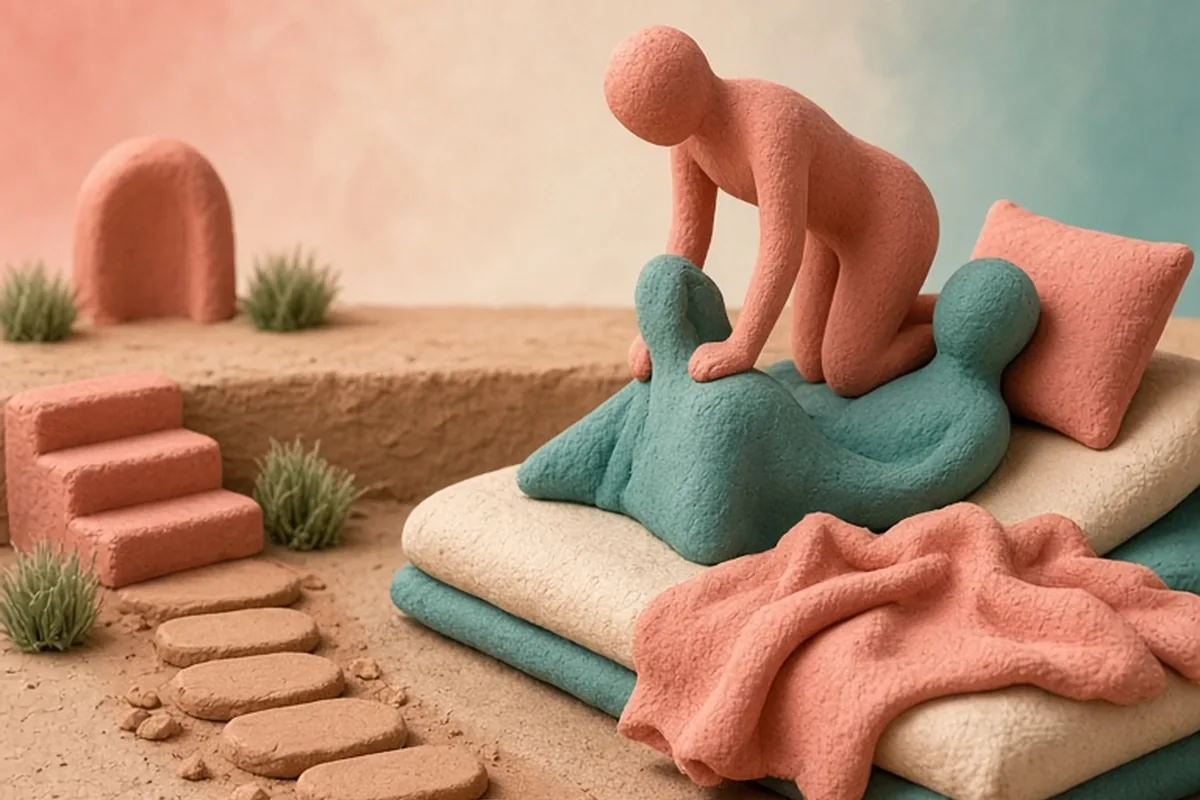
Being on top successfully comes down to finding physical stability, controlling the angle, and moving in ways that feel good for your own body rather than performing. To start, lean forward onto your hands or your partner's chest to take pressure off your thighs and knees. Shift from bouncing up and down to grinding or rocking your pelvis back and forth, which provides direct stimulation while preserving your stamina.
Taking the top position during intimacy offers full control over depth, pace, and angle, yet it frequently causes physical fatigue or performance anxiety if you rely purely on quad strength. Reframing the position as an adjustable posture built around support props, ergonomic angles, and micro-movements makes it dramatically more enjoyable and sustainable.
Finding Stable Postures to Protect Your Knees and Hips
The standard image of riding on top often involves hovering fully upright on your knees, but this posture puts intense strain on the quadriceps and knee joints within minutes. A more sustainable approach begins with distributing your body weight across multiple contact points. Instead of balancing purely on your lower legs, lower your torso forward so your forearms or hands rest on your partner's chest, shoulders, or the mattress. This immediately reduces the load on your lower body and creates a stable tripod base that lets you move your hips without fighting gravity.
Another effective adjustment is experimenting with foot and leg placement. Some people find relief by keeping their feet flat on the bed in a low, wide crouch, while others prefer laying their shins flat with their toes pointed outward. You can also sit completely down on your partner's hips to rest whenever you feel muscle fatigue setting in. For instance, if you feel your knees aching on a soft mattress, sliding forward so your knees rest on the firmer surface outside your partner's torso can alleviate joint compression while maintaining closeness.
The trade-off with resting lower or leaning forward is that it limits the range of vertical movement. However, vertical depth is rarely the primary driver of pleasure for most women, making the ergonomic stability of a lower posture well worth the reduction in up-and-down travel.
Mastering Pelvic Rocking and Grinding Over Bouncing
Many women assume that being on top requires constant vertical bouncing, which quickly leads to exhaustion and often bypasses the most sensitive anatomical areas. A far more effective technique is pelvic rocking, where you keep continuous contact and tilt your pelvis backward and forward. This movement creates steady, consistent friction against the clitoral network rather than intermittent impact, allowing you to build arousal smoothly without burning through your physical energy.
To practice this movement, settle fully onto your partner and initiate small circular or figure-eight motions with your hips. Think of the motion coming from your lower abdomen and core rather than pushing off with your feet. By rolling your hips forward, your pubic bone maintains firm pressure against your partner's body, which naturally stimulates the external clitoris. You can alternate between slow, wide circles to explore different angles and tighter, faster grinds when you want to intensify the sensation.
A practical limitation of grinding is that it produces less visual dramatic movement if your partner expects energetic motion. Openly sharing that horizontal friction feels significantly better physically helps align your partner's expectations and encourages them to enjoy the shared rhythm.
Adjusting Angles for Optimal Clitoral and Internal Stimulation
Being on top gives you total command over the angle of entry, which dramatically alters how internal and external sensations feel. Leaning forward tends to direct pressure against the anterior vaginal wall while flattening your pubic area against your partner for constant clitoral friction. Conversely, leaning backward slightly while bracing your hands on your partner's thighs or knees creates a steeper angle that emphasizes deeper internal fullness.
You do not have to maintain a single static angle throughout an entire session. Shifting your torso angle by just a few inches can completely change the sensation. For example, you might start leaning forward while building arousal through slow friction, then gradually sit more upright as you approach higher excitement, using your hands to brace on your partner's knees for leverage.
Because your hands are often free in the top position, you can easily introduce direct manual touch or a small vibrator between your bodies. While adding toys or hands can feel slightly crowded at first, holding the device steady against your pubic bone while grinding provides direct, reliable stimulation that does not depend entirely on your partner's body contours.
Using Pillows and Furniture to Eliminate Joint Strain
Bed surfaces are often too soft or too low, forcing your joints into awkward angles. Incorporating everyday household items or dedicated position props can instantly solve physical discomfort. Placing a firm pillow or wedge cushion under your partner's hips elevates their pelvis, which reduces how far you have to bend your knees and creates a naturally inclined plane that makes grinding almost effortless.
Furniture modifications can also eliminate knee strain entirely. In the edge-of-the-bed variation, your partner lies on their back with their hips near the edge of the mattress, while you straddle them with your feet planted firmly flat on the floor. This stance allows your larger leg muscles and feet to support your weight naturally, mirroring the mechanics of a gentle seated squat rather than a high-friction knee balance.
The trade-off when using props is that setting them up requires a brief pause in the action. Taking thirty seconds to slide a pillow into place before starting prevents the need to stop prematurely due to cramps or joint discomfort later.
Pacing Your Energy and Letting Your Partner Share the Effort
Being on top does not mean you have to do all the physical work alone. Treating the position as a collaborative effort preserves your stamina and creates a shared dynamic. When you feel your muscles fatiguing, you can hold your hips still at your preferred depth and angle and cue your partner to take over the movement by lifting their hips up toward you.
Structuring the pace into active intervals and passive rests makes long sessions comfortable. During an active phase, you control the exact circular rhythm that brings you pleasure. During a rest phase, you can lean down against your partner's chest, hold them close, and let them provide gentle upward thrusts while you simply enjoy the sensation and recover your breath.
The potential downside of having your partner move from below is a temporary loss of precision in angle. You can easily manage this by placing your hands firmly on their lower hips to guide their range of motion, preventing them from thrusting too deeply or altering the angle that feels best for you.
Communicating Adjustments Clearly and Without Hesitation
Clear communication is essential when you are steering the pace and positioning. Because your partner cannot see the exact physical feedback your body is experiencing, giving brief, direct instructions ensures they support your rhythm rather than working against it. Simple phrases like 'stay right there,' 'slower circles,' or 'let me set the speed' keep both of you synchronized without breaking the emotional connection.
Non-verbal guidance is equally effective for subtle adjustments. If you want your partner to remain still while you grind, placing their hands flat on the bed beside you or resting their hands gently on your waist signals that you want complete control over the movement. If you want them to assist with upward pressure, guiding their hands to your hips and applying gentle downward pressure communicates the tempo you desire.
Some people worry that speaking up during intimacy ruins the spontaneous mood. In reality, precise feedback eliminates guesswork and increases mutual satisfaction, as your partner is generally eager to know exactly what feels best for you.
Exploring Reverse and Side-Angle Variations
Once you are comfortable with the basic straddle, trying reverse and lateral angles opens up new sensations and relieves different muscle groups. In reverse cowgirl, you face toward your partner's feet rather than their head. This position alters the internal angle of contact and allows you to lean forward onto their shins or the mattress, providing an entirely different sensory profile while giving your core a break.
Another practical modifier is the side-saddle or diagonal straddle. Instead of placing one leg on either side of your partner's torso, you sit diagonally across their hips with both of your knees bent toward one side, or with one leg draped over their body. This configuration eliminates wide hip abduction, making it an ideal choice for anyone dealing with hip tightness, pelvic discomfort, or tight hip flexors.
Reverse positions do carry a slightly higher risk of awkward bending if the movement becomes too erratic. Moving slowly, keeping your weight supported on your hands, and maintaining a steady rhythm ensures safety while you discover which alternative angles work best.
Frequently asked questions
How can I stop my thighs and knees from cramping when I am on top?
To prevent muscle cramps, avoid balancing on your knees with an upright torso for extended periods. Lean forward onto your forearms, use a wedge pillow beneath your partner's hips, or try the edge-of-the-bed variation with your feet flat on the floor.
What is the best way to get clitoral stimulation while on top?
Focus on horizontal pelvic grinding and circular motions rather than vertical bouncing. Leaning slightly forward presses your pubic bone directly against your partner's body, and having your hands free allows you to use your fingers or a vibrator easily.
How do I overcome feeling self-conscious about my body in the top position?
Shift your mental focus away from how you look and onto the physical sensations you are experiencing. Dimming the lighting and leaning forward against your partner's chest creates physical intimacy that helps ground your attention in the moment.
Can my partner do the movement while I stay in the top position?
Yes, you can rest completely flat on your partner's hips and let them lift and rock their pelvis upward. This allows you to maintain the beneficial angle of the position while letting your partner provide the physical momentum.
Your next step
For your next intimate session, place a firm pillow under your partner's hips and focus entirely on slow, horizontal grinding rather than vertical motion to find your ideal rhythm with minimal physical strain.