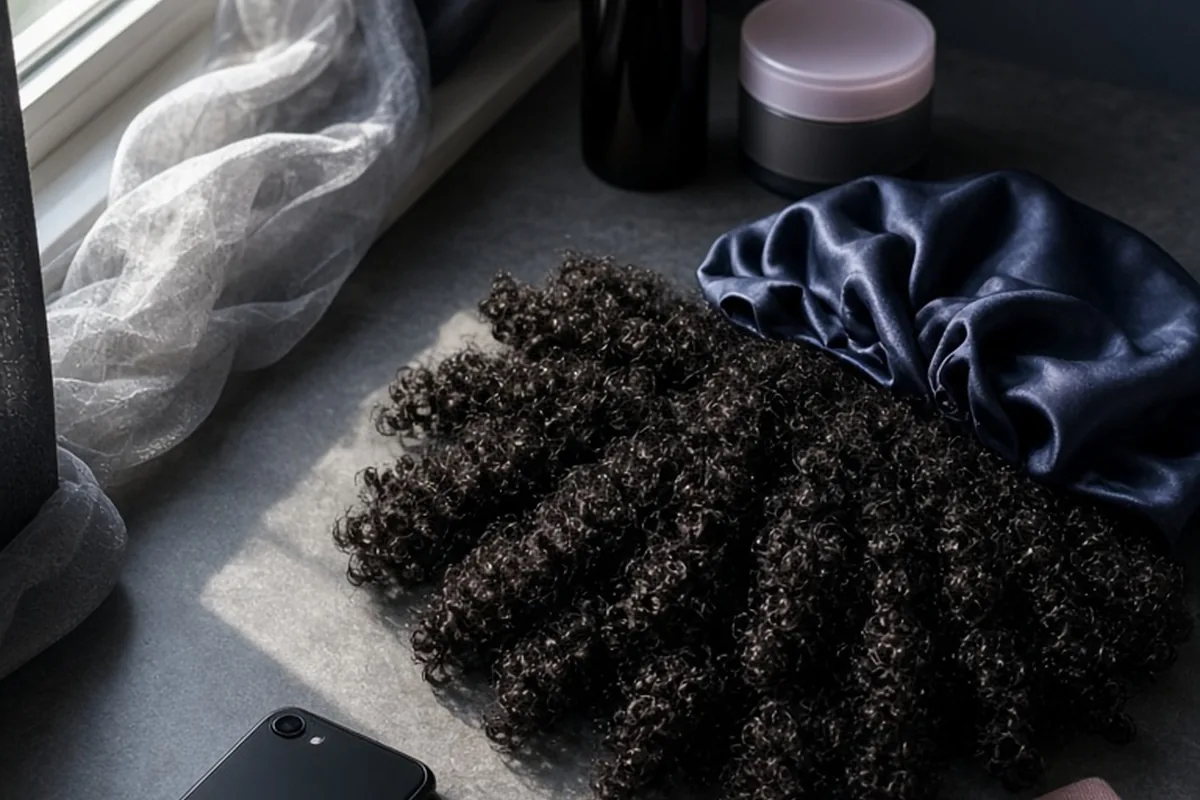
Caring for 4C hair requires consistent moisture retention, gentle handling, and low-manipulation styling to protect tightly coiled strands from breakage. Wash hair in manageable sections with a sulfate-free cleanser, detangle only when lubricated with a slippery conditioner using fingers or a wide-tooth comb, and deep condition regularly with indirect heat. Seal lingering moisture into the hair shaft using the liquid-oil-cream or liquid-cream-oil technique, and protect coils at night with a satin bonnet or silk scarf.
Because 4C hair features an intricate zig-zag coil pattern with minimal cuticle layers around each bend, strands lose internal hydration quickly and tangle easily. Establishing an effective hair care routine is not about forcing curls to conform to looser textures, but rather giving coils the lubrication, structural protection, and hydration they need to remain soft, resilient, and length-retaining over time.
Mapping the Structural Realities of 4C Hair and Moisture Loss
The physical architecture of 4C hair explains why it behaves differently from other hair types. Under close inspection, 4C strands form tight angles, coils, and crimps rather than smooth, spiraling rings. Every sharp turn along the hair shaft represents a potential weak point where the outer cuticle layer can lift or wear down from friction. Furthermore, the natural sebum produced by the sebaceous glands on the scalp struggles to travel down these winding bends. While straight or wavy hair naturally distributes scalp oils along the shaft within days, 4C coils often remain dry at the mid-lengths and ends unless hydration and emollients are applied manually.
Shrinkage is another defining characteristic of 4C hair, often reducing apparent length by more than half when dry. This shrinkage is not a flaw or a sign of damage; it is a direct indicator of healthy elasticity and coil memory. However, when tightly coiled strands contract closely against one another, their cuticles interlock, easily creating single-strand knots, also known as fairy knots. Managing 4C hair successfully requires accepting shrinkage as normal while taking conscious steps to prevent the high friction and fiber tangling that accompany it.
Cleansing Coils Without Stripping Essential Lipids
A successful wash day for 4C hair begins before stepping into the shower. Washing 4C hair when it is loose and dry often results in severe matting and knotting as water causes the hair to shrink instantly. Applying a pre-shampoo treatment, such as a botanical oil or a high-slip pre-cleanse formula, creates a protective barrier that softens the hair fiber and reduces hygral fatigue, which is the repeated swelling and contracting of the hair cuticle caused by water absorption. Separating the hair into four to six twisted sections before applying water keeps the strands elongated and manageable throughout the entire washing process.
When selecting a shampoo, opt for a sulfate-free, hydrating formula that cleanses the scalp without leaving the hair feeling squeaky or stiff. Focus the cleanser primarily on the scalp where excess sebum, dead skin cells, and product residues accumulate, allowing the lather to run gently down the lengths of the twists rather than scrubbing the hair fibers against one another. If heavy butters, styling waxes, or silicone-based products are a regular part of your regimen, incorporate a clarifying shampoo once every month or six weeks to reset the hair cuticle, ensuring that future conditioning treatments can penetrate the hair shaft effectively.
Detangling Strategies That Prevent Mechanical Breakage
Detangling is often the stage where 4C hair experiences the most mechanical damage. Attempting to comb through dry 4C hair disrupts the fragile cuticles and snaps the strands at their natural turning points. Detangling must always be performed on damp or wet hair that has been thoroughly saturated with a rinse-out conditioner or dedicated detangling product. The primary quality to look for in a detangling product is slip, which describes how easily the formula allows hair strands and tools to slide past each other without catching or snagging.
Start by working through each section using your fingers before reaching for any styling tools. Finger detangling allows you to feel individual knots and separate tangled fibers gently without forcing a comb through a cluster. When you do use a tool, choose a seamless wide-tooth comb or a flexible-bristle detangling brush, and always work upward from the ends of the hair toward the roots. Removing naturally shed hairs during this step is essential, as loose shed strands that remain trapped inside the coil canopy will wrap around active hairs and form stubborn, complex knots over time.
Deep Conditioning and Managing the Moisture-Protein Balance
Deep conditioning is a foundational requirement for 4C hair care because standard wash-and-rinse conditioners rarely deliver enough lasting hydration to dense, tightly packed coils. A dedicated deep treatment works to soften the hair cortex and temporarily smooth lifted cuticles. Because 4C hair cuticles often lie tightly compact, introducing gentle, indirect warmth significantly improves the absorption of moisturizing ingredients. Wearing a plastic conditioning cap underneath a heated gel cap, sitting under a hooded dryer, or wrapping a warm, damp towel around the head for twenty to thirty minutes allows the hair shaft to accept moisture far more efficiently than cold conditioning.
Maintaining healthy hair also demands a careful balance between moisture and structural protein. If 4C hair receives only moisture without adequate structural support, the fibers can become overly soft, weak, and limp, losing their natural elasticity and breaking when manipulated. Conversely, excessive use of protein treatments leaves coils feeling stiff, rough, and prone to immediate snapping. If your strands feel brittle and snap under minimal tension, focus on moisture-rich treatments containing humectants like glycerin and aloe. If hair feels mushy, stretches unnaturally when wet, and fails to bounce back, incorporate a light protein reconstructor to restore its internal integrity.
Sealing Hydration Using the LOC and LCO Layering Methods
Understanding the fundamental difference between hydrating and sealing is critical for 4C hair health. True hydration comes exclusively from water or water-based products where water is listed as the primary ingredient. Raw oils and butters do not contain water and cannot moisturize the hair on their own; instead, they function as occlusives that coat the exterior of the strand to slow down the rate at which water evaporates. Applying heavy oils directly to dry hair simply seals dehydration into the fiber and repels any topical moisture applied later, leaving hair brittle and dull.
To retain moisture for several days, use a systematic layering approach such as the Liquid-Oil-Cream (LOC) or Liquid-Cream-Oil (LCO) method. The liquid step consists of clean water or a lightweight leave-in conditioning spray that introduces core hydration. In the LCO method, which works exceptionally well for lower-porosity 4C hair that struggles to absorb heavy products, a moisturizing cream is applied directly over the liquid to penetrate the strand before a light oil, such as jojoba or almond oil, is smoothed over the surface to seal the cuticle. For higher-porosity coils that lose moisture rapidly, the LOC method places an oil barrier immediately over the liquid, followed by a dense butter, like shea or mango butter, to provide a durable moisture seal.
Protective Styling Practices That Preserve Fragile Ends
The oldest and most vulnerable parts of 4C hair are the ends, which have been exposed to the elements, clothing friction, and manipulation the longest. Protective styles, such as two-strand twists, flat twists, cornrows, box braids, and braided crowns, shield these fragile ends by keeping them tucked away and reducing daily handling. By eliminating the friction caused by collars, scarves, and daily restyling, protective styles allow 4C hair to maintain its structural integrity and retain length over consecutive months.
However, a protective style only protects when installed with appropriate tension. Excessively tight braids or heavy extensions pull directly on delicate hair follicles along the hairline and nape, potentially causing inflammation and traction alopecia. Styles should never feel painful, cause headaches, or create small white bumps on the scalp. Even while hair is secured in a protective style, the scalp still needs periodic cleansing with a diluted shampoo, and the lengths of the coils should be lightly misted with a water-based refresher spray every few days to keep them from drying out beneath the style.
Nighttime Protection to Prevent Cuticle Abrasion
Much of the breakage experienced by 4C hair occurs during sleep. Standard cotton pillowcases act as absorbent blotters, drawing natural oils and topical moisture directly out of the hair fibers throughout the night. In addition, the coarse weave of cotton creates rough friction as the head moves, catching on delicate coils, fraying the cuticle layer, and undoing hours of careful detangling. Protecting hair overnight is an effortless way to preserve moisture levels and prevent avoidable mechanical damage.
Covering the hair with a high-grade satin or pure silk bonnet or wrapping it in a smooth scarf creates a frictionless surface that lets coils glide smoothly during movement. If you find head coverings uncomfortable or prone to slipping off during sleep, sleeping on a satin or silk pillowcase provides an effective alternative. Before covering the hair at night, grouping coils into several loose twists, loose braids, or a loose pineapple puff using a satin scrunchie prevents strands from flattening, tangling, and matting while you sleep.
Illustrative Scenarios
Adjusting Detangling Practices to Reduce Mechanical Shedding
An individual with dense 4C hair experienced persistent mid-shaft breakage and excessive comb debris while detangling dry hair with a fine-tooth comb every morning. By restructuring the routine to wash hair weekly in four braided sections, detangling exclusively while coated in a slippery rinse-out conditioner using fingers followed by a wide-tooth comb, mechanical stress was minimized. The individual then adopted loose two-strand twists as a low-manipulation weekday style, misting them lightly with a water-based leave-in spray every three days.
Key point: Shifting from dry, daily combing to lubricated, section-based detangling on damp hair eliminates unnecessary mechanical friction and protects fragile coil junctions from snapping.
Frequently asked questions
How often should 4C hair be washed?
Most people with 4C hair find that washing every seven to fourteen days strikes the ideal balance between keeping the scalp clean and preserving natural oils. Washing too frequently can strip delicate cuticles of moisture, while waiting longer than two weeks can cause product buildup and scalp irritation that hinders healthy hair growth.
Can 4C hair retain length without using heavy extensions?
Yes, 4C hair can retain length effectively without synthetic or human hair extensions. Low-manipulation styles created with your natural hair, such as two-strand twists, flat twists, and braided buns, protect the ends from environmental friction while eliminating the excessive weight and tension that extensions sometimes place on the scalp.
Why does 4C hair still feel dry after applying hair oil?
Hair oil does not contain water, meaning it cannot provide moisture by itself; it only creates an occlusive barrier that seals in whatever is already present. If oil is applied to dry hair, it blocks external humidity and locks dehydration inside, causing the strands to feel coated, rigid, and brittle until rehydrated with water or a water-based leave-in conditioner.
What is the best way to prevent single-strand knots on 4C hair?
Single-strand knots occur when contracting coils loop around themselves as they shrink. You can reduce their frequency by keeping the hair stretched through heat-free methods like twists, braids, or banding, and by ensuring your ends are trimmed periodically to remove frayed fibers that catch on neighboring strands.
Your next step
Divide your hair into four manageable sections before your next wash day, and practice detangling exclusively with a high-slip conditioner on wet hair to immediately reduce mechanical breakage.