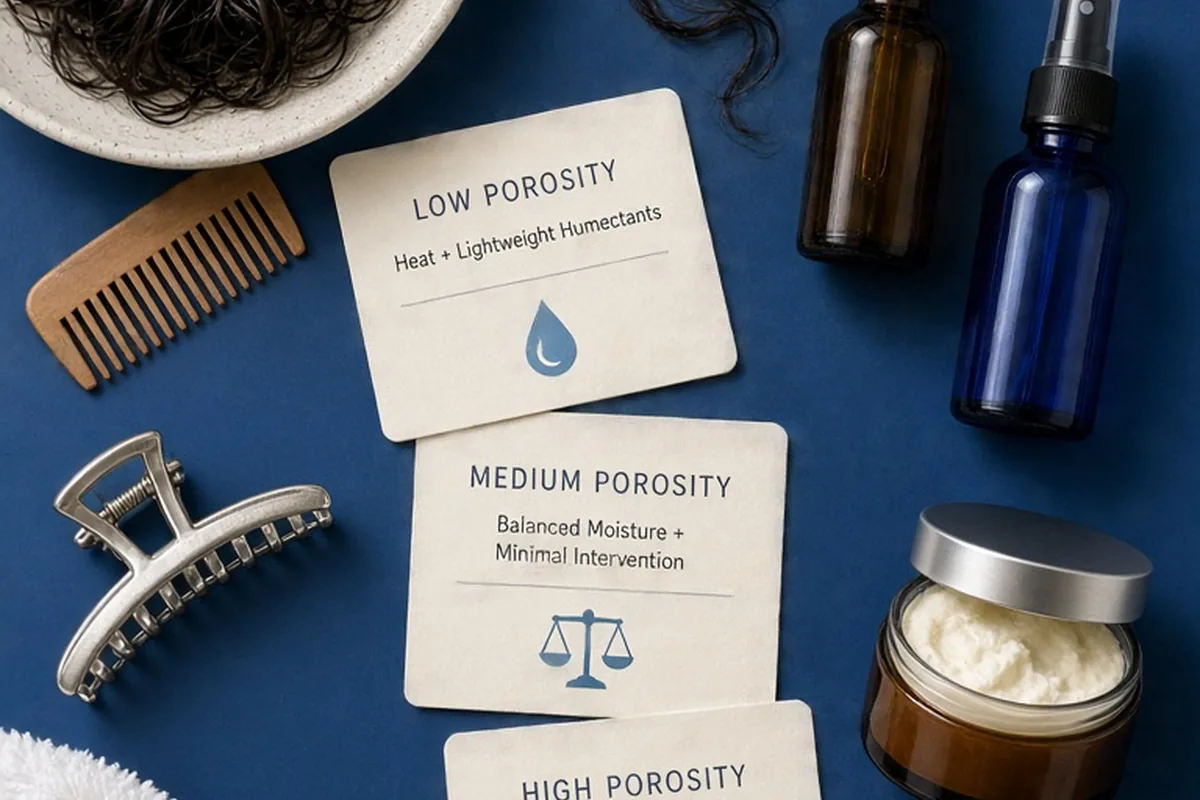
Caring for hair porosity requires matching your cleansing, conditioning, and styling habits to how easily your hair cuticles absorb and retain moisture. Low porosity hair requires gentle heat, clarifying cleansers, and lightweight liquid humectants to penetrate tightly bound cuticles. High porosity hair requires frequent protein reinforcement, rich leave-in emollients, and heavy occlusive sealants to trap hydration within compromised cuticles. Medium porosity hair thrives on balanced moisture maintenance and minimal intervention.
Hair porosity refers to your hair shaft's capacity to absorb, hold, and release water, lipids, and product formulations. Because your hair cuticles can lie completely flat, open naturally, or suffer damage from chemical treatments and heat styling, treating every strand with a universal routine often leads to chronic dryness, greasy product buildup, or severe breakage.
Identifying Your Cuticle Structure with Reliable Porosity Tests
Before redesigning your hair care regimen, you must establish an accurate baseline for your cuticle permeability. While the traditional water glass float test is widely discussed online, it is frequently inaccurate because surface tension, natural scalp sebum, and leftover styling residues can cause high porosity strands to float or low porosity strands to sink. A more reliable diagnostic is the dry spray test. Mist a clean, product-free, dry section of your hair with room-temperature water from a spray bottle. If tiny water droplets bead on the surface for several minutes before absorbing, your cuticles are tightly packed, indicating low porosity. If the water absorbs immediately and leaves the strand damp, your cuticles are raised or compromised, indicating high porosity. If the water sits momentarily and then absorbs evenly within thirty to sixty seconds, your hair sits in the medium porosity range.
You can also assess porosity using tactile feedback through the slip-and-slide assessment. Take an individual shed strand between your index finger and thumb, starting at the hair tip and sliding your fingers upward toward the root. Low porosity strands feel smooth, uniform, and slick because the overlapping shingle-like cuticles lie flat and continuous against the hair cortex. High porosity strands feel rough, bumpy, or uneven under your fingers, which occurs when individual cuticle scales are lifted, chipped, or missing due to genetic texture patterns, mechanical friction, or chemical processing.
Recognizing drying time provides another practical indicator of cuticle behavior. Low porosity hair takes a noticeably long time to get thoroughly saturated in the shower and can take upwards of six to eight hours to air dry fully. High porosity hair absorbs water instantly upon contact but dries out rapidly, often feeling parched, frizzy, and brittle within an hour or two after washing because open cuticles allow moisture to evaporate into ambient air just as quickly as it entered.
Caring for Low Porosity Hair with Heat and Lightweight Humectants
Low porosity hair features densely layered cuticles that create a hydrophobic barrier, making it difficult for water and conditioning agents to enter the cortex. The primary challenge with this hair profile is product accumulation: heavy creams, thick butters, and dense silicones remain on the exterior of the strand rather than absorbing, causing a stiff, dull film that attracts dirt and repels hydration. To care for low porosity hair successfully, you must introduce indirect heat to gently expand the cuticle layer during your conditioning stage.
Incorporate thermal heat caps, warm towel wraps, or handheld hair steamers when applying deep conditioners. Applying moderate warmth for fifteen to twenty minutes softens the cuticle shingles, allowing nourishing fatty acids and hydrating agents to penetrate beneath the surface. When applying leave-in products, do so on warm, freshly cleansed, dripping-wet hair. The lingering warmth from your shower water keeps cuticles pliable, while water acts as a carrier vehicle for your styling formulas.
Product selection for low porosity hair should center on lightweight, water-soluble humectants and fine-molecule plant oils. Ingredients such as vegetable glycerin, aloe vera juice, panthenol, agave nectar, and flaxseed extract draw water into the hair without depositing heavy coatings. When sealing in hydration, avoid raw shea butter, castor oil, and heavy mineral oils; instead, select lightweight penetrating lipids like argan oil, sweet almond oil, jojoba oil, or grapeseed oil that lubricate the strand without weighing it down.
Caring for High Porosity Hair with Protein and Occlusive Sealants
High porosity hair possesses elevated, damaged, or sparse cuticles with micro-gaps exposing the underlying keratin cortex. Whether caused by genetic curl patterns, bleaching, coloring, chemical relaxers, or frequent thermal styling, high porosity hair loses internal moisture rapidly through evaporation. The core strategy for managing high porosity hair is twofold: repairing structural gaps in the cuticle matrix using hydrolyzed proteins and locking in moisture using rich, emollient barriers.
Hydrolyzed proteins and amino acids are vital for high porosity care because their reduced molecular size allows them to temporarily adhere to weak, exposed areas along the hair shaft. Incorporate deep conditioning formulas containing hydrolyzed wheat protein, hydrolyzed silk, keratin, or collagen every one to two weeks depending on the severity of damage. These proteins form a temporary protective scaffold that reinforces strand tensile strength, prevents premature snapping, and reduces excessive moisture absorption in humid environments.
To prevent internal moisture from evaporating after wash day, implement the Liquid-Cream-Oil (LCO) or Liquid-Oil-Cream (LOC) layering method. Begin with a water-based moisturizing leave-in conditioner to hydrate the cortex, follow with a thick styling cream rich in murumuru, cupuacu, or shea butter, and finish with an occlusive sealing oil such as Jamaican black castor oil, avocado oil, or olive oil. Furthermore, finishing your wash cycle with a cool water rinse or a slightly acidic, pH-balancing leave-in spray (around pH 4.5 to 5.5) helps constrict the cuticle scales, helping your applied moisture stay anchored inside.
Maintaining Medium Porosity Hair to Prevent Over-Processing
Medium or normal porosity hair is characterized by an organized, slightly relaxed cuticle structure that permits moisture to enter steadily and remain inside without aggressive sealing techniques. While medium porosity hair requires less corrective effort than extreme low or high porosity profiles, it is vulnerable to shifts in porosity if subjected to excessive heat tools, harsh clarifying agents, or unmonitored chemical coloring.
The objective when managing medium porosity hair is balance. Your weekly or bi-weekly routine should incorporate balanced moisture-to-protein conditioning. You do not need prolonged heat steaming sessions or daily heavy occlusive butters, nor do you require intense weekly reconstructive protein treatments. A standard hydrating deep conditioner used every two weeks, paired with a lightweight silicone-free or water-soluble silicone leave-in conditioner, keeps medium porosity cuticles resilient, shiny, and flexible.
Be mindful of seasonal shifts that can temporarily change your hair behavior. During dry winter months with indoor heating, medium porosity hair may benefit from incorporating richer humectants or a drop of squalane oil on the ends to prevent dryness. In high-humidity summer conditions, incorporating a light anti-humectant styling gel helps prevent the cuticle from taking on excess environmental humidity, preserving your natural curl definition or smooth blowout without causing frizz.
Structuring Your Wash Day Around Cuticle Permeability
A successful wash day routine should be mapped specifically to the behavior of your cuticles from the pre-shampoo phase through final styling. For low porosity strands, cleansing is the most critical step to prevent build-up. Use a clarifying shampoo containing gentle chelating agents or mild sulfates once every two to three weeks to strip away stubborn product residue that prevents water absorption. Avoid pre-shampoo oil treatments (pre-poos) with heavy unrefined oils, as this adds another barrier over closed cuticles; instead, opt for warm water cleansing and immediate deep conditioning.
For high porosity hair, wash day should emphasize protection against hygral fatigue—the weakening of the hair fiber caused by repeated swelling and contracting of the cortex during water absorption. Apply a pre-shampoo penetrating oil, such as unrefined coconut oil, twenty to thirty minutes before washing. Coconut oil has a unique affinity for hair proteins, reducing cuticle swelling and mitigating protein loss during the shampooing process. Always wash high porosity strands with sulfate-free, moisturizing cleansers that preserve the hair's delicate lipid layer.
Detangling techniques must also adapt to your porosity level. Low porosity hair gains slip best when saturated with warm water and coated in a high-slip, lightweight conditioner containing marshmallow root or slippery elm extract. High porosity hair requires detangling with wide-tooth combs or flexible-bristle brushes under a thick layer of emollient conditioner, starting from the tips and working slowly toward the roots to prevent tearing fragile, exposed cuticles.
Ingredient Evaluation: What to Prioritize and What to Limit
Reading ingredient labels correctly allows you to assemble an effective hair care routine regardless of marketing claims. Porosity dictates whether a specific botanical extract, lipid, or chemical compound will nourish your hair or cause severe product buildup and breakage. When auditing formulas, check the first five ingredients, as they make up the bulk of the product concentration.
For low porosity hair, prioritize water-based formulas where water, aloe leaf juice, or herbal infusions appear first, followed by film-forming humectants like hydroxyethylcellulose, panthenol, sorbitol, and honey. Limit products heavy in hydrolyzed proteins, hydrolyzed keratin, and raw, unrefined butters within daily leave-in products. Excess protein on low porosity hair binds tightly to the outer cuticle, making strands feel brittle, stiff, and prone to snapping.
For high porosity hair, look for rich emollients such as cetearyl alcohol, behentrimonium methosulfate, shea butter, mango seed butter, and babassu oil. Prioritize conditioners containing hydrolyzed quinoa, hydrolyzed soy protein, and ceramides. Ceramides are naturally occurring lipids that act like biological mortar between lifted cuticle scales, helping restore smoothness and lipid integrity. Limit clear, drying alcohol-based gels and harsh sodium lauryl sulfate cleansers, which strip away remaining natural protective oils.
Environmental, Chemical, and Thermal Factors That Alter Porosity
Porosity is not entirely static; while your natural curl pattern and genetics set a baseline, external physical, chemical, and environmental stressors can dramatically increase your hair porosity over time. Recognizing how everyday habits impact cuticle integrity allows you to make necessary regimen adjustments before irreversible damage occurs.
Chemical services such as bleaching, permanent hair dyeing, high-lift coloring, relaxers, and perms work by artificially lifting the cuticle scales using alkaline agents (like ammonia or sodium hydroxide) to alter the internal pigment or disulfide bonds of the cortex. Even after neutralizing treatments, the cuticles rarely return to their original, tightly closed alignment. If you have chemically treated your hair, you must transition your routine toward high porosity maintenance protocols, regardless of what your natural, untreated hair required.
Thermal styling tools operating at high temperatures degrade the protective 18-methyleicosanoic acid (18-MEA) lipid layer on the cuticle surface, causing micro-fractures in the keratin matrix. Similarly, ultraviolet (UV) radiation from prolonged sun exposure degrades hair proteins, while hard water minerals (calcium, magnesium, iron) attach to cuticles, creating a rough texture that mimics high porosity while blocking moisture entry like low porosity hair. Installing a shower filter and applying thermal protectants before blow-drying or flat-ironing protects cuticle health over time.
Frequently asked questions
Can you permanently change your hair porosity?
You cannot alter your genetic baseline porosity for new hair growth emerging from the scalp. However, you can temporarily manage your existing strands with targeted acidic rinses, deep conditioners, and proteins, or inadvertently increase porosity through heat tools, sun exposure, and chemical processing.
Is protein or moisture more important for low porosity hair?
Moisture is significantly more critical for low porosity hair because the tightly closed cuticles naturally protect the internal protein structure from damage. Over-applying protein on low porosity hair often causes product accumulation, resulting in a stiff, straw-like texture and breakage.
How often should you deep condition high porosity hair?
High porosity hair benefits from deep conditioning once every week to ten days to replenish lost lipids and moisture. Alternating between a protein-rich deep conditioner and a purely moisturizing mask helps maintain optimal elasticity and structural strength.
Why does low porosity hair take so long to get wet in the shower?
The cuticle scales on low porosity hair lie flat, compact, and overlapping, creating an effective water-resistant shield. Without warm water or gentle heat to relax the cuticles, water runs off the outer surface instead of penetrating the internal cortex.
Your next step
Perform a warm-water spray test on clean, dry strands today to identify your cuticle behavior, then replace one unsuitable styling product with a porosity-matched formula.