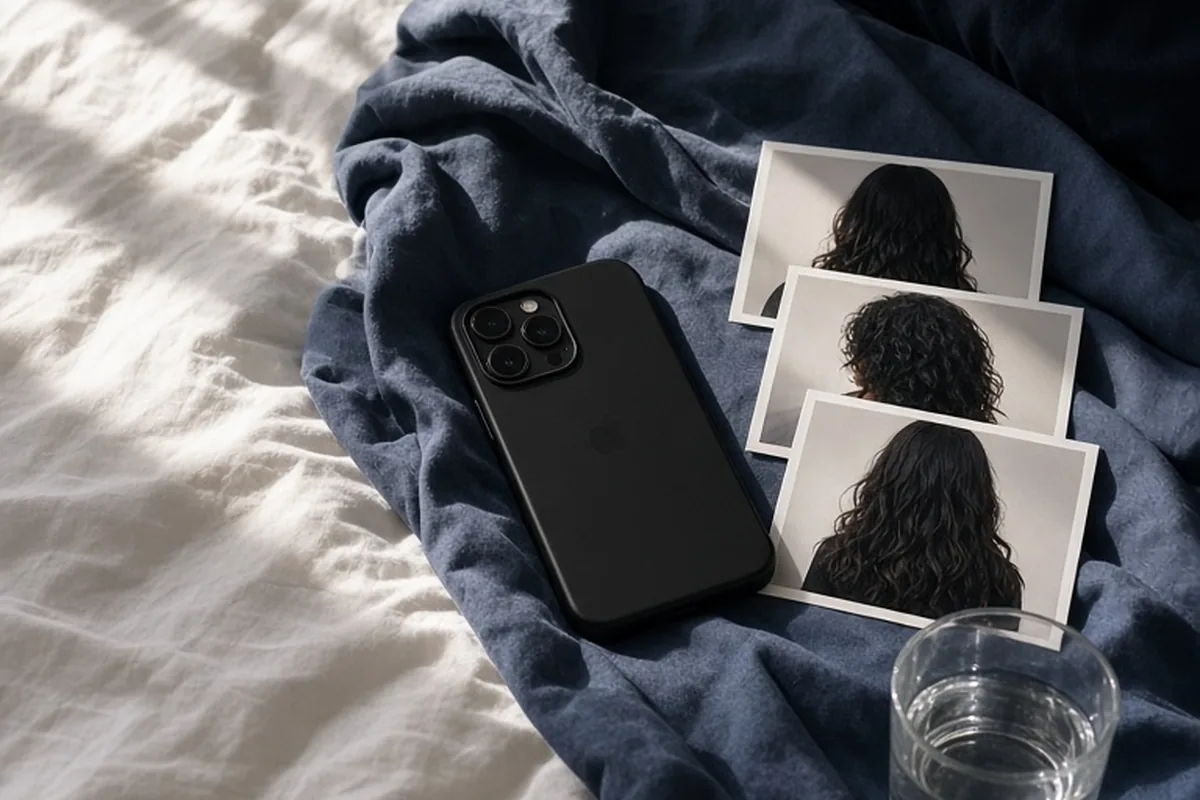
To care for your hair salon consultation, arrive with dry hair worn in its natural everyday state, washed one to two days prior without heavy concealing products. Bring three to five realistic reference images, compile an accurate chronological history of past chemical treatments and home routines, and clearly communicate your maintenance budget, styling skill level, and physical boundaries before any shears or chemicals touch your hair.
A hair salon consultation is a diagnostic meeting and collaborative planning session that determines the safety, feasibility, and longevity of your requested style.
Arriving with the Right Hair State for Cut, Color, or Curl Consultations
How you wear your hair to a salon consultation directly affects what the stylist can accurately evaluate. The long-standing myth that hair must be filthy or excessively oily for salon appointments often backfires during a consultation. Heavy sebum buildup, dry shampoo residue, and thick edge controls coat the cuticle, masking the natural porosity, elasticity, and true tonal level of your strands. For color assessments, heavy product build-up can create an artificial barrier that obscures underlying brassiness or uneven porosity, making it difficult for the colorist to gauge lift capability.
For haircut consultations, especially for textured and curly hair, arriving with hair styled in its natural, dry state is essential. If you frequently wear wash-and-go styles, twist-outs, or natural curls, coming in with hair that has been blown out or flattened under a tight ponytail hides your genuine curl pattern, shrinkage percentage, and spring factor. The stylist needs to see how individual sections fall around your face, crown, and neckline under ordinary conditions. If you typically blow-dry and flat-iron your hair every week, communicate that preference upfront so the professional understands your primary wear pattern.
The ideal preparation is washing your hair 24 to 48 hours before the consultation using your standard shampoo and conditioner, followed by minimal styling product. Avoid putting your hair into tight buns, clips, headbands, or hats on the way to the salon, as mechanical creasing alters the natural root direction and volume distribution. Arriving in this neutral baseline allows the professional to conduct a tactile assessment of scalp health, strand thickness, density per square inch, and overall moisture balance.
Selecting and Translating Reference Photos for Your Specific Texture
Inspiration photos are essential visual tools during a consultation, but uncurated image galleries often create misaligned expectations. Stylists do not simply look at the overall aesthetic of a photo; they break down the subject's base color level, tonal warmth, hair density, strand diameter, face shape, and the artificial lighting used in the shot. Many viral salon images feature ring lights, high-contrast editing, filter presets, and hidden hair extensions that produce illusions of fullness or platinum lightness rarely achievable on fine, natural hair in a single visit.
To build an effective reference collection, select three to five images that showcase hair with similar texture, density, and natural base tone to your own. If you have fine, low-density wavy hair, bringing photos of thick, high-density coarse hair will lead to disappointment, because the volume and perimeter weight will behave entirely differently. When presenting your chosen photos, pinpoint the exact elements you admire rather than assuming the stylist sees what you see. State clearly whether you are drawn to the face-framing brightness, the specific shadow root depth, the internal layering, or the overall silhouette.
Equally valuable is bringing one or two photos of results you actively dislike or want to avoid. Showing a tone that feels too ash, a layer that sits too short, or an undercut that feels too aggressive provides concrete boundaries. This contrast helps the stylist triangulate your personal style vocabulary, eliminating subjective misunderstandings around terms like caramel, mushroom brown, choppy, or subtle.
Disclosing Full Chemical History, Home Care Products, and Water Quality
Transparency regarding your hair history is a matter of chemical safety rather than judgment. Hair retains a structural record of everything applied to it until that specific section is physically cut off. Even if dark box dye, metallic salts from henna, or at-home bleach were applied two years ago and have seemingly faded to brown, those chemical compounds remain embedded inside the cortex. Applying professional bleach or permanent color over residual metallic salts or progressive box dyes can cause severe thermal reactions, rapid structural breakage, or unexpected discoloration.
Provide your stylist with a chronological summary covering the past two to three years of chemical services. Mention in-salon treatments such as permanent straightening, relaxers, keratin smoothing treatments, perms, and professional glosses, as well as any over-the-counter tinting conditioners or root touch-up sprays. Keratin and smoothing treatments, for instance, coat the hair shaft with cross-linked proteins that can resist lightening agents or cause color lifting to turn patchy if not factored into the formulation.
Do not overlook daily environmental factors and home product lines. If your home runs on untreated well water or municipal hard water with high mineral content like iron, calcium, or copper, tell your colorist. Mineral accumulation reacts unpredictably with lighteners, sometimes causing rapid heat generation in the foil. Mentioning whether you use bond builders, silicone-heavy drugstore serums, or frequent heat styling above 400 degrees Fahrenheit gives the practitioner a realistic baseline of your hair's internal protein integrity.
Navigating Texture, Density, and Porosity Assessments in the Hair Salon Consultation
A thorough consultation involves physical touch and strand examination. The professional should run fingers through your hair to check density differences between the nape, crown, and hairline, while checking porosity from roots to ends. Porosity dictates how rapidly hair absorbs moisture, color molecules, and chemical processing solutions. Highly porous ends that have experienced years of mechanical friction or sun exposure process lighteners and toners much faster than healthy, low-porosity new growth near the scalp, requiring custom formulation adjustments.
For clients with coily, curly, or tight-textured hair (Type 3 and Type 4 patterns), the consultation must include a discussion on moisture-protein balance and mechanical handling. The stylist should evaluate the degree of curl variation across different zones of your head, as it is common to have looser S-patterns at the crown and tighter coils at the nape. Discussing whether the hair will be cut wet, dry in its natural curl cluster, or blown out straight determines how the layers will compress and expand in everyday life.
Pay close attention to how the stylist handles your hair during this physical check. They should handle fragile strands with care, use appropriate wide-tooth combs or detangling tools, and observe your scalp for signs of irritation, flaking, or tension sensitivity. If you experience scalp conditions like psoriasis, seborrheic dermatitis, or contact allergies, point them out so the salon can select scalp-safe cleansers, avoid direct on-scalp bleach placement, or perform patch testing before applying chemical formulations.
Establishing Realistic Maintenance Commitments and At-Home Styling Routines
A cut or color is only as sustainable as your willingness and ability to maintain it at home. During the consultation, provide an unvarnished summary of your typical morning routine. If you wash your hair twice a week, air-dry without styling tools, and spend less than ten minutes getting ready, a precision micro-bob requiring daily round-brush blowouts and flat ironing will become a daily frustration. Similarly, a high-contrast platinum blonde requiring purple toning shampoos, weekly deep conditioning masks, and six-week root touch-ups is unsuitable for someone seeking low-effort yearly maintenance.
Discuss your maintenance cadence openly. High-maintenance options, such as global bleach blondes, solid red tones, short pixie perimeter shaping, and blunt bangs, require salon visits every four to six weeks to prevent banding or structural loss of shape. Low-maintenance techniques, like lived-in balayage, root smudges, soft textured perimeter cuts, and long internal layers, can easily stretch to four to six months between comprehensive appointments with only occasional glossing visits in between.
Ask the professional to outline the exact post-service home regimen needed to preserve the result. Inquire about water temperature recommendations, sulfate-free cleansers, UV protectants, heat protectant sprays, and bond-building repair treatments. Understanding these home care demands before committing to a service ensures you factor the cost and time of aftercare into your overall lifestyle plan.
Conducting Strand Tests, Patch Tests, and Reviewing Service Scope
When planning major color corrections, significant lightening on previously dyed dark hair, or applying strong chemical relaxers, verbal agreement alone is insufficient. A strand test is the most definitive diagnostic procedure available to a colorist. By applying the intended lightening or color formula to a small, hidden interior snip of hair or a half-inch section near the nape, the stylist observes chemical lift progression, structural elasticity retention, and underlying pigment exposure in real time.
A strand test reveals hidden chemical barriers that no amount of visual inspection can uncover. If the test strand turns gummy, breaks under gentle tension, or reveals uneven bands of orange and charcoal pigment, the colorist knows immediately that the goal cannot be achieved in a single session without compromising strand integrity. This provides empirical proof that an altered, multi-session plan or a gentler, transitional tone must be adopted instead of pushing forward with an aggressive global application.
Patch tests for skin sensitivity should also be requested if you have a history of contact dermatitis, allergies to oxidative hair dyes containing paraphenylenediamine (PPD), or sensitive skin. Applying a tiny dab of formulated color behind the ear or on the inner elbow 24 to 48 hours prior to full application ensures you avoid adverse allergic reactions, scalp burning, or systemic contact responses.
Clarifying Pricing Tiers, Service Steps, and Navigating Red Flags
A professional salon consultation must always conclude with full transparency regarding total investment, timing, and procedural steps. Many modern salons operate on hourly pricing models, while others use à la carte menus where bond additives, extra bowls of lightener, toners, glosses, treatments, and blowout finishes are billed individually. Never hesitate to ask for a comprehensive breakdown of the estimate before work starts to eliminate any surprise charges at checkout.
A reliable stylist will walk you through the realistic milestones of your transformation. If your goal requires multiple sessions to protect hair health, they should map out what Stage 1, Stage 2, and Stage 3 will look like, how long you should wait between visits, and the expected cost for each phase. They should also detail the approximate time you will spend in the chair on the day of the appointment, accounting for processing, toning, and finishing steps.
Be alert to consultation red flags that indicate a lack of alignment or professional care. If a stylist dismisses your concerns about hair damage, promises to take dark box-dyed hair to cool platinum in two hours without a strand test, rushes past your lifestyle questions, or pressures you into purchasing services you feel uncomfortable with, step back. A consultation is a mutual interview. You are under no obligation to book or proceed with a service if the stylist does not listen to your boundaries or fails to demonstrate clear technical competence.
Frequently asked questions
Should I wash my hair right before going to a salon consultation?
It is best to wash your hair 24 to 48 hours before your appointment. This timeline removes excess oil and styling residue while allowing your natural texture and oil distribution to show accurately without irritating the scalp.
Are salon consultations usually free or do they cost money?
Policies vary by salon. Many stylists offer complimentary 15-minute consultations, while independent specialists or color-correction experts often charge a stand-alone consultation fee that may or may not be applied toward the cost of your future service.
Can I leave a consultation without booking a full service appointment?
Yes. A consultation is an exploratory assessment designed to evaluate feasibility, pricing, and communication compatibility. If the proposed timeline, price, or approach does not align with your expectations, you can thank the stylist and leave without booking.
What should I do if a stylist promises results that seem unrealistic?
Request a physical strand test before agreeing to the service. An in-person test reveals exactly how your hair handles the chemistry and provides hard evidence of what is achievable without risking widespread breakage.
Your next step
Organize three reference images and write down your chemical treatment history over the past two years to bring to your consultation.