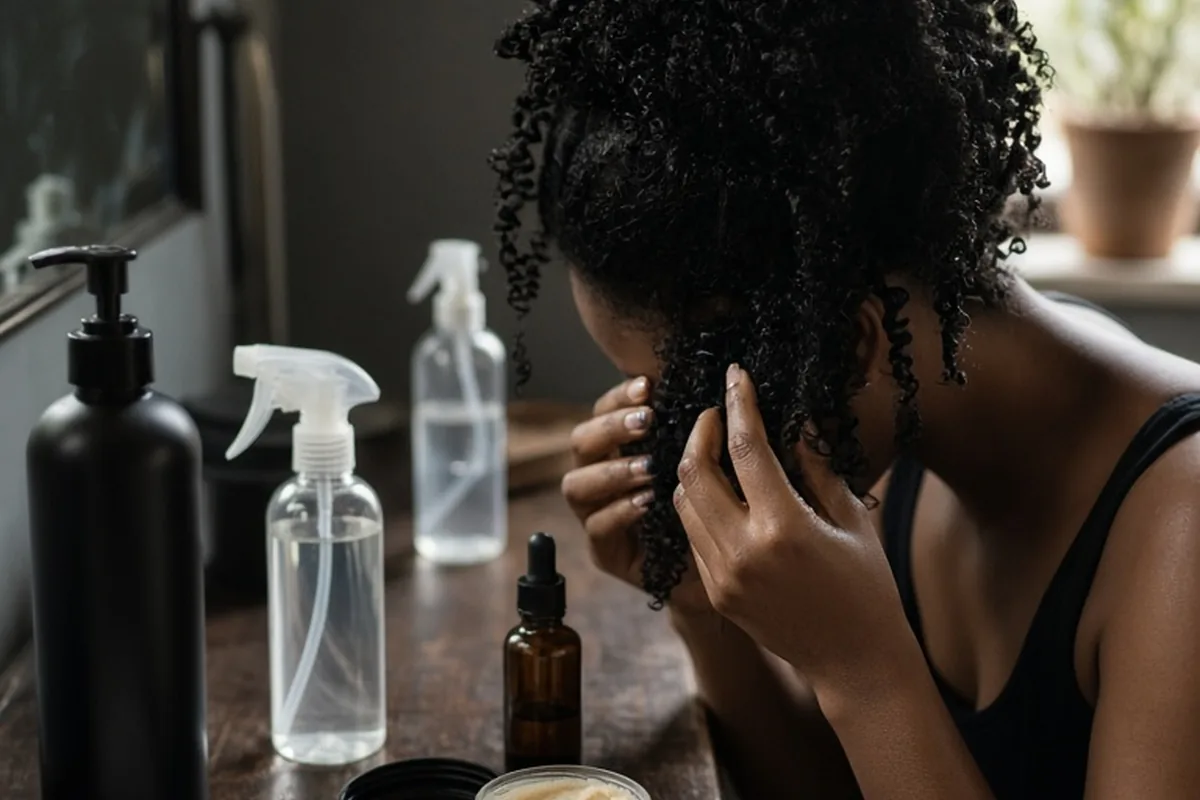
To properly care for Black hair using moisturizers, apply water-based leave-in creams or lotions directly to clean, damp strands before layering on a plant oil or butter to seal in hydration. To care for the moisturizer product itself, store bottles in a cool, dry area away from shower steam, use clean hands or spatulas to prevent microbial growth, and discard formulas showing separation, texture changes, or rancid odors.
Textured, coily, and kinky hair types have unique structural characteristics that make moisture retention both critical and challenging. The tight bends along the hair shaft prevent natural sebum from traveling efficiently from the scalp down to the ends, leaving strands prone to dryness and friction-induced breakage if hydration is not consistently maintained.
Distinguishing True Hydrating Moisturizers from Sealants and Oils
A frequent point of confusion in textured hair routines is the functional difference between a true hydrator and an occlusive sealant. True moisturizers must contain water (aqua) as the primary first ingredient. Water is the only element that hydrates the hair cortex, providing elasticity and softening stiff strands. Products labeled as moisturizers often feature humectants such as vegetable glycerin, aloe vera juice, panthenol, or honey, which attract ambient moisture to the hair fiber. Without a water base, a product cannot hydrate dry hair on its own.
In contrast, pure oils and heavy butters—such as castor oil, olive oil, and raw shea butter—do not contain water and therefore cannot moisturize the hair fiber. Instead, their lipid structure forms a hydrophobic barrier over the cuticle layer. When used correctly, these sealants trap the water-based moisturizer inside the hair shaft, slowing down evaporation throughout the week. Applying pure oils to bone-dry hair coats the exterior without imparting moisture, creating a barrier that actually blocks future hydration from entering until the hair is washed again.
When reading product labels, check the ingredient list carefully. Look for water or aloe vera leaf juice listed first, followed by emollient fatty alcohols like cetyl alcohol, stearyl alcohol, or cetearyl alcohol. These ingredients help soften the cuticle and allow the water base to penetrate smoothly. If a product contains mostly petrolatum, mineral oil, or pure plant oils without water near the top, treat it as a sealant rather than a daily hydrating step.
Matching Moisturizer Formulations to Hair Porosity and Strand Thickness
Hair porosity—the measure of how easily your cuticles absorb and retain moisture—determines which moisturizer weight and formulation will work best. Low-porosity Black hair has tightly bound, overlapping cuticle scales that resist water penetration. For low-porosity strands, heavy creams and thick butters tend to sit on top of the hair, leaving a greasy film without quenching internal dryness. Lightweight, liquid-based leave-ins and milk moisturizers formulated with humectants and minimal heavy waxes absorb much more effectively, especially when paired with warm water or gentle heat to lift the cuticles during application.
High-porosity hair, on the other hand, possesses gaps and raised cuticles, often due to genetics, chemical processing, heat styling, or mechanical wear. While high-porosity hair absorbs water instantly, it loses hydration just as rapidly through evaporation. For these strands, richer moisturizing creams containing heavier emollients, ceramides, and hydrolysed proteins are beneficial. The protein components temporarily reinforce structural gaps in the cuticle, while dense creams create a thicker layer that prevents moisture from escaping throughout the day.
Strand diameter also influences how a moisturizer behaves. Fine, coily hair can easily become weighed down and limp if treated with dense formulas, even if the overall density is high. Coarse strands, which have a thick individual diameter and a resilient outer cuticle, usually thrive on denser butter-creams that provide intense lubrication and reduce friction between neighboring fibers.
Applying Moisturizers with the LOC and LCO Layering Techniques
The sequence in which you apply moisture determines how long hydration lasts between wash days. The two most established layering frameworks for Black hair care are the Liquid-Oil-Cream (LOC) method and the Liquid-Cream-Oil (LCO) method. Both systems prioritize applying a liquid hydrator first, but they vary in how the sealing and softening layers are applied. Choosing between them depends on how your specific curl pattern responds to product weight and oil distribution.
In the LCO method, you start with a water-based liquid or leave-in conditioner, follow immediately with a rich moisturizing cream, and finish with a thin layer of sealing oil. This approach is widely favored for medium-to-low porosity hair because it ensures that all hydrating and emollient ingredients penetrate the shaft before any oil forms a barrier. The final oil layer coats the smoothed cuticle, locking in the cream beneath it and providing long-lasting shine without excess buildup.
The LOC method applies the liquid first, followed by a pure oil, and finishes with a heavy styling butter or cream. This technique is especially useful for high-porosity coils and protective styling preparations, such as installing two-strand twists or braids. The oil helps buffer the porous cuticle, and the heavier cream seals the exterior while providing hold and curl definition. To apply either technique effectively, section hair into four to six parts, work the product from tips upward toward the roots, and distribute evenly using your fingers or a wide-tooth detangling tool.
Caring for Moisturizer Products to Prevent Spoilage and Contamination
Caring for your hair moisturizer products is just as important as caring for your hair itself. Because effective moisturizers are formulated with water and organic botanical ingredients, they provide an environment where bacteria, yeast, and mold can grow if preservative systems are compromised. Leaving open jars or unsealed bottles in a warm, damp shower allows water droplets and humidity to enter the packaging, diluting preservatives and promoting microbial contamination.
To extend the shelf life and efficacy of your moisturizers, store all containers in a dry, room-temperature environment outside the shower stall, such as a vanity drawer, linen closet, or bedroom shelf. Avoid dipping wet, unwashed fingers into wide-mouthed cream jars. Instead, scoop out the needed amount using a clean cosmetic spatula or a dry, sanitized spoon. If using pump or squeeze bottles, keep the nozzle wiped clean to prevent product from oxidizing and drying into hardened, discolored plugs at the opening.
Check your hair moisturizers periodically for signs of chemical breakdown. Separation of oil and water phases that cannot be blended back together with gentle shaking, noticeable changes in color, thinning of the texture, or sour, rancid scents indicate that the formulation has degraded. Discontinue use immediately if a product shows these signs, as applying spoiled formulas can cause scalp irritation, contact dermatitis, and foul odors on your hair.
Preventing Product Buildup and Moisture Overload on Coily Strands
Applying moisturizer daily without regular cleansing creates a heavy accumulation of oils, butters, and conditioning agents on the hair and scalp. Over time, this buildup forms an impermeable coating that repels water during subsequent washes, resulting in hair that feels simultaneously greasy on the outside and brittle and dry on the inside. When strands snap easily despite constant oiling, product buildup is often the underlying reason.
To maintain healthy moisture balance, incorporate a clarifying shampoo or sulfate-free chelating cleanser every three to four weeks, depending on how frequently you apply leave-in products. Cleansing the hair down to a clean slate strips away dried polymer films and stubborn silicone layers, allowing fresh water and hydrating creams to reach the cortex directly. Follow clarifying washes with a rich, conditioning treatment to restore softness before reapplying your leave-in routine.
Be mindful of moisture overload, sometimes referred to as hygral fatigue. This condition occurs when hair absorbs excessive water without adequate structural protein balance, causing strands to feel mushy, overly stretchy, and weak when wet. If your hair lacks elasticity or loses its natural coil spring, reduce the frequency of soaking wet styling and introduce a light protein-balancing conditioner into your monthly rotation.
Nighttime Retention Habits to Lock In Daily Moisture
Applying high-quality moisturizers will yield limited results if physical friction and absorbent fabrics strip the hydration away overnight. Standard cotton pillowcases and sheets are highly absorbent; they act like sponges, pulling oils and water directly out of your strands while you sleep. The coarse weave of cotton also generates friction against delicate coils, resulting in morning tangles, frizz, and mid-shaft split ends.
Protecting your moisture investment requires sleeping with a high-grade satin or silk bonnet, headscarf, or pillowcase. Silk and satin fabrics feature tight, smooth weaves that do not absorb lipid barriers or moisture from the hair. Strands glide freely across the slick surface, preserving moisture levels and extending the lifespan of your twist-outs, braid-outs, or wash-and-go styles without requiring daily reapplication of product.
For long or medium coils, grouping the hair into loose pineapple buns or large two-strand twists under your bonnet prevents the ends from rubbing against clothing or bedding. When waking, gently fluff your hair using clean fingers lightly coated with two to three drops of lightweight oil, avoiding excessive combing or aggressive restyling that could disrupt your moisture barrier.
Seasonal Adjustments for Humectants in Humid and Arid Climates
Moisturizing formulations interact dynamically with atmospheric humidity. Humectants like glycerin, sorbitol, and propylene glycol function by binding water molecules from the surrounding environment to the hair shaft. In moderate humidity, this process keeps curls supple and bouncy. However, in extreme weather conditions, the effectiveness of humectant-rich moisturizers shifts dramatically.
In arid, dry winter air or desert environments where relative humidity drops below 30 percent, there is little to no ambient moisture for humectants to pull from the air. In these conditions, strong humectants can draw moisture out from the deeper layers of the hair cortex toward the drier atmosphere, accelerating internal dehydration. During dry seasons, switch to moisturizers that feature higher concentrations of film-forming emollients, such as jojoba oil, babassu oil, and cetyl esters, which protect moisture regardless of ambient dew points.
Conversely, in humid summer weather with dew points exceeding 60 degrees Fahrenheit (15 degrees Celsius), humectants absorb excessive airborne moisture. This causes the hair cuticle to swell rapidly, leading to severe frizz, lack of definition, and weakened curl structure. In high humidity, finish your moisturizing routine with an anti-humectant sealing butter or a light botanical gel to prevent external humidity from penetrating and disrupting your style.
Frequently asked questions
How often should you apply moisturizer to Black hair?
Most textured hair types benefit from moisturizing every two to four days, depending on hair porosity and environmental conditions. Rather than moisturizing on a rigid schedule, feel the mid-lengths and ends of your hair; if they feel stiff, rough, or dry to the touch, apply a small amount of water-based leave-in followed by a light sealant.
Can you use moisturizer on dry Black hair between wash days?
Yes, but it is most effective to lightly mist the hair with clean water or a botanical refresher spray before smoothing a small amount of moisturizing cream over the strands. Applying moisturizer to completely dry hair without any mist can lead to product sitting on the surface rather than penetrating the shaft.
How long does a bottle of hair moisturizer stay fresh once opened?
Most commercial hair moisturizers remain stable for 12 to 24 months after opening, as indicated by the open-jar symbol (PAO) on the back of the bottle. If stored in a humid bathroom or contaminated by wet hands, the formula may break down or develop bacterial growth sooner.
Your next step
Assess your hair porosity today by noting how quickly water absorbs during your next wash, and place your moisturizer containers in a dry, cool cabinet outside the shower to preserve their ingredients.