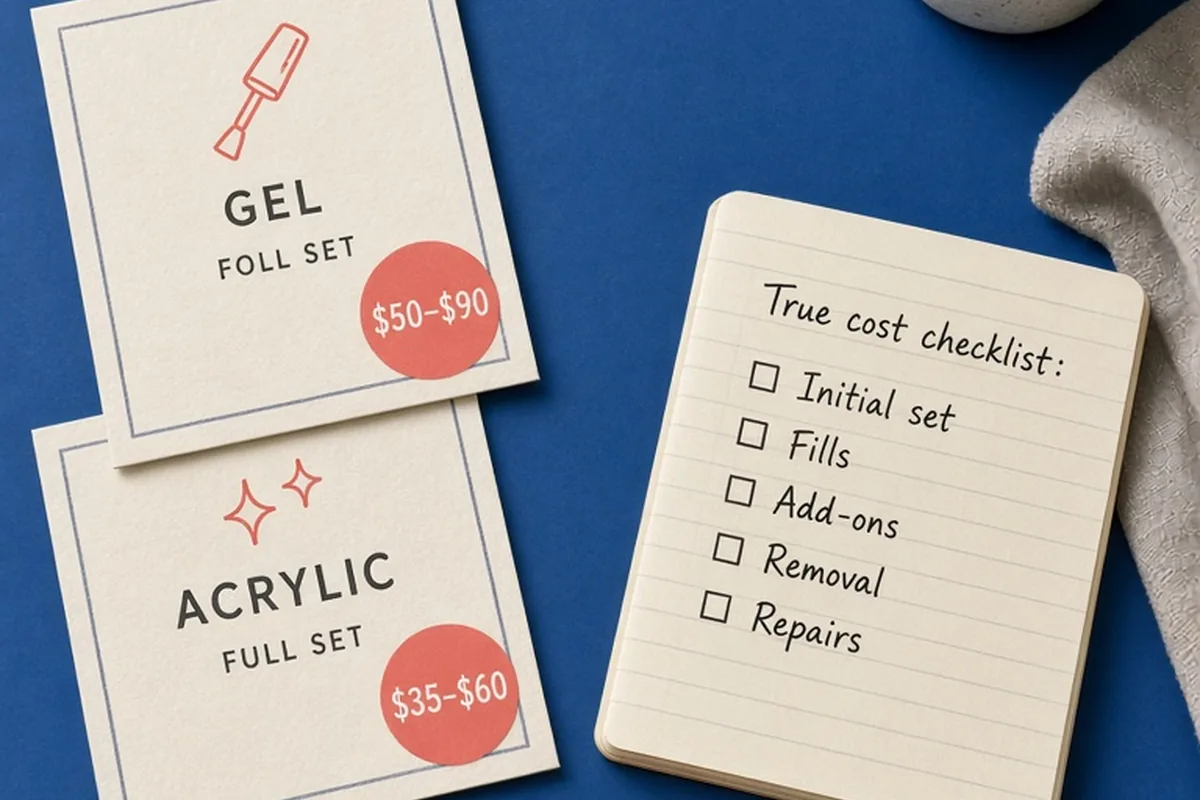
To compare acrylic and gel nail costs accurately, evaluate the full set application price, recurring fill-in fees, specialty add-ons, and professional removal charges. While standard acrylic sets generally feature a lower initial price point ($35 to $60) compared to hard or soft gel extensions ($50 to $90), recurring maintenance schedules, repair frequencies, and specific nail art upgrades will determine your true annual beauty expenditure.
Navigating salon service menus can quickly become overwhelming when service names, application techniques, and pricing tiers differ from one technician to the next. Understanding the mechanical differences and long-term financial commitments behind acrylic and gel enhancements empowers you to choose a manicure style that suits both your lifestyle and your monthly personal care budget.
Initial Application Costs and Upfront Service Pricing
The first step in comparing nail enhancements is evaluating the initial salon appointment, commonly billed as a full set. Traditional acrylic nails combine a liquid monomer and a powdered polymer that hardens on contact with air, creating a rigid extension over a plastic tip or sculpted form. Because acrylic materials are widely manufactured and standard across the industry, base full sets typically range between $35 and $60 at mid-tier salons. The process requires moderate service time, usually around sixty to ninety minutes, which keeps baseline labor costs relatively accessible for most clients.
In contrast, gel enhancements encompass several distinct product categories, including hard builder gels, soft soak-off gels, and pre-formed soft gel extension systems such as Gel-X. These formulations require ultraviolet (UV) or light-emitting diode (LED) light curing units to cross-link the oligomers into a durable, flexible structure. Because professional gel products generally carry higher wholesale supply costs and require precise curing protocols, initial gel extension sets commonly start between $50 and $90, with high-end specialty salons charging $100 or more. When budgeting for your first visit, recognizing whether you are paying for an overlay on natural nails or a full extension set is essential for an apples-to-apples comparison.
Recurring Infill Schedules and Ongoing Maintenance Fees
The initial appointment represents only a small portion of your ongoing expenditure, making maintenance frequency the most critical variable in your total cost. Natural nails grow roughly three millimeters per month, creating a visible gap at the cuticle line that weakens the structural balance of the enhancement. Acrylic nails typically demand maintenance appointments, known as fills or infills, every two to three weeks to rebalance the apex and prevent lifting. Standard acrylic fills usually cost between $25 and $45, provided all ten original enhancements remain intact.
Gel maintenance costs vary depending on the specific gel chemistry applied. Hard builder gels can be backfilled similarly to acrylics at a rate of $35 to $60 per session every three to four weeks, often offering slightly longer wear time due to their flexible adhesion. However, many soft gel extension systems cannot be filled; instead, they require a complete soak-off and a fresh application during every appointment cycle. This cycle of continuous removal and reapplication can elevate ongoing monthly costs significantly, as you are repeatedly paying full set rates rather than reduced infill pricing.
Hidden Add-Ons, Length Upgrades, and Design Surcharges
Base menu prices rarely reflect the final amount shown on your salon receipt after factoring in customization choices. Acrylic enhancements traditionally finish with a regular air-dry polish, but most contemporary clients opt for a cured gel top coat or gel color overlay to prevent chipping, which routinely adds $10 to $20 to an acrylic service. Gel services often include cured color within their baseline structure, though premium finishes such as chrome powders, cat-eye magnetic effects, or matte sealants still incur additional line-item charges.
Physical dimensions and custom shaping also influence the final invoice across both systems. Salons frequently apply tiered pricing based on nail length, charging $5 to $15 extra for medium, long, or extra-long extensions due to the additional product volume and filing time involved. Complex geometric shapes such as stiletto, coffin, or tapered square cuts may carry an additional shaping surcharge of $5 to $10. Detailed nail art, hand-painted illustrations, French tips, and 3D embellishments are usually billed either per finger or in timed increments, making clear communication with your technician essential before service begins.
Removal Charges and Transition Expenses
Proper product removal is essential for maintaining natural nail integrity, yet removal fees are frequently omitted when calculating long-term budgets. Acrylic nails break down completely in pure acetone, requiring a twenty- to thirty-minute soak accompanied by gentle scraping. Salons typically charge between $10 and $20 for this service if you are not getting a new set immediately, though some establishments discount the fee when paired with a subsequent manicure.
Gel removal costs depend entirely on whether you wear soak-off or non-soak-off formulations. Soft gels and builder gels labeled as soak-off dissolve under acetone wraps in roughly fifteen minutes, commanding modest removal fees of $10 to $15. Hard builder gels, however, are non-porous and impervious to acetone, meaning they must be carefully filed down using professional electric files. This meticulous mechanical removal demands advanced technician skill to protect the natural nail plate, often raising standalone removal rates to $20 to $35. Attempting improper at-home peeling or forceful removal to save money can thin the nail plate, resulting in costly restorative care later.
Durability, Lifestyle Wear, and Unplanned Repair Costs
Evaluating cost per wear requires factoring in how each enhancement reacts to your everyday physical routines. Acrylics offer exceptional rigidity and impact resistance, making them a preferred choice for individuals who perform rigorous manual tasks or desire substantial extension lengths. However, their lack of flexibility means severe trauma can cause the extension to snap or pull away from the natural nail bed. Replacing a broken acrylic nail between regular appointments typically incurs an individual repair charge of $3 to $7 per finger.
Gel products offer greater elasticity, absorbing moderate shocks by flexing alongside the natural nail plate rather than breaking abruptly. This flexibility provides superior resilience for individuals who frequently submerge their hands in water or work extensively at computer keyboards. Nevertheless, prolonged exposure to harsh household detergents or excessive heat can trigger perimeter lifting or peeling in gel formulations. If water becomes trapped beneath lifted gel layers, immediate salon intervention is necessary to re-prep the surface and prevent bacterial discoloration, adding sporadic repair visits to your monthly tally.
Calculating True Cost Per Wear Across a Three-Month Period
A realistic comparison between acrylic and gel systems emerges when projecting expenditures across a rolling three-month timeframe. Consider a standard acrylic regimen: an initial full set with gel polish ($55), followed by five bi-weekly infills ($35 each), plus occasional repair fees and tipping. Over twelve weeks, this baseline acrylic routine averages approximately $230 to $260 in total salon services before gratuity.
By comparison, a structured hard gel overlay routine on natural nails might involve an initial application ($75) followed by three four-week rebalancing sessions ($50 each). Because hard gel often holds structural integrity longer without lifting, fewer total salon visits are needed over the same twelve weeks, totaling roughly $225 before tips. However, if you choose full-cover soft gel extensions that require a full soak-off and new application every three weeks ($70 per visit), the twelve-week total can reach $280 to $350. Comparing total appointment volume alongside unit prices reveals the true economic profile of each system.
Actionable Strategies to Reduce Ongoing Enhancement Expenses
You can optimize your beauty budget without compromising nail health by implementing several practical scheduling and maintenance strategies. Choosing a moderate length and classic shape reduces specialty surcharges while minimizing mechanical leverage, which lowers the likelihood of costly accidental breaks. Additionally, transitioning from full extensions to structured natural nail overlays once your natural nails grow out eliminates extension fees entirely during maintenance appointments.
Establishing consistent daily aftercare habits also extends the functional lifespan of both acrylic and gel enhancements. Applying pure jojoba-based cuticle oil twice daily preserves product flexibility and seals the perimeter against premature lifting. Wearing protective rubber gloves during dishwashing and household cleaning shields enhancements from abrasive chemicals and moisture absorption, directly reducing the frequency of emergency salon repair appointments.
- Opt for short-to-medium lengths to avoid length surcharges and decrease break risks.
- Schedule standing appointments to maintain optimal balance before severe outgrowth occurs.
- Apply daily cuticle oil to prevent perimeter dehydration and product separation.
- Wear protective gloves during cleaning to shield enhancements from harsh solvents.
Frequently asked questions
Why do salons charge extra for gel polish over an acrylic set?
Salons charge an additional $10 to $20 for gel polish on acrylics because the product itself is more costly than standard lacquer and requires dedicated curing time under UV or LED lamps. This add-on provides immediate drying and extends chip resistance, but it increases the overall service time and material expense.
Are builder gel overlays cheaper in the long run than full acrylic extensions?
Builder gel overlays on natural nails often prove more economical over time because they do not require artificial tip extensions or frequent replacement cycles. Their superior flexibility can also extend appointment intervals from two weeks to three or four weeks, reducing total annual visits.
What is the most cost-effective way to transition between nail systems?
The most budget-friendly transition method is having your existing enhancements professionally soaked or filed down during a scheduled maintenance visit rather than booking a standalone removal appointment. Combining removal with a basic natural manicure avoids standalone service minimums and protects nail health.
Your next step
To establish your accurate nail budget, review your local salon's itemized service menu, select the enhancement system matching your daily manual activity level, and book your appointments around a realistic two-to-four-week maintenance schedule.