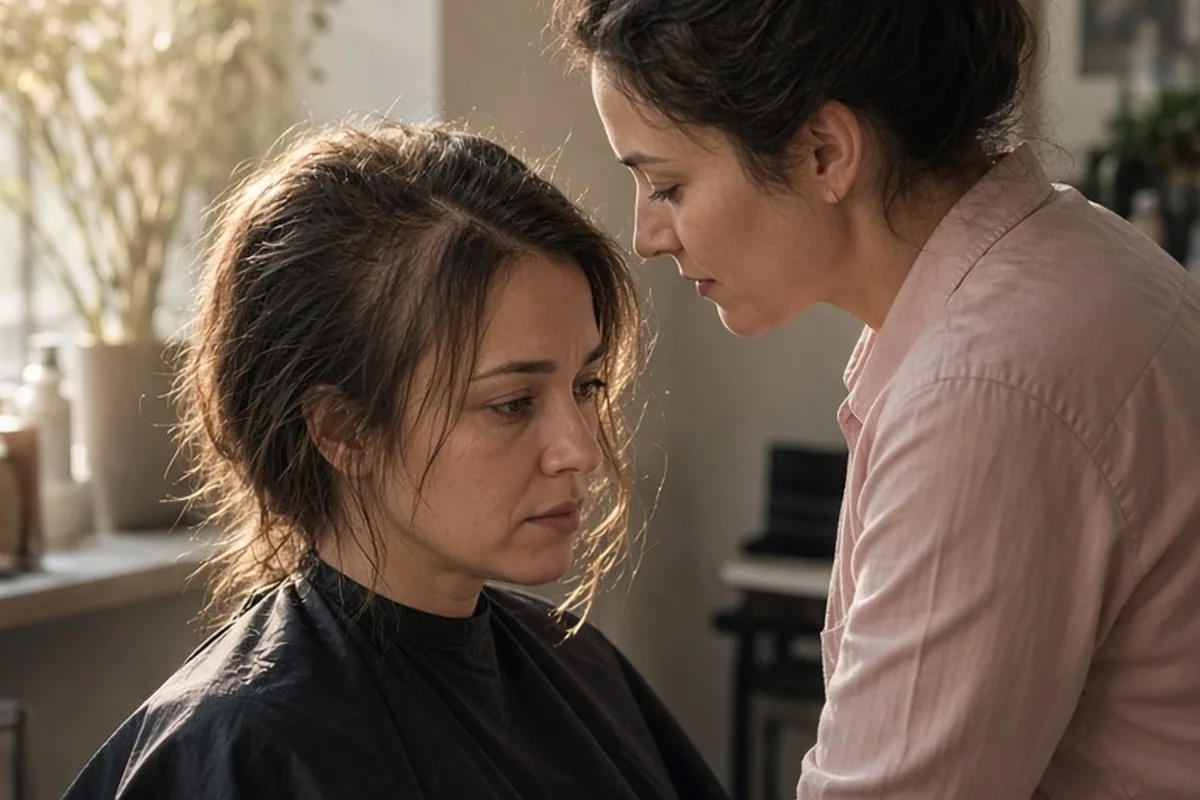
To explain postpartum hair loss to your hairstylist, tell them directly when booking and at the start of your consultation that you are experiencing post-pregnancy shedding. Point out specific concern zones, such as sparse temples or crown thinning, request low-tension washing and gentle detangling, and ask for cuts or blending techniques that accommodate halo regrowth without aggressive chemical processing.
Sitting in a salon chair while navigating postpartum shedding can feel distinctly vulnerable, especially when your hairline looks unfamiliar and handfuls of loose strands come away during everyday washing. Treating your stylist as an informed partner rather than trying to disguise changes on your own removes the guesswork, protects delicate new growth, and gives you a cut that flatters your hair in its current transitional state.
Booking the Appointment and Setting Expectations in Advance
The conversation about postpartum hair loss should ideally begin before you ever sit in the styling chair. When scheduling your appointment, either online or over the phone, use the appointment notes field or tell the receptionist that you have recently had a baby and are dealing with noticeable shedding. You do not need to share intimate medical details; a straightforward note such as 'Experiencing postpartum hair thinning at temples, would appreciate a stylist comfortable working with fragile regrowth' immediately frames the appointment around care and collaboration.
Requesting an extra ten minutes for your initial consultation gives you and the stylist breathing room. Standard salon turnaround times often encourage a rushed transition straight from the greeting to the shampoo bowl. In contrast, an extended consultation lets the stylist examine your hair while it is completely dry. A dry inspection allows them to see the true baseline density of your hair, identify localized areas of sparse growth along the hairline, and observe how your natural cowlicks interact with uneven, newly sprouted 'baby hairs' before water alters the hair texture.
If you are visiting an unfamiliar salon, take time to review individual stylist profiles or contact the front desk to ask which team member works frequently with postpartum clients or fine, thinning hair. Stylists who specialize in restorative treatments, scalp wellness, or textured hair care often possess a deeper practical familiarity with telogen effluvium and will handle your hair with deliberate gentleness rather than defaulting to vigorous styling methods.
Exact Phrases to Guide Your In-Chair Consultation
Once you are seated in front of the mirror, direct communication helps clear away awkwardness. Stylists encounter hair shedding daily, but they cannot read your comfort level unless you speak up. Start by pointing directly to the areas where you feel most self-conscious, such as the front hairline, the temporal peaks, or the crown where the part line may appear wider than it used to. Clearly stating what you notice prevents the stylist from accidentally pulling, brushing roughly, or clipping back fragile sections without realizing they are tender.
You can use clear, conversational phrasing such as: 'I am several months postpartum and currently in the middle of standard shedding. My temples and hairline are thinner than normal, and I have short baby hairs growing back in along the top. I need a plan that works with this regrowth instead of fighting it, and I want to avoid anything that puts heavy tension on my scalp.' This language conveys that you understand what is happening biologically, that you are not looking for an unrealistic miracle, and that physical hair preservation is your main priority.
Be equally explicit about your daily routine and styling limits at home. If you only have five minutes in the morning to get ready, tell your stylist candidly: 'I do not have time to round-brush and blow-dry these short hairs flat every morning. I need a cut that dries naturally or requires minimal heat manipulation without leaving the thin patches completely exposed.' This boundary stops the stylist from giving you an intricate, high-maintenance cut that looks full when styled with professional tools but falls flat or separates the moment you wash it at home.
Cutting Strategies for Blending Postpartum Regrowth and Thin Temples
When explaining your styling goals, discuss haircut geometry that creates the appearance of density while masking uneven growth. Traditional heavy, blunt bangs can be difficult to pull off if your front hairline is already sparse, as pulling hair from further back to create a full fringe can inadvertently expose a wider part line. Instead, ask your stylist about soft curtain bangs, wispy bottleneck bangs, or chin-skimming face-framing layers. These styles strategically incorporate short, spiky regrowth into the movement of your hair, making flyaways look intentional rather than haphazard.
If your overall density feels significantly depleted, consider taking off length from the perimeter to establish a blunt, cohesive baseline. Long, stringy ends exaggerate postpartum shedding by drawing the eye down to see-through sections. Transitioning to a blunt collarbone-length lob, a structured bob, or a shoulder-length cut removes dead weight, boosts natural root volume, and instantly makes the remaining bulk of your hair feel substantially thicker and healthier.
Make sure to specifically ask your stylist to use shears rather than thinning shears, texturizing razors, or aggressive slide-cutting techniques. While thinning shears are wonderful for debulking heavy, thick hair, using them on a postpartum client can create internal hollows that make diffuse thinning appear worse. Explicitly say: 'Please keep my perimeter lines clean and blunt, and avoid texturizing shears or slide-cutting through the mid-lengths, because I need to preserve every bit of visible fullness right now.'
Navigating Hair Color, Bleach, and Chemical Processing Safely
Chemical services require a candid conversation about chemical exposure and mechanical stress. Hair undergoing postpartum shedding is often structurally vulnerable, and the scalp itself can be more sensitive due to ongoing hormonal recalibration. If you usually get full platinum highlights or all-over lightener directly against the scalp, discuss gentler alternatives. Requesting off-scalp techniques, such as soft balayage, low-contrast babylights, or a shadow root, keeps bleaching agents away from sensitive follicles and minimizes root breakage as new strands emerge.
For covering postpartum gray regrowth or refreshing dull tones, ask your stylist to substitute permanent high-lift dyes with demi-permanent glosses or gentle, ammonia-free glazes. Demi-permanent formulas coat the cuticle and add shine without opening the hair shaft as aggressively as permanent color. A rich gloss can smooth the unruly texture of new growth, reflect light to create the illusion of greater hair density, and gradually fade over several weeks without creating a harsh demarcation line that requires frequent, damaging salon touch-ups.
Be cautious with in-salon chemical straightening, relaxers, or permanent wave treatments during periods of active shedding. These services alter the internal disulfide bonds of the hair fiber, which can cause snapping if applied to fine or weakened regrowth. If you desire smoothing, speak with your stylist about deep conditioning masks, bonding treatments, or gentle blow-dry lotions rather than long-lasting chemical reconstructors until your shedding subsides and new growth reaches stable length.
Managing Postpartum Hair Shedding at Your Salon Appointment for Textured Curls and Coils
For clients with naturally curly, coily, or afro-textured hair, postpartum shedding carries distinct risks that require specialized communication. Tight protective styling, heavy knotless braids, or sleek pulled-back updos—styles often leaned on by busy new mothers—can place substantial mechanical traction on already compromised roots. This tension can combine with shedding to provoke traction alopecia along the front hairline and nape. Tell your stylist directly: 'My edges and temples are delicate right now from postpartum shedding. I want to avoid tight braiding, heavy extensions, or any style that pulls firmly on my scalp.'
During the washing and conditioning phase, request thorough moisture infusion and low-friction detangling. Postpartum shifts can leave textured hair prone to dryness, tangling, and single-strand knots, which compounds shedding when combed out aggressively. Ask your stylist to apply generous slip with a rich conditioner and to detangle your hair patiently in small sections, starting from the ends and moving upward with fingers or a wide-tooth comb rather than a fine-toothed brush.
If you desire a protective look, ask your stylist for low-tension alternatives. Looser, two-strand twists using lightweight natural hair, soft halo twists, or loose flat-twists distribute tension evenly without gripping baby hairs. Emphasize that your edges should be left entirely free from tension, avoiding firm edge-control brushing or tight perimeter braiding, so fragile regrowth can anchor properly without mechanical disruption.
Setting Physical Boundaries for Washing, Combing, and Blow-Drying
The physical handling of your hair throughout the appointment matters just as much as the haircut itself. Standard salon habits often include vigorous shampoo scrubbing and tight round-brush pulling to achieve high-volume blowouts. While well-intentioned, these mechanical forces can rip out strands that are in the telogen phase prematurely and cause snapping along new, delicate baby hairs. Advocate for yourself before your head leans back over the shampoo basin.
Tell your shampoo technician: 'My scalp is quite tender, and I have active shedding right now. Could you please use gentle, flat-palm pressure instead of vigorous scrubbing, and detangle with a wide-tooth comb starting at my ends?' Communicating this prevents the uncomfortable experience of a technician digging their nails in or pulling forcefully through wet tangles, which is when hair elasticity is at its weakest.
When it is time to blow-dry, remind your stylist to keep heat settings moderate and tension minimal. Ask them to rough-dry your hair with their hands or a gentle paddle brush until it is at least seventy percent dry before bringing in any styling brush. If they reach for a small metal round brush to yank your hairline straight, politely intervene: 'Could we use a soft boar-bristle brush or simply diffuse it on medium heat? Pulling hard on my front hairline makes me nervous while those short hairs are growing in.'
Maintaining Salon Results at Home Without Adding Tension
Leaving the salon with a great cut is only half the battle; how you handle your hair at home determines how well your delicate regrowth survives over the following months. Before walking out the door, ask your stylist to demonstrate exactly how to style your baby hairs without heavy heat or excessive product buildup. A small amount of lightweight styling cream or a drop of nourishing oil applied with a clean spoolie can gently coax rebellious halo regrowth into place without hardening or suffocating the scalp.
Avoid the common postpartum habit of pulling your hair back into a tight, high 'mom bun' with standard elastic ties every day. Repeated tension at the crown and hairline puts constant mechanical pull on follicles that are already vulnerable. Instead, switch to soft silk or satin scrunchies, use wide jaw clips that distribute weight broadly across the head, or leave your hair down when lounging at home. Sleeping on a satin or silk pillowcase also reduces friction overnight, preventing morning tangles that lead to breakage during brushing.
Finally, align your home expectations with biological reality. Your stylist can create cuts that conceal shedding and protect regrowth, but the hair growth cycle operates at its own pace. Continue treating your scalp with gentle washing routines, avoid scouring shampoos that strip natural sebum, and schedule follow-up cleanups every eight to twelve weeks simply to reshape your perimeter and keep your layers blending cleanly as short hairs gradually catch up with the rest of your length.
Frequently asked questions
Will my hairstylist judge me for severe postpartum hair loss?
Professional stylists see postpartum shedding on a regular basis and consider it a completely routine, natural bodily transition. They are trained to evaluate hair density objectively and will focus on how to shape and care for your hair safely rather than passing judgment.
Can I get my hair dyed or highlighted while experiencing postpartum shedding?
Yes, but it is best to opt for gentler, off-scalp applications like balayage, babylights, or demi-permanent glosses. Keeping lighteners and harsh developers away from the scalp reduces irritation and avoids putting chemical stress on fragile emerging baby hairs.
Is it better to cut my hair short if I have postpartum hair loss?
A shorter, blunt cut such as a bob or shoulder-length lob can instantly make thinning hair appear denser by removing thin, stringy ends. However, you do not have to cut your hair dramatically if you do not want to; incorporating curtain bangs or soft face-framing layers can disguise temple thinning while preserving overall length.
What should I do if a stylist brushes my hair too roughly during shedding?
Speak up immediately and politely by asking them to pause, switch to a wide-tooth comb, and start detangling gently from the tips upward. Remind them that your hair is fragile from postpartum shedding and that you prefer a gentle, slow detangling process.
Your next step
When you call to book your next appointment, request an extra ten minutes for an initial dry consultation and tell the receptionist you want to discuss low-tension options for postpartum shedding.