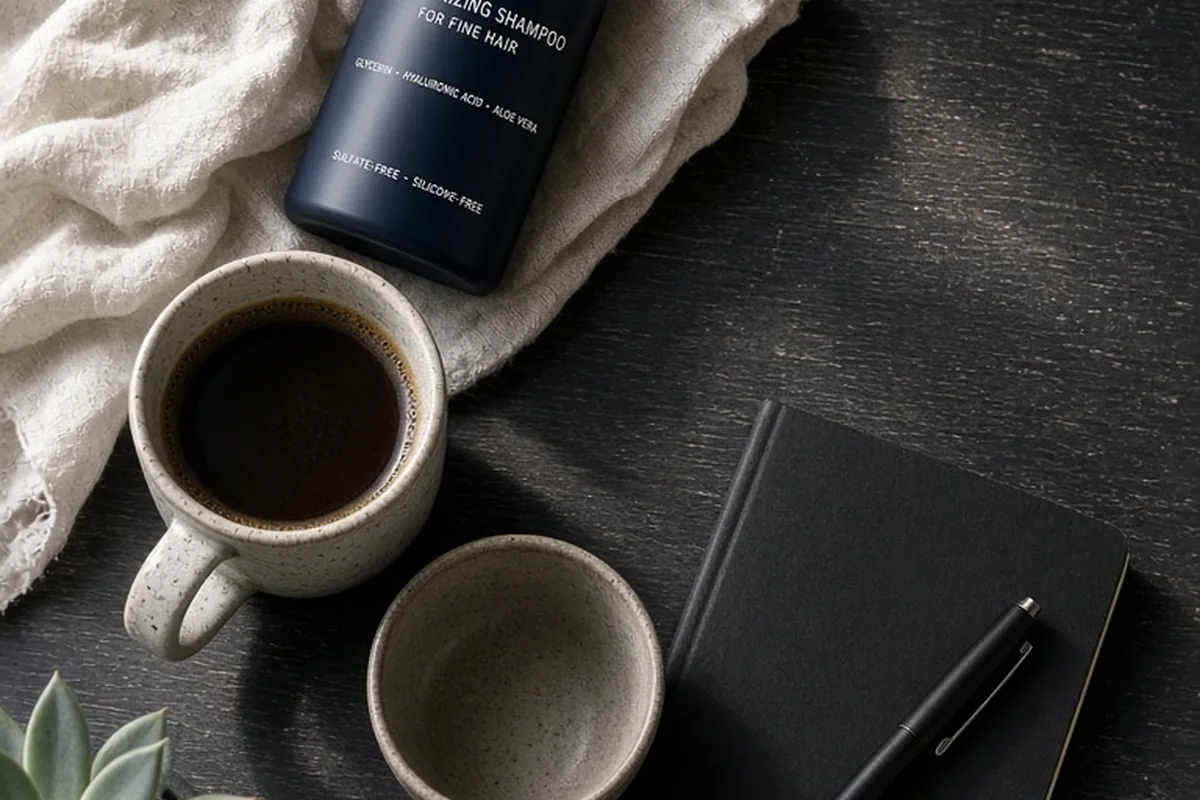
To explain moisturizing shampoo for fine hair to your hairstylist, tell them you need internal strand hydration without surface weight. State clearly that your ends feel dry, brittle, or tangled, but rich, creamy formulas make your roots flat and greasy within hours. Request lightweight humectants like glycerin, hyaluronic acid, or aloe vera, and explicitly ask them to avoid dense botanical butters or heavy silicones at the wash bowl and in retail recommendations.
Navigating a salon consultation can feel daunting when standard industry language equates moisture with rich, dense formulas that overpower delicate hair strands.
The Core Dilemma: Why Fine Hair Needs Moisture Without the Weight
Fine hair presents a distinct physiological contradiction in the salon chair. Individual fine hair strands have a smaller cross-sectional diameter than medium or coarse strands, meaning they have a narrower cortex and fewer structural cuticle layers. Because of this slender diameter, fine hair loses internal hydration rapidly through environmental exposure, heated styling tools, and chemical processing. When fine strands dry out, they become brittle, prone to split ends, and easily snagged by friction. However, that same small diameter means fine hair has significantly less physical surface area to support topical oils, lipids, and conditioning agents before becoming overwhelmed.
Traditional moisturizing shampoos are formulated primarily for coarse, thick, or chemically relaxed hair types that require substantial lipid barrier reinforcement. These conventional formulas rely heavily on dense plant butters, mineral oils, and high-molecular-weight silicones to seal the outer cuticle. On fine hair, those heavy occlusive ingredients fail to distribute properly along the narrow shaft, causing strands to adhere to one another. Instead of feeling supple and moving freely, fine hair quickly collapses at the crown, clumps into stringy sections, and displays visible grease within hours of washing. Understanding this distinction allows you to help your stylist see that your hair is dehydrated, not coarse.
The fundamental issue comes down to the difference between hydration and occlusion. Hydration refers to the absorption of water into the hair cortex to restore elasticity and suppleness, while occlusion involves coating the outside of the hair shaft with lipids to prevent that moisture from escaping. Fine hair constantly craves cortical hydration to prevent mechanical breakage, but it requires only the sheerest layer of surface occlusion to seal the cuticle. Explaining this precise structural balance to your stylist establishes that you are not rejecting moisture itself, but rather rejecting the dense emollients commonly bundled into commercial moisturizing lines.
Exact Phrases to Use During Your Salon Consultation
The timing of your consultation sets the tone for the entire salon visit. Always initiate the conversation while sitting in the styling chair before moving to the shampoo bowl, while your hair is completely dry and in its natural state. Once your hair is saturated with water, a stylist cannot easily assess your natural density, your natural root volume, or the exact areas where dryness manifests. Point directly to your mid-lengths and ends with your fingers to provide a physical anchor for your verbal explanation.
You can open the dialogue with a direct, practical script: I am struggling with mid-length and end dryness, but traditional hydrating products make my roots limp and greasy almost immediately. I need a shampoo that delivers weightless moisture using humectants rather than heavy oils or butters. This statement immediately signals to the stylist that you understand your hair texture and prevents them from automatically reaching for an ultra-rich repair formula from their backbar.
If your stylist begins suggesting a generic smoothing or damage-repair system, clarify your boundaries using concrete performance markers. You might say: If a shampoo leaves a coating on my hair, I lose all natural body and have to wash it again tomorrow morning. What do you have on your shelf that increases strand elasticity and softness without leaving behind any residue? Framing the issue around clean-rinsing performance guides the stylist toward professional clarifying-hydrating hybrids or volume-safe moisture lines designed specifically for delicate textures.
Ingredients to Request Versus Ingredients to Decline
Having a basic working knowledge of cosmetic ingredients allows you to speak the same technical language as your stylist without sounding confrontational. When discussing cleansing options, ask your stylist to look for formulas that feature water-binding humectants high on the ingredient list. Ingredients such as vegetable glycerin, sodium PCA, hyaluronic acid, aloe barbadensis leaf juice, and panthenol (provitamin B5) draw ambient moisture into the hair shaft without depositing a heavy physical film. Lightweight hydrolyzed proteins, including hydrolyzed silk or hydrolyzed wheat protein in modest concentrations, can also reinforce fine hair structures without causing stiffness or greasy clumping.
Conversely, you should specify the emollient categories that consistently cause problems for your fine hair. Inform your stylist that you want to avoid shampoos where unrefined shea butter, cocoa butter, murumuru butter, mineral oil, or petrolatum appear within the first five or six ingredients. While these ingredients are exceptional for textured, tightly coiled, or high-porosity coarse hair, their lipid structures are far too dense for fine strands to bear. You can ask: Does this moisturizing formula get its softness from water-soluble ingredients or from heavy botanical butters?
Silicones require a nuanced conversation because they are not universally detrimental to fine hair, yet they can be problematic when misapplied. Non-water-soluble silicones, such as standard dimethicone or amodimethicone without accompanying clarifying surfactants, tend to accumulate on fine hair cuticles over consecutive washes, eventually blocking moisture absorption entirely and dragging the root down. If your stylist recommends a silicone-containing line, ask whether the silicones are water-soluble—such as dimethicone copolyol or PEG-modified dimethicone—or whether the system includes a balanced surfactant blend that rinses thoroughly without requiring an aggressive clarifying shampoo.
Navigating the Backwash Sink and In-Salon Cleansing Rituals
The shampoo bowl is where miscommunications frequently materialize into flat, over-conditioned hair. In many busy salons, the assistant or stylist operates on autopilot at the backwash, instinctively reaching for a standardized liter pump labeled for moisture or deep conditioning. To prevent an accidental overload before the wash begins, politely ask the person washing your hair what specific bottle they are selecting before they apply it. A quick question such as, Is that a clear hydrating formula or a heavy cream cleanser? gives you an immediate opportunity to redirect them if they picked up an intensive repair product.
Visual appearance is an effective diagnostic tool at the sink. In general, shampoos that pour as completely clear gels feature surfactant systems that rinse away cleanly, making them well-suited for fine hair needing hydration. Shampoos that present as thick, pearlescent, opaque creams usually contain high percentages of suspended conditioning agents, pearlizing waxes, and heavy lipid emollients designed to coat the cuticle during the lather phase. Requesting a translucent or clear hydrating cleanser at the basin ensures that the primary job of the shampoo—cleansing sebum and lifting debris from the scalp—is completed without premature residue buildup.
You should also establish clear expectations regarding conditioner placement while leaning back at the basin. Remind the person washing your hair to keep all conditioning masks or detangling rinses strictly to your mid-shaft and ends, keeping the product at least two to three inches away from your scalp. Fine hair does not require conditioning at the root because natural sebum naturally migrates down the first inch of the hair shaft. Ask them to spend an extra thirty seconds thoroughly rinsing the nape of your neck and behind your ears, where residual emollient buildup most commonly gathers and weighs hair down.
Moisturizing Shampoo for Fine Hair: Retail Recommendations and Take-Home Vetting
When your stylist walks you to the retail display at the conclusion of your appointment, you will likely face a wall of brand families divided into color-coded categories. Stylists often gravitate toward two extremes for fine hair: either an aggressive volumizing collection that can leave ends parched over time, or an intensive nourishment collection meant for damaged, thick hair. When vetting their recommendation for a moisturizing shampoo for fine hair, inspect the front and back of the bottle together. Look for terminology such as weightless hydration, clean moisture, featherlight nourishment, or fine-hair hydrator rather than deep nourishment, intense lipid replenishment, or moisture recovery.
Take a moment to read the physical packaging before agreeing to purchase. Inquire directly about the return or exchange policy on opened salon retail products. Professional salons frequently allow clients to exchange a product within two weeks if it proves incompatible with their hair at home, which provides a risk-free safety net in case the recommended formula proves too heavy after repeated domestic washings. Ask your stylist: If I find that this weighs my crown down after two consecutive washes at home, can I bring it back to swap for a lighter formula in this product family?
If you feel uncertain about a full-sized investment, ask whether the salon carries travel-sized bottles or complimentary backbar samples. Testing a prospective moisturizing shampoo in your own shower with your household water quality is valuable, as hard or mineral-heavy domestic tap water reacts differently with cleansers than softened salon water systems. Trying a smaller volume over three consecutive wash days allows you to observe whether your roots maintain lift while your ends retain flexibility, confirming the stylist's advice before you commit to an expensive liter purchase.
Troubleshooting Stylist Assumptions Around Volumizing Versus Hydrating Formulas
A common obstacle fine-haired clients encounter is a stylist who refuses to recommend any form of moisturizing shampoo, insisting instead that fine hair must exclusively use volumizing products. Many hairstylists are trained to prioritize immediate physical lift and texture over tactile softness when working with fine strands. Volumizing shampoos achieve that lifted aesthetic primarily by incorporating high-clarity anionic surfactants that thoroughly strip surface oils, coupled with structural film-forming polymers that deposit microscopic friction onto the cuticle. This friction props individual strands apart, creating the illusion of fullness at the cost of depleting moisture.
If your stylist tries to steer you exclusively toward a volumizing cleanser, explain why that approach has failed your personal routine in the past. You can explain: When I rely solely on volumizing shampoos, my hair becomes dry, static-prone, and brittle, and my ends snap when I detangle. I would rather achieve volume through strategic blow-drying and root styling sprays while allowing my shampoo to maintain softness and hydration. This clarifies that you are not expecting your shampoo to perform mechanical miracles for root lift, freeing the stylist to focus on a gentle, non-stripping cleanser.
Another effective compromise is discussing a cyclical washing strategy with your stylist. You can propose using a lightweight, humectant-focused moisturizing shampoo for your standard maintenance washes throughout the week, paired with a gentle chelating or clarifying wash once every seven to ten days. Presenting this structured routine demonstrates to your stylist that you have a proactive plan to prevent residue accumulation, making them far more comfortable recommending a genuinely hydrating formula for your everyday cleansing routine.
Frequently asked questions
Can fine hair tolerate a moisturizing shampoo on a daily basis?
Yes, provided the shampoo relies on lightweight, water-soluble humectants like glycerin or panthenol rather than dense butters, heavy silicones, or mineral waxes. A daily formula for fine hair should feature gentle surfactants that rinse clean away, leaving no tactile film on the scalp or roots.
What is the visual difference between a heavy moisturizing shampoo and a lightweight one?
Lightweight moisturizing shampoos are typically translucent or completely clear gels, which generally indicates fewer heavy lipid agents and suspending waxes. Heavy formulas usually appear as thick, pearlescent, opaque creams that leave conditioning agents bound to the cuticle.
How do I know if my fine hair is lacking moisture or lacking protein?
Moisture deficiency causes hair to feel rough, brittle, dull, and prone to static or snags, snapping when stretched without bouncing back. Protein deficiency typically manifests as hair that feels mushy, overly stretchy when wet, limp, and unable to hold its natural curl or wave pattern.
What should I say if my stylist insists fine hair only needs volumizing shampoo?
Tell them that while you appreciate root lift, volumizing shampoos leave your ends excessively dry, brittle, and difficult to detangle. Clarify that you prefer to address hydration at the wash bowl and build physical volume through lightweight styling mousses or blow-dry techniques.
Your next step
Before your next salon appointment, inspect the ingredient list on your current shampoo bottle to identify any heavy butters or insoluble silicones, and write down the two exact consultation phrases you will use during your dry consultation.