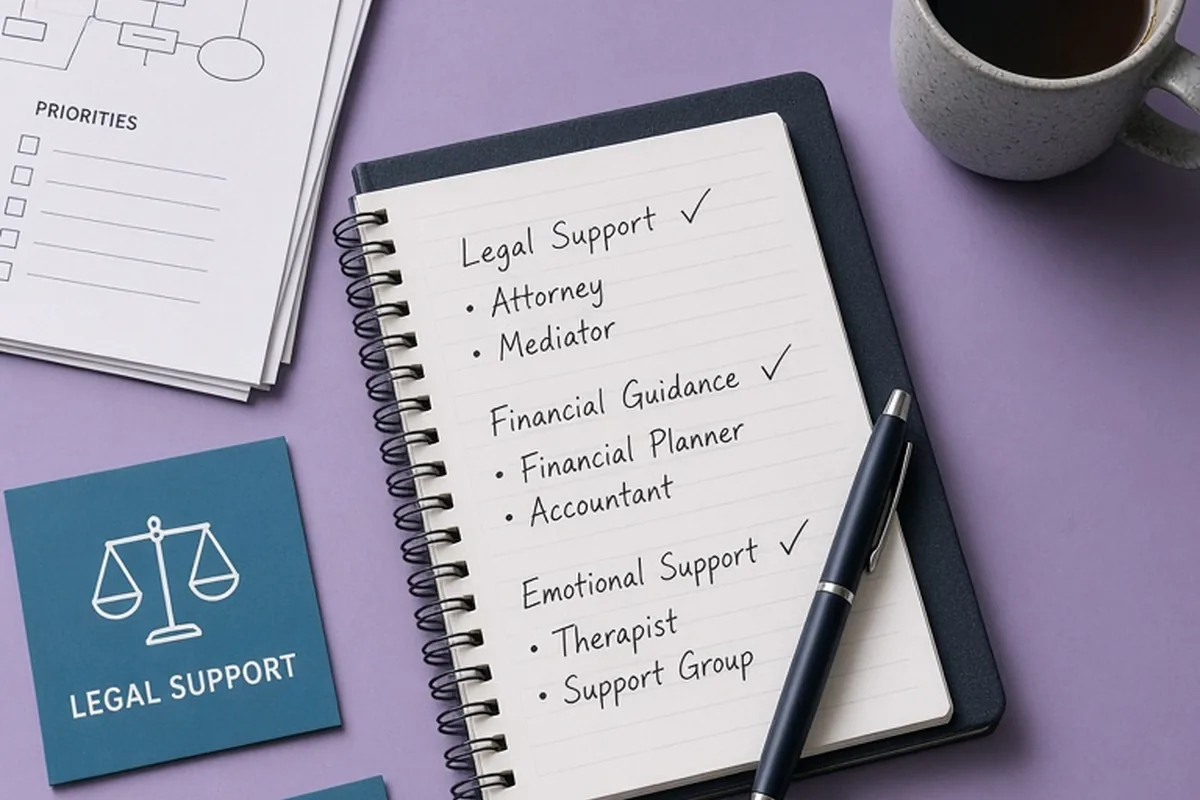
To find support after preparing for divorce, transition from document gathering to assembling vetted professionals and personal care networks. Retain a qualified family law attorney or mediator licensed in your jurisdiction to evaluate your prepared assets. Pair legal representation with a certified financial planner or accountant to assess tax and division implications, and engage a licensed therapist or local support group to manage stress, preserve boundaries, and make steady decisions.
Preparing paperwork, listing marital assets, and mapping personal priorities gives you clarity, but managing the actual divorce process requires experienced external guidance to protect your future.
Selecting Legal Counsel Versus a Neutral Divorce Mediator
Once your personal records, account statements, and property lists are compiled, you must determine what form of legal process best matches your relationship dynamic and safety needs. A contested divorce with significant asset disputes or high conflict generally demands an independent family law attorney who advocates solely for your interests. In contrast, couples who agree on fundamental issues and can communicate transparently often choose professional mediation, where a single neutral practitioner helps both spouses draft an uncontested settlement agreement for court review.
When interviewing legal counsel, bring an organized summary of your assets and debts rather than unvetted binders of raw paperwork. Ask potential attorneys about their hourly rates, retainer fee structures, billing increments for staff paralegals, and their familiarity with the family court judges in your specific county. If you consider mediation, verify that the neutral mediator holds relevant professional credentials, and plan to hire an independent consulting attorney to review any proposed settlement agreement before signing it so you fully understand your statutory rights.
Further reading: USA.gov: Get a copy of a divorce decree
Hiring Financial Specialists to Evaluate Assets and Debts
Document preparation often reveals complex balance sheets containing retirement accounts, equity compensation, real estate mortgages, and joint credit balances. A general attorney focuses primarily on statutory property division guidelines, but a Certified Divorce Financial Analyst or qualified public accountant evaluates how settlement structures impact your cash flow and long-term security over years. Financial specialists examine the present and future value of unequal assets, such as balancing immediate home equity against illiquid 401(k) balances that carry deferred taxation.
Consulting a tax professional is equally critical during this transitional phase. Federal tax treatment on property transfers, spousal maintenance, and dependent exemptions depends on your specific filing status, final decree terms, and IRS regulations. Bringing your initial financial inventory to an accountant enables you to anticipate post-divorce tax liabilities, project future housing budgets, and prevent unexpected shortfalls that could undermine an otherwise equitable settlement agreement.
Further reading: IRS Publication 504: Divorced or Separated Individuals
Building Emotional and Mental Health Resources
Transitioning from private preparation to active separation triggers acute emotional fatigue, grief, and anxiety. Leaning entirely on friends or adult children can strain personal relationships and frequently results in well-intentioned but legally inaccurate guidance. Working with a licensed mental health counselor or marriage and family therapist creates a confidential, objective setting where you can process fear, regulate conflict impulses, and develop constructive coping mechanisms.
In addition to individual therapy, structured divorce support groups offer validation from peers working through comparable custody, housing, and lifestyle shifts. Community mental health clinics, hospital networks, and community centers regularly host weekly divorce recovery workshops. Participating in these spaces helps reduce isolation and prevents reactive decision-making during tense procedural negotiations.
Navigating State Court Self-Help Centers and Legal Aid Clinics
If retaining private counsel or specialized financial consultants exceeds your household budget, court-sponsored resources provide practical procedural orientation. Most county family courts operate self-help desks, facilitator offices, or pro se clinics designed to assist self-represented litigants. While self-help staff cannot provide strategic legal advice or act as your courtroom advocate, they explain mandatory filing sequences, identify statutory form requirements, and clarify service-of-process deadlines.
Regional legal aid societies and non-profit bar association clinics also offer low-cost or pro bono assistance for qualifying individuals, particularly when domestic safety concerns, custody disputes, or extreme income disparities exist. Because rules, filing fees, and standardized forms vary widely across jurisdictions, consulting your regional court clerk or state judicial website guarantees that you submit filings that comply with local rules.
Further reading: USA.gov: Get a copy of a divorce decree
Organizing Parenting Coordinators and Family Stabilization Services
When children are involved, finding professional co-parenting guidance early minimizes operational friction and shields minors from adult disputes. Family stabilization courses, often mandated by state family courts before finalizing a dissolution, teach communication techniques, boundary setting, and shared custody logistics. Engaging a parenting coordinator or child specialist can help parents negotiate holiday schedules, extracurricular expenses, and medical decision protocols before submitting an agreement to a judge.
A parenting specialist also helps identify whether joint custody plans or structured parallel parenting models fit your family circumstances. In high-conflict relationships where direct communication produces recurrent arguments, specialized coordinators recommend utilizing monitored parenting communication applications and secure neutral pickup locations. Establishing these neutral guardrails during the early stages of divorce preserves developmental stability for children and prevents unnecessary enforcement hearings.
Establishing Reliable Digital and Personal Boundaries
Gathering support extends beyond professional retainers; it requires curating a safe, functional day-to-day personal environment. Once you move into formal separation, reset personal passwords on individual email accounts, online banking profiles, cloud storage vaults, and cellular service plans. Notify trusted friends and close family members regarding the boundaries you need, asking them to respect court privacy by refraining from discussing dispute details or posting about your spouse on social media platforms.
Establish designated hours during the week to address legal correspondence, financial balance reconciliations, and housing logistics. Dedicating focused blocks of time to divorce management prevents procedural paperwork from consuming every evening and weekend. Setting structured limits around when you review emails from counsel or your spouse protects your emotional stamina, career obligations, and parenting focus throughout the months ahead.
Evaluating Community Housing and Credit Transition Programs
Transitioning from shared marital living arrangements to independent residences requires localized logistical support. Independent real estate professionals with certified divorce real estate credentials understand the legal constraints of marital property sales, court orders, and spousal buyouts. They coordinate directly with title officers and attorneys to prevent unauthorized property encumbrances while legal proceedings remain open.
Simultaneously, local community banking advisors and credit counseling agencies assist individuals in establishing separate revolving credit, removing authorized user attachments, and auditing credit reports for marital debt errors. Opening independent banking accounts at an entirely separate financial institution from your former joint accounts protects incoming earnings and gives you autonomy over daily living expenditures as you navigate settlement discussions.
Illustrative Scenarios
Transitioning from Document Gathering to Strategy
After spending several months cataloging joint bank statements, tax records, and real estate documents into folders, an individual felt overwhelmed about how to take the next step. Confused by conflicting advice from relatives urging an aggressive lawsuit, the person initially scheduled multiple consultations with adversarial litigators without a clear objective. Recognizing rising anxiety, the individual paused to consult a local divorce mediation professional alongside an independent consulting attorney. This approach allowed the person to present the organized records clearly, confirm local statutory property division practices, and resolve the matter amicably without depleting savings on courtroom disputes.
Key point: Organized records are most effective when paired with professional advisors who align with your goals rather than escalating conflict.
Managing Co-Parenting Tensions Through Structured Third-Party Tools
Following an initial separation filing, two parents found that everyday text messages about school pickups and soccer practices consistently escalated into arguments over finances and past grievances. The primary caregiver initially considered filing emergency motions in court to restrict communications entirely. Instead, upon consulting a court-connected family facilitator, both parents agreed to engage a licensed parenting coordinator and transition all logistics to a court-approved messaging platform. The secure application logged all scheduling updates and restricted off-topic arguments, stabilizing the home routine for their children.
Key point: Implementing structured communication tools and specialized third-party facilitators prevents routine co-parenting logistics from deteriorating into legal disputes.
Frequently asked questions
How do I choose between an attorney and a mediator after preparing my documents?
Choose an attorney if there is significant conflict, hidden asset concerns, domestic safety issues, or an unwillingness to communicate fairly. Consider a professional mediator if both spouses agree to disclose all assets voluntarily and want to negotiate a settlement cooperatively. Even in mediation, retaining an independent consulting attorney ensures your legal interests are protected before you sign.
What should I bring to an initial consultation with a divorce professional?
Bring a summary of marital assets, debts, recent tax returns, pay stubs, and a concise timeline of your marriage and separation. Avoid bringing unorganized boxes of paperwork; presenting a streamlined one-page summary sheet helps the professional assess your legal position quickly and reduces preliminary hourly billing charges.
Where can I find free or low-cost divorce support services?
Check with your county family court self-help center or clerk's office for free legal information packets, procedural workshops, and pro se clinics. Additionally, reach out to local legal aid organizations, accredited non-profit counseling clinics, and community divorce recovery groups that offer sliding-scale or volunteer-led support.
How do divorce proceedings impact current-year federal taxes?
Your marital status on December 31 generally determines your filing status for that entire tax year under federal guidelines. Property transfers incident to divorce, dependent child exemptions, and spousal support handling carry specific tax rules that vary by agreement date and state decree structure, requiring guidance from a certified tax advisor or official IRS guidance.
Your next step
Schedule an exploratory consultation with a licensed family law attorney or court self-help clinic in your county this week to review your prepared financial overview.