You get over an ex-girlfriend by treating the breakup like grief plus habit change: stop checking her feeds, limit contact, name what you miss, and fill the empty hours with sleep, movement, friends, and work. Expect waves, not a straight line. When you can remember her without needing to fix it, you are healing.
There is no switch that turns off attachment, but there is a way to stop feeding it while your life catches up.
Accept that missing her does not mean you should go back
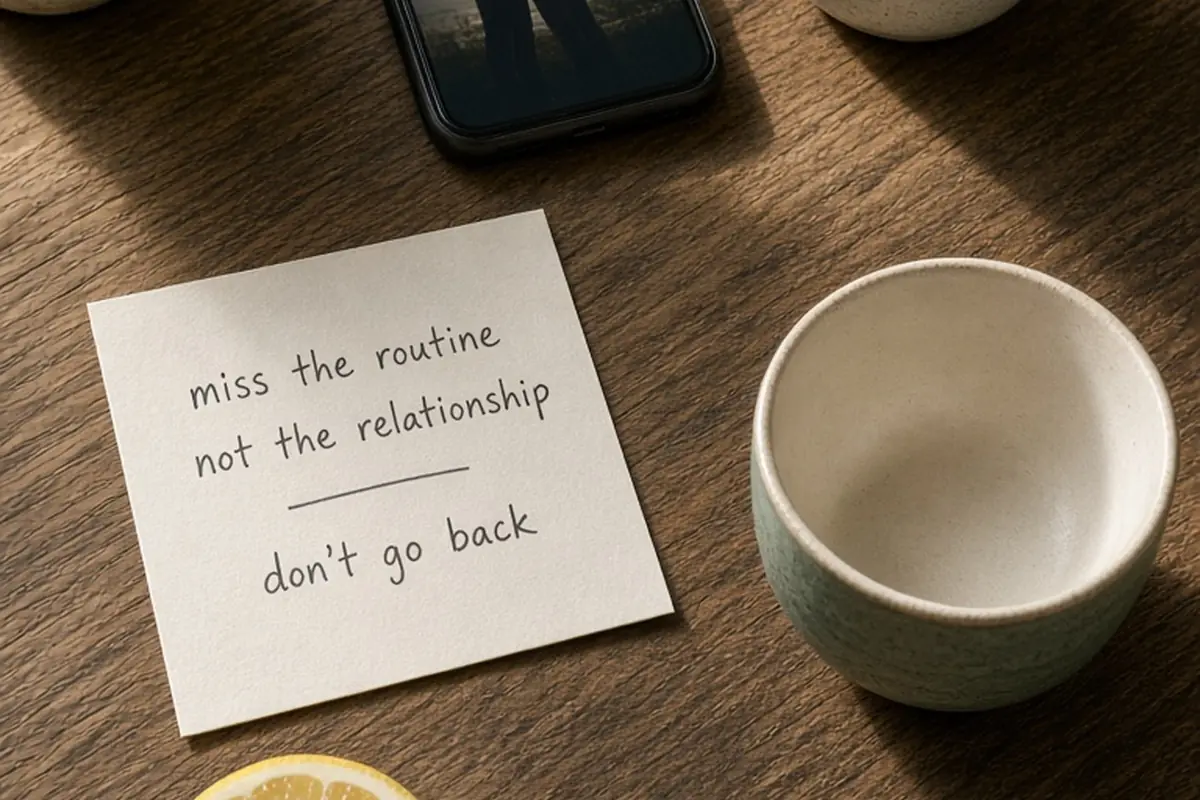
The first trap is confusing pain with proof. Missing her can mean you miss routine, sex, being chosen, inside jokes, or the version of yourself that felt wanted. It does not automatically mean the relationship was right or that one more message will solve the reason it ended. Give the feeling a name before you give it a job: loneliness, rejection, boredom, guilt, desire, or fear of starting over.
A useful move is to write two honest lists: what you actually miss and what was not working. Keep them specific. “She made me feel calm on Sundays” is different from “we fought every time I needed space.” The limit here is important: lists will not erase longing, and you should not use them to talk yourself into hating her. They are there to keep your memory honest when your body wants a highlight reel.
Cut the drip feed of contact and checking
If you keep tasting the relationship in small doses, your system never learns that it is over. Mute or unfollow her accounts, archive the chat, move photos off your phone, and ask friends not to report back. If you share kids, work, or a lease, keep contact logistical and brief: pickup times, bills, keys. The goal is not to punish her; it is to stop reopening the wound every evening.
Expect urges to spike at predictable times: late night, after drinking, after a date that goes nowhere, when a song hits, or when you see a place you used to go. Plan for those moments instead of relying on willpower. Put a friend on speed dial, keep your phone out of the bedroom, and have a ten-minute walk route ready. The trade-off is that distance can feel cold at first, especially if the breakup was gentle. It is still kinder than keeping both of you half-attached.
Let grief be real without letting it run your life
A breakup can bring sadness, anger, relief, embarrassment, and hope in the same afternoon. That mix is normal. What makes it worse is arguing with the feeling or performing recovery for an audience. Set a daily container: twenty minutes to write, cry, lift, walk, or sit in the car and admit what hurts. When the time is up, do one small task that belongs to your life now.
Do not rush to turn pain into a lesson before it has finished being pain. At the same time, do not let grief become an identity that gets you out of showers, work, meals, and friendships. If you notice you cannot function, are using alcohol to sleep, or are thinking about harming yourself, treat that as a signal to get direct support from a qualified professional or someone you trust right away. Practical routines help many people, but they are not a substitute for care when the bottom drops out.
Rebuild the parts of you the relationship crowded out
Attraction and confidence usually return through evidence, not affirmations. Give yourself evidence: train three times a week, cook two decent meals, finish a work task you have avoided, see friends who knew you before her, and clean the space where you sleep. These are not magic. They are votes for the man you are becoming, and each vote makes the next one easier.
Choose one domain to strengthen first instead of trying to become a new person by Friday. If the relationship made you isolated, start with friendship. If it made you passive, start with a decision you have postponed. If it made you anxious, start with sleep and mornings. The limit is that self-improvement can become another way to compete with her new life or prove she made a mistake. Build for the life you want when nobody is watching.
Handle mutual friends, places, and the urge to ask for closure
Shared worlds make breakups messy. You may run into her at a gym, a wedding, a group chat, or a street you both liked. Decide your rules before emotions are loud: greet politely, keep it short, leave if you need to, and do not use friends as detectives. If a friend keeps bringing her up, say, “I am trying not to track her. Tell me about your week instead.”
Closure is usually something you give yourself after you stop waiting for a better explanation. If a conversation is truly necessary, ask for one clear thing and accept that you may not get a satisfying answer. A better self-check is: “What would I do if I knew she was never going to explain it?” Then do that. The trade-off is that unanswered questions can itch for a while. Chasing them often costs more dignity than it buys peace.
Date again only when you can be curious instead of hungry
Rebounding is not automatically wrong, but using someone as anesthesia usually hurts both of you. A decent readiness test is simple: can you meet a new woman without comparing every laugh to your ex, without needing instant reassurance, and without telling the story of the breakup like a courtroom case? If not, keep building your life and let dating wait.
When you do go out, keep stakes low and honesty high. Choose a coffee or walk, be clear that you are dating casually if that is true, and do not perform intimacy to prove you are over someone. Pay attention to how you feel after the date: energized and curious is different from empty and triumphant. No approach guarantees attraction, and rejection may still sting. The win is that you can want someone without needing them to rescue you from your history.
Know what progress actually looks like
Progress is not never thinking about her. It is thinking about her and still choosing your day. It is hearing her name without scanning the room, seeing a photo without reading the comments, and remembering a good trip without rewriting the bad ending. Some weeks you will feel free; then a dream or anniversary knocks you sideways. That is a wave, not a failure.
Measure recovery by behavior: Are you sleeping? Are you reaching out when you said you would not? Are you present with friends? Are you making choices from self-respect rather than spite? If you slip, reset the same day instead of declaring the whole effort ruined. The limit is that time alone does not heal if you keep feeding the attachment. Time plus boundaries plus a fuller life is what slowly gives you back to yourself.
Illustrative Scenarios
The late reply that felt like a door opening
A composite example: three weeks after a breakup, “Marc” gets a 1:12 a.m. text from his ex that says, “Hope you are good.” He reads it as a sign she regrets leaving and spends an hour drafting the perfect casual reply. Instead, he waits until morning, notices he only wants the text to mean the breakup was a mistake, and answers once with a polite, closed message: “Hope you are too. Take care.” Then he archives the thread and goes to the gym.
Key point: A late message can be loneliness, guilt, or habit. Waiting until you are calm helps you answer the reality, not the hope.
The photo that looked like a message
A composite example: “Devon” sees his ex like a friend’s photo where she is standing near a man he does not know. His first interpretation is that she moved on fast and wanted him to see it. He almost checks the man’s profile, then remembers the agreement he made with himself: no detective work. He mutates the group chat for a day, tells a friend he feels jealous without asking for details, and plans dinner with his brother. The jealousy fades faster than expected.
Key point: Social media often shows context-free moments. Protecting your attention is more useful than solving a story you cannot verify.
Frequently asked questions
Should I stay friends with my ex-girlfriend?
Usually not right away if you still want her back or feel pulled to check on her. Friendship works better after both people can hear about the other dating without spiraling. If you try it, keep boundaries clear and be honest if it starts hurting.
How long does it take to get over an ex-girlfriend?
There is no reliable timeline because it depends on the relationship, the breakup, and how much contact you keep. A better marker is whether your choices are becoming steadier: fewer checks, better sleep, less bargaining, more interest in your own life. If functioning keeps getting worse, seek direct support.
What if we work together or share a friend group?
Keep communication necessary, brief, and boring: schedules, tasks, logistics. Tell close friends you do not want updates, and leave events early if you need to without making a scene. You can be civil without being available.
Is it okay to hook up or date right after a breakup?
It can be, if you are honest with yourself and the other person about what you can offer. If you are using attention to numb pain or make your ex jealous, pause. Choose low-pressure dates and stop if you leave feeling emptier.
Your next step
Tonight, do one concrete reset: mute or unfollow her, put the chat in archive, and write down the next morning plan you will do before checking your phone.