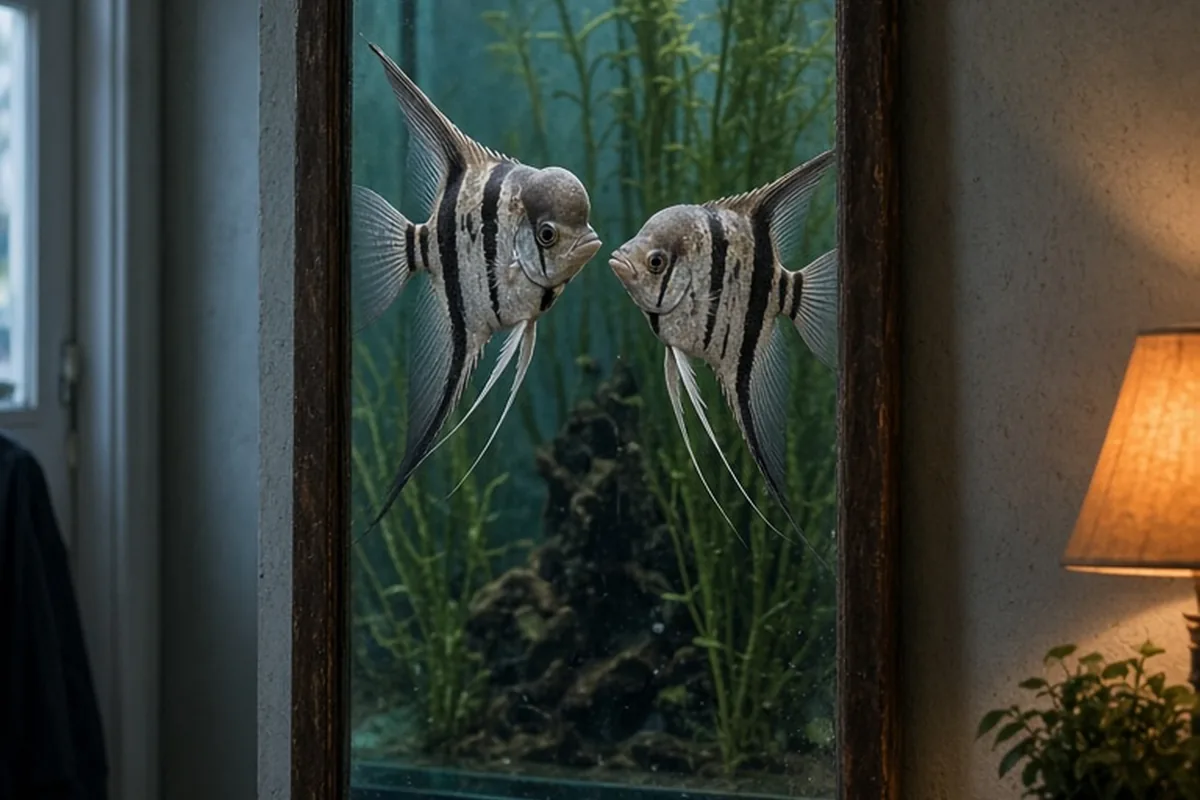
To identify male and female angelfish reliably, inspect their breeding papillae during spawning. The male papilla is pointed, slender, and angled forward like a pencil tip, while the female papilla is wider, blunt, and cylindrical like an eraser. Subtle adult traits include a rounded male forehead bump and a straighter female ventral line, though physical morphology alone is never completely definitive outside active reproduction.
Freshwater angelfish (Pterophyllum scalare) are among the most popular cichlids in the home aquarium, yet distinguishing males from females presents a perennial challenge for aquarists. Because these fish lack prominent sexual dimorphism across most of their lifespan, hobbyists often rely on a combination of anatomical observations, courtship behaviors, and reproductive timing to determine the sex of their specimens.
The Breeding Papilla as the Primary Diagnostic Feature
The single definitive physical difference between male and female angelfish appears in the genital papilla, commonly called the breeding tube. Located on the ventral side between the anal fin and the ventral fins, this organ descends when fish mature and prepare to reproduce. In females, the breeding tube functions as an ovipositor designed to deposit rows of adhesive eggs onto vertical surfaces such as slate, broad leaves, or aquarium glass. As a result, the female organ is relatively broad, blunt, and rounded at the terminal end, bearing a profile comparable to a pencil eraser. It generally protrudes downward at an angle perpendicular to the belly line to facilitate flat placement of the clutch.
In contrast, the male papilla serves to fertilize the eggs immediately after deposition. It is noticeably thinner, more pointed, and often angles slightly forward or backward rather than dropping straight down. Observing this structure requires patience, as the papilla remains retracted inside the vent during ordinary non-spawning periods. Attempting to force inspection by netting or holding the fish out of water creates severe physiological stress and rarely causes the tube to extend. The most reliable approach is observing the pair undisturbed in a dedicated tank while they clean a prospective spawning site, at which point the papillae extend fully and remain visible for several hours.
Secondary Physical Traits and Crown Morphology
Beyond the breeding tube, mature angelfish frequently display subtle variations in their head contours and ventral body lines, though these secondary characteristics serve as probabilistic clues rather than absolute proof. Fully grown males often develop a modest fatty deposit on the forehead directly above the eyes, creating a subtle nuchal hump or convex profile. In many domestic strains, this gives the male an abrupt, angular crown when viewed in profile. Females, by comparison, typically maintain a smoother, flatter, or slightly concave slope running from the snout up to the dorsal fin insertion.
Body geometry along the ventral keel can also offer contextual hints when comparing fish of identical age and diet. A mature female angelfish often exhibits a slightly more rounded, swollen abdomen even between spawning cycles, creating a softer angle between the ventral fins and the anal fin. Males tend to show a straighter, more streamlined lower body line. However, line breeding and genetic variations across varieties such as veil angels, marbles, and koi types have blurred these geometric markers. Heavy feeding or internal parasitic issues can mimic abdominal fullness, meaning an aquarist should never rely on body contours in isolation.
Courtship Dynamics and Spawning Behaviors
Behavioral cues during maturity provide substantial evidence regarding sex, particularly when angelfish are maintained in communal settings. As angelfish reach reproductive maturity around eight to twelve months of age, potential pairs begin separating themselves from the general hierarchy. Males typically assume an assertive posture, flaring their gills, locking jaws with rivals, and defending a defined territory around vertical structures. When courting an interested partner, a male frequently performs lateral displays, twitching his body and shimmying alongside the female while guiding her toward a chosen spawning surface.
The cooperative cleaning ritual provides another strong indicator of pair formation, though behavioral observation carries an important caveat. Angelfish of the same sex, particularly two mature females housed without a male, are known to form pseudo-pairs. In these instances, both females may clean a slate, perform reciprocal courtship rituals, and even deposit two separate clutches of unfertilized eggs side by side. Conversely, two aggressive males might engage in intense territorial defense that mimics pair-bonding before escalating into damaging combat. Therefore, witnessing collaborative pre-spawning behavior strongly suggests pairing, but only the appearance of viable, fertilized eggs confirms a true heterosexual bond.
Developmental Limitations in Juvenile Angelfish
Retail stores and commercial hatcheries commonly sell juvenile angelfish between the sizes of a quarter and a half-dollar coin. At this developmental stage, distinguishing males from females through visual inspection is practically impossible. The internal reproductive organs are not yet developed, secondary cranial humps have not formed, and the genital papillae remain completely hidden within the body cavity. Any retail claim that very young angelfish are pre-sexed based on dorsal fin length, stripe patterns, or minor fin extensions is inaccurate.
Attempting to sex juveniles visually often leads hobbyists to purchase mismatched groups that cause long-term stocking imbalances. To establish a confirmed pair from young fish, the standard methodology involves acquiring a cohort of five to six unrelated juveniles and raising them together in a tank of appropriate capacity, such as a 55-gallon aquarium. As the cohort reaches sexual maturity, natural pair bonding occurs organically. Once a definitive pair forms and stakes out territory, the remaining fish can be rehomed or moved to another aquarium to prevent chronic social stress.
Managing Territory and Social Stress in Paired Tanks
Identifying a male and female pair changes the social structure of an aquarium dramatically. Angelfish are generally peaceful cichlids under non-breeding conditions, but pair formation shifts their behavior toward intense territorial defense. The bonded pair claims an operational perimeter of roughly twelve to eighteen inches around their chosen spawning substrate, driving off all other tankmates with charging runs, fin nipping, and chasing. In aquariums smaller than forty gallons, this localized aggression can easily corner subordinate fish, leading to torn fins, secondary bacterial infections, and chronic wasting.
Proper habitat layout mitigates this aggression effectively. Aquarists should incorporate tall sightline breaks using broadleaf plants such as Echinodorus (Amazon swords), upright driftwood branches, or vertical slate panels placed at opposite ends of the enclosure. These visual barriers allow non-breeding fish to forage and swim without constantly entering the breeding pair's line of sight. If aggressive interactions persist despite visual buffering, transferring the confirmed male and female to a dedicated 20-gallon-high or 29-gallon breeding aquarium provides the best balance of safety for community tankmates and stability for the parents.
Common Myths and Misleading Visual Markers
Decades of fishkeeping lore have generated numerous myths regarding angelfish sexing that continue to circulate in online forums. One widespread claim suggests that the angle of the dorsal fin relative to the spine indicates gender, with males supposedly having dorsal fins that rise strictly vertical and females possessing fins that slant backward. Controlled observations of diverse captive strains demonstrate that fin angles correspond to genetics, juvenile nutrition, and water flow rather than sex. A fish with an upright dorsal fin is just as likely to be female as it is to be male.
Another persistent misconception involves the length of the trailing pelvic fins and the presence of crown coloration. Some hobbyists believe that extended ventral filaments or deeper pigmentation on the head indicate a male. In reality, modern color strains—such as high-coverage blushes, calicos, and pearls—express coloration based on underlying pigment genes that are not sex-linked. Relying on these visual shortcuts invariably produces false identifications. Systematic observation of the genital papilla during active spawning remains the only verifiable morphological test available to the home keeper.
Optimizing Environmental Conditions for Spawning Confirmation
Because definitive sex identification relies on the extension of the breeding tubes during spawning, aquarists often condition their fish to induce reproductive behavior safely. Conditioning begins with dietary refinement. Offering high-protein, nutrient-dense foods such as live or frozen bloodworms, brine shrimp, and high-grade spirulina flakes for ten to fourteen days stimulates egg production in females and elevates hormonal activity in males. Consistent nutrition signals favorable conditions, prompting the fish to display their breeding anatomy.
Water parameters must complement this conditioning regimen. Angelfish respond favorably to stable, slightly soft water with a neutral to mildly acidic pH between 6.5 and 7.2. Conducting a moderate water change of twenty to twenty-five percent using water that is one to two degrees Fahrenheit cooler than the aquarium can mimic the onset of natural rainfall cycles, which often serves as an environmental trigger for spawning. Maintaining a pristine environment with low dissolved organics prevents fungal issues on the ovipositor and encourages the pair to proceed with deposition, allowing the aquarist to clearly document which fish deposits eggs and which fish follows to fertilize.
Frequently asked questions
Can two female angelfish lay eggs together without a male?
Yes, two mature female angelfish kept in the same aquarium can pair up and perform typical courtship rituals. Both females will extend their wide ovipositors and deposit rows of eggs on the substrate, but because there is no male to fertilize them, the entire clutch will turn white and fungused within two to three days.
At what age or size can you tell if an angelfish is male or female?
Angelfish generally cannot be sexed accurately until they reach reproductive maturity, which occurs between eight and twelve months of age when the fish measure approximately three inches in body diameter. Prior to this stage, internal reproductive organs are underdeveloped, and breeding tubes remain unextended.
Does the size of the angelfish indicate its sex?
Size alone is not a reliable indicator of sex. While adult males occasionally grow slightly larger and develop a slightly thicker forehead profile than females of the same brood, individual genetics, tank hierarchy, and access to food exert far greater influence on total adult size.
Your next step
Inspect your mature angelfish during their next active spawning cycle to examine the shape of their breeding tubes, noting whether the organ is slender and pointed or broad and blunt.