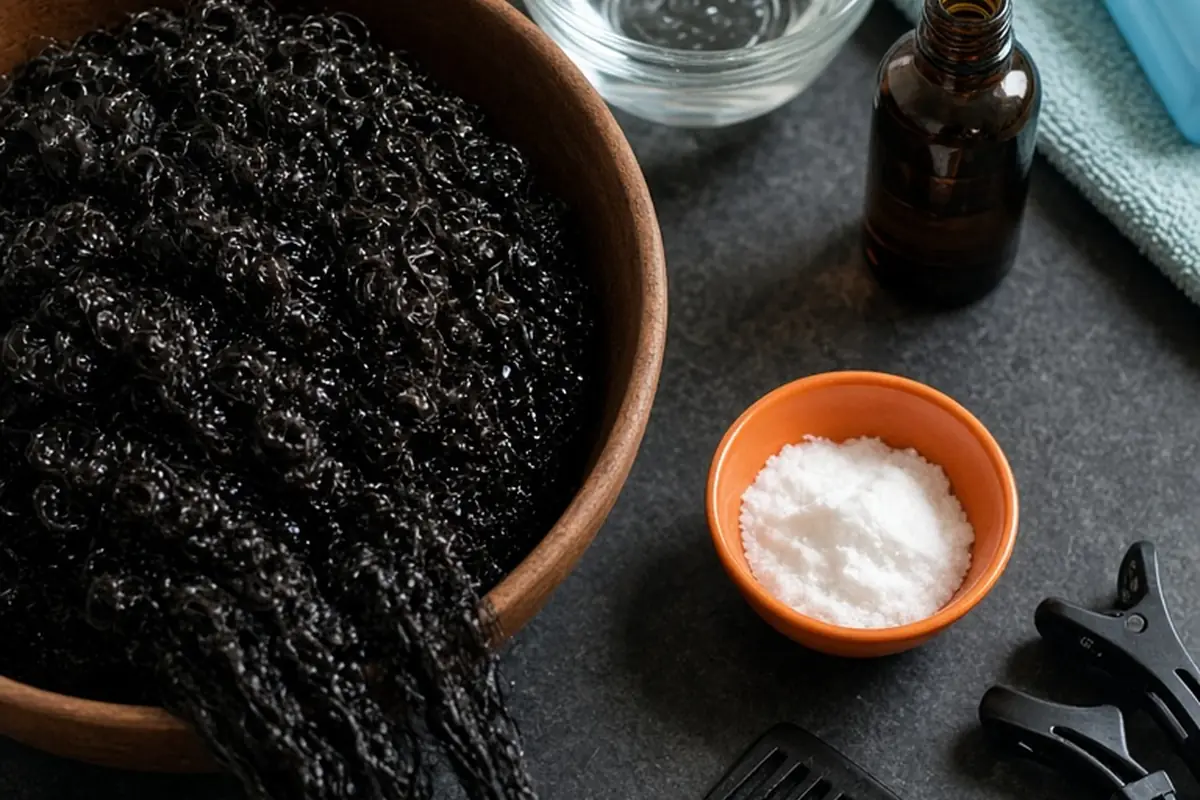
Preparing Black hair for a moisturizer requires thoroughly cleansing the scalp and strands to remove silicone or butter buildup, detangling in sections while damp, and opening the hair cuticle with warm water or gentle steam. Because true moisture comes from water, hair must be clean and damp rather than bone-dry or coated in old product, allowing water-based moisturizing ingredients to penetrate the cortex before you apply an emollient or sealing oil.
Moisturizing textured and Afro-coiled hair is often treated as a simple matter of applying a rich cream, yet many people find their hair feels brittle or greasy just hours later. In most cases, the issue lies not in the moisturizer itself, but in how the hair was prepared before application. Without the right foundation, topical lotions and butters sit on top of the strand rather than absorbing deeply into the fiber.
Clearing Old Buildup Before Adding New Hydration
One of the primary reasons Black hair fails to absorb moisture is the accumulation of residual oils, heavy butters, silicones, and environmental debris on the hair shaft. When you layer fresh moisturizer over existing product buildup, the active humectants and conditioning agents cannot reach the hair cortex. Instead, they mingle with dried styling residues, creating a dull, tacky film that blocks external hydration and eventually leads to chronic dryness and snapping.
To properly prepare your strands, begin with an intentional cleansing routine. If you regularly use raw shea butter, beeswax, or heavy botanical oils, a gentle clarifying shampoo or an apple cider vinegar rinse once or twice a month is necessary to strip away accumulated occlusives. On standard wash days, follow with a sulfate-free, moisture-rich shampoo focused directly on the scalp and gently worked down the lengths. Clean hair shafts present an exposed, receptive cuticle layer that allows water and water-based moisturizers to enter freely.
Assessing Your Hair Porosity to Determine Prep Steps
Porosity describes how readily your hair cuticles open and close to absorb and retain moisture. Because textured hair ranges widely from low to high porosity, your preparation steps must align with your specific cuticle structure. Low-porosity Black hair has tightly bound, overlapping cuticle scales that resist water penetration, while high-porosity hair has raised, chipped, or compromised cuticles that take in moisture instantly but lose it just as quickly.
If you have low-porosity hair, your preparation must incorporate mild heat or steam to lift the tight cuticles before applying leave-in products or creams. Without this thermal assistance, water-based moisturizers tend to bead up on the surface. Conversely, preparing high-porosity hair requires strengthening the protein framework and using cool or lukewarm water rinses during the prep stage to smooth raised cuticles, preventing rapid evaporation once the moisturizer is worked through the strands.
Water Temperature and Steam Techniques for Cuticle Prep
Water is the fundamental source of hydration for hair, making thermal prep one of the most effective ways to prime tightly coiled textures. Rinsing your hair with warm water softens the keratin structure and encourages cuticles to lift slightly without causing heat damage. Avoid scalding hot water, which strips natural scalp sebum and inflames sensitive skin, and avoid ice-cold water during the initial prep stage because it causes cuticles to clamp shut before moisture can enter.
Incorporating indirect steam is another excellent preparation method, especially for tightly coiled 4A to 4C textures prone to shrinkage and rigidity. Sitting under a hooded steamer for ten to fifteen minutes or wearing a shower cap over damp hair covered with a warm, damp towel creates a humid environment. This softens hardened natural oils on the hair shaft and expands the strand, creating optimal pathways for subsequent moisturizing lotions and botanical creams.
Sectioning and Gentle Detangling on Damp Black Hair
Attempting to apply moisturizer across an unsectioned mass of coily or kinky hair inevitably results in uneven coverage, leaving inner layers dry while outer layers receive excess product. Sectioning your hair into four to eight distinct quadrants using plastic butterfly clips or soft hair bands allows you to manage each area with precision and ensure even saturation from root to tip.
Before smoothing on your primary moisturizer, gently detangle each section while it remains damp and lubricated with water or a lightweight priming spray. Use your fingers first to separate shed hairs and break up large tangles, then follow with a wide-tooth comb or flexible detangling brush working upward from the ends to the roots. Removing shed hair and smoothing the fiber alignment ensures that when you apply your rich cream, every individual strand receives uniform contact without mechanical breakage.
Applying a Liquid Base or Priming Hydrosol
A common mistake in textured hair care is applying thick, oil-heavy creams directly onto dry or barely damp hair. True moisturization requires an aqueous base because oils and butters are sealants and emollients, not hydrators. Preparing the hair involves ensuring the strand is thoroughly saturated with clean water, a floral hydrosol like rosewater, or an aloe vera juice mist before heavy products touch the hair.
For an extra conditioning foundation, layer a lightweight, water-based leave-in conditioner over your damp hair as a primer. Look for formulations where purified water or aloe barbadensis leaf juice is listed as the very first ingredient, paired with humectants such as vegetable glycerin, panthenol, or agave nectar. This liquid step plumps the hair shaft, infuses moisture into the cortex, and creates a smooth surface that helps heavier moisturizing butters spread evenly without drag.
Common Preparation Mistakes That Block Moisture Absorption
Several routine habits can inadvertently undermine your moisturizing efforts before you even open a product jar. The most frequent error is applying heavy sealing oils, such as castor oil or mineral oil, to dry hair under the assumption that they provide moisture. Because pure oils contain no water, applying them first forms a hydrophobic barrier that repels all future moisture, locking internal dryness in and external hydration out.
Another widespread issue is rushing the drying process using rough terrycloth towels, which pull away essential moisture and create friction that chips the cuticle layer. Instead, gently squeeze excess water with a microfiber towel or a soft cotton t-shirt until hair is damp rather than soaking wet. Finally, skipping regular clarifying washes in favor of continuous co-washing can saturate the hair shaft with conditioning agents that eventually ferment, attract dust, and block the absorption of daily moisturizers.
Customizing the Moisturizing Routine for Black Hair Textures
Different curl patterns and densities require subtle adjustments in how you finalize your preparation. Denser, tightly coiled 4B and 4C patterns benefit from remaining slightly wetter during prep, as the high density of coils creates friction that makes product distribution difficult on semi-dry strands. In contrast, looser 3B and 3C curls can be prepared on towel-damp hair to avoid weighing down natural curl volume with excess water weight.
Once your hair is clean, warm-rinsed, sectioned, detangled, and primed with an aqueous base, it is primed for either the LOC (Liquid-Oil-Cream) or LCO (Liquid-Cream-Oil) application method. The ideal sequence depends on how your hair responds: applying cream before oil traps water inside the cortex while using the oil as a finishing seal, whereas applying oil over the liquid primer helps soften coarse strands before a heavy butter seals the outer layer.
Frequently asked questions
Should Black hair be wet or dry before applying moisturizer?
Black hair should generally be damp to wet before applying a moisturizer. Because moisture is water, applying water-based products to damp hair allows the ingredients to penetrate the strand effectively. Applying heavy moisturizers to completely dry hair often leads to product buildup on the surface without hydrating the inner cortex.
How often should you clarify Black hair before moisturizing?
Clarifying should typically be done every two to four weeks, depending on how many heavy butters, oils, and styling gels you use. If your hair begins to feel coated, resistant to water, or consistently dry despite frequent moisturizing, it is time for a clarifying wash to remove buildup.
Can I use warm water if my scalp is sensitive or dry?
Yes, but use lukewarm water rather than hot water. Lukewarm water is gentle enough to avoid irritating a sensitive scalp while still providing enough warmth to lift the hair cuticles and soften natural sebum for effective moisturizing.
Your next step
Divide your clean, damp hair into four manageable sections today, mist each section thoroughly with warm water or an aloe primer, and detangle with a wide-tooth comb before applying your favorite moisturizing cream.