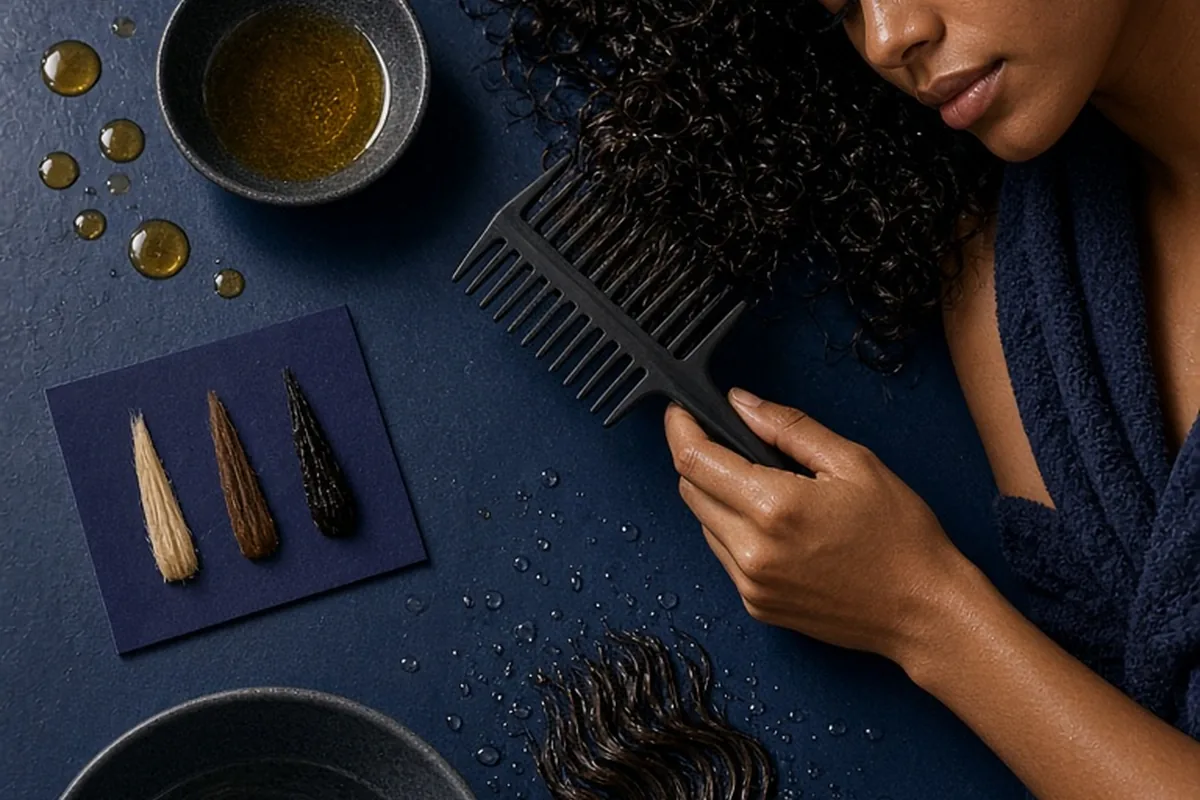
To prepare curly hair for moisturizing shampoo, start by applying a nourishing pre-shampoo oil or conditioner to dry or damp curls, which lubricates the strands and softens tangles. Gently detangle using your fingers or a wide-tooth comb from ends to roots to minimize mechanical breakage. Before dispensing shampoo, thoroughly drench your hair with warm water for several minutes so the cuticle swells slightly and lifts surface impurities without stripping natural sebum.
Cleansing curly hair requires balancing effective scalp purification with essential lipid preservation. Because curly and coily hair patterns naturally impede the smooth migration of scalp sebum down the fiber shaft, leaping directly into a wash without thorough preparation frequently causes knotting, fiber friction, and uneven moisture distribution.
Applying a Pre-Shampoo Treatment to Protect Fragile Curls
A pre-shampoo treatment, commonly called a pre-poo, forms a protective barrier over delicate curl cuticles prior to the introduction of surfactants. When curly hair gets wet, the hair shaft rapidly absorbs water and swells, a phenomenon known as hygral expansion. Repeated rapid swelling and contracting can fatigue the hair fiber over time. Applying a plant-derived oil or rich conditioning balm before washing creates a hydrophobic buffer that slows moisture influx, minimizing cuticle stress while softening accumulated styling residues.
To apply a pre-poo effectively, divide dry or slightly dampened hair into four or six manageable quadrants. Work a moderate amount of carrier oil, such as jojoba, sunflower, or argan oil, or a commercial pre-wash butter from the mid-lengths down to the ends where the hair is oldest and most porous. Smooth the product downward along the cuticle direction rather than rubbing strands together. Allow the treatment to sit for ten to twenty minutes under a shower cap so body heat gently softens stubborn product buildup and loosens shed hairs before you step into the shower.
Assessing Curl Porosity and Moisture Needs Before Selection
Understanding how your hair cuticle behaves when exposed to water and cosmetic agents allows you to tailor your preparation steps to your unique texture. Low-porosity curls feature tightly overlapping, flat cuticle scales that resist water penetration and product absorption. If you have low porosity, applying heavy raw butters prior to shampooing may cause unwanted coating, making it difficult for the moisturizing shampoo to cleanse the scalp. Instead, low-porosity hair benefits from brief exposure to gentle warmth or warm mist during the pre-wash phase to help open the cuticle layer.
High-porosity hair, by contrast, has raised, damaged, or naturally open cuticles that absorb water instantly but lose hydration just as quickly. For highly porous curls, preparation must focus on reinforcing strand elasticity and providing temporary structural replenishment. A pre-cleansing mask rich in hydrolyzed proteins, fatty alcohols, or ceramides helps fill microscopic gaps along the cuticle before shampooing. Tailoring your pre-wash treatment to your porosity baseline ensures that the moisturizing shampoo cleanses effectively without leaching residual moisture from the core cortex.
Gentle Detangling and Sectioning Strategies
Curly hair naturally sheds between fifty and one hundred strands daily, but because curls interlock, these shed hairs remain trapped within the curl pattern until physically cleared. If you apply shampoo to uncombed, tangled curls, the friction of washing mats these loose strands into tight, stubborn knots that are difficult to undo without mechanical damage. Preparing your hair through deliberate dry or oil-assisted detangling significantly reduces the risk of snap breakage and mid-shaft splits during washing.
Always begin detangling at the very ends of the hair, using a generous amount of pre-wash lubricant to provide slip. Work in small sections, gently separating knots with your fingertips before passing a wide-tooth seamless comb or a flexible-bristle detangling brush through the section. Once a section is free of tangles, loosely twist or clip it to the scalp before moving on to the next. Keeping your hair organized in dedicated twists or clips prevents neighboring sections from re-tangling when you transition to the shower basin.
Calibrating Water Saturation and Temperature for Textured Hair
Complete water saturation is a crucial yet frequently overlooked preparatory step before applying any moisturizing shampoo. Textured hair, particularly dense Type 3 and Type 4 curl patterns, often repels surface moisture initially, leaving inner layers dry even after standing under running water. If you apply shampoo to partially dry curls, the cleanser cannot distribute evenly, forcing you to use excessive product and causing localized friction that strips the hair unevenly.
Stand under a steady stream of lukewarm water for at least two to three minutes, using your hands to lift and separate your hair sections so water penetrates all the way to the roots and inner nape. Warm water encourages the cuticle to relax slightly, loosening environmental dust, sebum plugs, and water-soluble styling products. Avoid hot water, as high temperatures strip delicate surface lipids and inflame sensitive scalp tissue, while excessively cold water prevents stubborn styling polymers and heavy oils from emulsifying during the wash.
Screening Moisturizing Shampoo Formulations for Your Specific Curl Pattern
Not all moisturizing shampoos function identically; preparing your routine means verifying that your chosen formula matches your current scalp condition and curl requirements. An effective moisturizing shampoo for curly hair generally relies on mild non-ionic or amphoteric surfactants, such as cocamidopropyl betaine, sodium cocoyl isethionate, or decyl glucoside, rather than harsh primary detergents like sodium lauryl sulfate. These milder cleansers remove debris while leaving natural lipid structures intact.
Check ingredient lists for conditioning humectants and emollients, including vegetable glycerin, panthenol, aloe vera leaf juice, and unrefined seed oils. However, if your curls are prone to product accumulation from frequent stylers like edge controls or silicone serums, an overly rich moisturizing shampoo used exclusively can lead to limp strands and scalp irritation. Balance your routine by reviewing what products you applied during the week, choosing a gentle moisturizing cleanser for standard wash days and scheduling an occasional clarifying step when your scalp requires deeper purification.
Targeting the Scalp While Protecting Fragile Curl Lengths
A common mistake when using moisturizing shampoo is applying product indiscriminately along the entire length of the hair bundle. Shampoo is fundamentally engineered to clean the scalp, where sebum, sweat, exfoliated skin cells, and microbial flora collect. The mid-lengths and ends of curly hair rarely produce oils and require gentle preservation rather than direct detergent action.
Prepare for the wash step by dispensing a quarter-sized amount of shampoo into your palms and emulsifying it with a splash of water between your hands before touching your hair. Apply the lather directly onto your scalp along exposed section parts. Use the soft pads of your fingertips or an ergonomic silicone scalp massager in small circular motions to dislodge buildup. Allow the lather to rinse downward through the lengths naturally when you flush the hair with water; this indirect exposure is sufficient to cleanse delicate curl ends without stripping them.
Illustrative Scenarios
Adjusting Pre-Wash Prep for Fine, High-Density Curls
A composite client with fine, high-density Type 3B curls experienced persistent mid-length breakage and dullness after every wash. She previously applied rich coconut oil directly to dry hair and jumped immediately into washing without sectioning. By shifting her preparation routine to a lightweight jojoba pre-wash, dividing her hair into four loose twists, and ensuring a full three-minute warm water saturation before applying a sulfate-free moisturizing shampoo directly to her scalp, she eliminated tangling during lathering and maintained definition without weighing down her fine texture.
Key point: Matching pre-wash oil weight to strand diameter and thoroughly saturating sectioned hair before washing prevents mechanical breakage and avoids heavy product buildup.
Frequently asked questions
How often should you prepare curly hair with a pre-shampoo treatment?
Most curly textures benefit from a pre-shampoo treatment once a week or prior to every standard wash session if your hair is prone to dryness and tangling. If your hair is exceptionally fine or low porosity, limiting rich oil treatments to every other wash helps prevent product buildup while maintaining adequate slip.
Can you use regular conditioner as a pre-wash detangler?
Yes, a standard rinse-out conditioner with high slip works very well as a pre-shampoo detangler on dry or lightly dampened curls. Its conditioning agents coat the hair fiber, allowing fingers or wide-tooth combs to glide through knots easily before you begin cleansing.
Should moisturizing shampoo be applied to soaking wet or damp hair?
Moisturizing shampoo should always be applied to thoroughly soaking wet hair. Ample water allows the surfactant molecules to lather smoothly, distribute evenly across the scalp, and cleanse without creating abrasive friction between fragile curl clusters.
What should you do if your scalp feels greasy but your curl ends feel brittle?
Focus your preparatory detangling and pre-shampoo oils strictly from the mid-lengths to the ends, leaving the scalp clean and untreated. When washing, apply your moisturizing shampoo directly to the roots to remove excess oil while shielding your vulnerable ends with the pre-applied oil barrier.
Your next step
Divide your hair into four loose sections right now and apply a quarter-sized amount of lightweight oil or conditioner to your ends before stepping into your next wash.