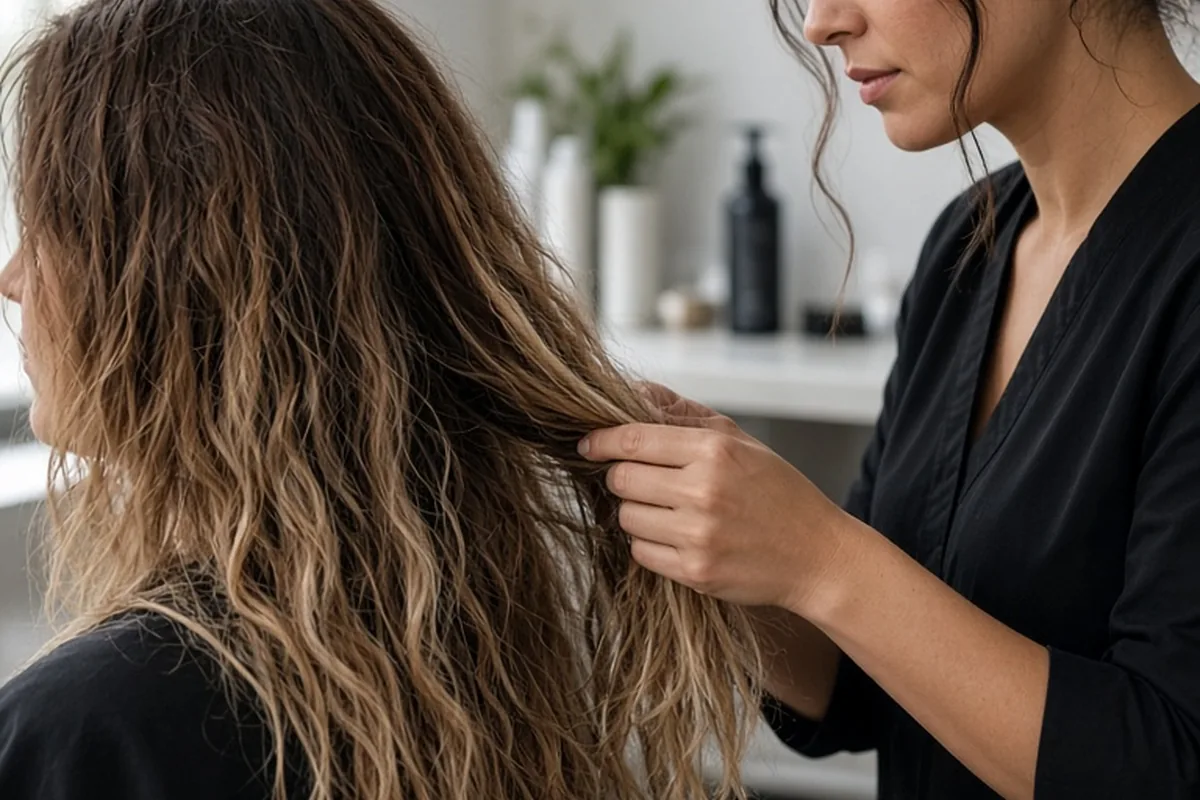
To talk to a stylist about hair damage, schedule a standalone consultation before booking any chemical services. Arrive with clean, product-free hair in its natural texture. Provide an honest history of every color, bleach, chemical, and heat treatment applied over the past two years. Describe your specific physical symptoms, such as wet elasticity, snap breakage, or lost curl patterns, and ask for a strand test to determine what your hair can safely tolerate.
Walking into a salon chair with compromised hair often brings feelings of hesitation, embarrassment, or fear that a professional will scold you or cut off all your length. Stylists encounter heat degradation, chemical over-processing, and mechanical stress every day, and they rely on open client communication to avoid compounding structural failure. Approaching the conversation as an objective diagnostic evaluation rather than a personal confession helps you establish a clear, collaborative recovery plan.
Booking a Standalone Salon Consultation Before Any Chemical Service
The standard appointment booking process works against clients with compromised hair. When you schedule an all-over lightening service, balayage, or perm through an online portal, the salon allocates a predetermined window of time tailored strictly to application, processing, and styling. If you sit down in the chair with brittle or mushy strands, the stylist faces an impossible dilemma: they must either rush a high-risk service to stay on schedule or cancel your appointment on the spot, leaving both of your schedules disrupted.
To avoid this pressure, book a separate 15-to-30-minute consultation several days or weeks before any active service. State clearly when booking that your hair has experienced recent stress or breakage and that you need a professional assessment of its tensile strength. A dedicated consultation removes the financial and temporal urgency to apply chemicals immediately, creating room for an unhurried, honest examination of your hair fiber.
Prepare for this appointment by arriving with hair that has been washed twenty-four hours prior, completely dried, and left free of heavy styling products, silicones, edge controls, or masking leave-in creams. Heavy conditioners and smoothing serums coat the hair shaft, masking porosity issues and creating a false sense of elasticity. If you have naturally wavy, curly, or coily hair, wear it in an unstretched wash-and-go state so the professional can see the genuine state of your curl clumping, natural shrinkage, and perimeter density.
Disclosing Past Bleach, Box Color, Keratin, and Heat Habits Without Apology
Stylists work with applied cosmetic chemistry, not personal judgment. Lighteners, oxidative dyes, perms, and relaxers trigger chemical shifts deep inside the hair cortex. If your stylist does not know what chemical compounds or thermal alterations already exist along the length of your hair, they cannot predict how modern salon formulas will react. Concealing past mistakes out of embarrassment frequently leads to severe chemical reactions, unpredicted color results, or extreme breakage.
Provide a comprehensive timeline of everything that has touched your hair over the past two to three years. Hair grows roughly half an inch each month, meaning shoulder-length hair retains roughly two to three years of environmental, thermal, and chemical exposure on its ends. Disclose every application of drugstore box dye, metallic vegetable dyes, henna, professional lightening, glosses, chemical straighteners, and salon smoothing treatments. Henna and metallic salts react violently with professional ammonia and hydrogen peroxide, sometimes producing smoke, heat spikes, and complete fiber dissolution.
Be equally precise about your home thermal routine. Instead of telling your stylist that you use a flat iron occasionally, tell them the exact temperature setting on your tool, how many passes you make per section, how many days per week you apply heat, and whether you consistently apply a dedicated heat protectant. Extreme direct heat crystallizes the natural keratin in the hair shaft, permanently melting the fiber's interior structure. Knowing your true thermal history allows the stylist to differentiate between superficial surface dryness and permanent heat degradation.
Translating Physical Hair Damage Symptoms into Professional Salon Terminology
Describing your hair simply as dry or frizzy gives a professional very little diagnostic data. Dryness is a surface condition often remedied by humectants and conditioning lipids, whereas true structural damage involves fractured protein bonds and stripped protective cuticles. To get an accurate assessment, describe the exact physical behavior of your hair when it is wet versus when it is dry.
Clarify whether you are observing natural shedding or mechanical breakage. Shedding occurs when a hair strand completes its growth cycle and falls from the follicle, visible by a tiny white bulb at the root end. Breakage consists of shorter, jagged pieces of varying lengths snapping off during detangling or styling without a root bulb. Explain where this breakage happens: near the scalp, across the crown, at the mid-lengths, or strictly at the brittle perimeter ends.
Detail your hair's wet tensile elasticity. If your hair stretches like a rubber band when wet, feels mushy or gummy, and fails to snap back to its original length, the internal cortex has lost its structural protein framework, typical of over-bleaching. Conversely, if your hair feels rough, wire-like, and snaps immediately under light tension without stretching at all, it suffers from severe porosity imbalance or brittle protein overload. For textured, curly, and coily hair, point out specific areas where the curl pattern has gone limp, where wave definition has flattened, or where mid-shaft split knots create constant tangling.
Evaluating In-Salon Bond Builders, Deep Reconstructors, and Necessary Trims
When discussing professional repair services, ask the stylist to separate structural stabilization from aesthetic smoothing. In-salon bond-building additives and multi-step polypeptide treatments work within the cortex to reconnect broken disulfide links or reinforce structural integrity. However, these systems do not reverse physical damage entirely; they act as scaffolding to preserve remaining strength. Ask the stylist whether a recommended service targets moisture replenishment, lipid barrier restoration, or intense protein reconstruction.
Face the conversation about cutting with practical clarity. Once the protective cuticle unravels and the hair shaft splits, no professional product or conditioning mask can fuse that hair fiber permanently back together. If split ends are not cut off, mechanical friction causes the split to travel upward toward the root, destroying healthy hair along the way. Ask your stylist to show you the minimum amount of length needed to eliminate split ends versus what would be required to achieve a completely thick, blunt hemline.
Discuss service costs, billing structures, and service tiers before committing to a treatment plan. Salon repair protocols vary significantly in price based on whether they are integrated as a quick chemical add-on, billed as a comprehensive standalone reconstructive service, or charged at an hourly corrective rate. Ask what the specific treatment involves, whether it requires dedicated processing under heat, and how frequently it must be repeated to sustain structural stability.
Setting Physical Boundaries Around Hair Length and Requiring a Strand Test
You always retain final authority over what happens to your hair in the salon chair. A common fear among clients is that a stylist will take scissor-happy liberties and cut off months or years of growth without consent. Communicate your boundaries clearly and calmly before the stylist touches a pair of shears. You can agree to a phased plan, such as removing half an inch every six weeks, rather than accepting a drastic four-inch chop in a single session.
If you or the stylist are debating whether your hair can withstand a desired chemical service, insist on a wet strand test. A strand test isolates a small, discreet section of hair—usually near the nape or behind the ear—and applies the proposed chemical formula for the full duration of processing. The stylist then rinses, dries, and physically pulls on the test strand to inspect for elasticity, breakage, or chemical reaction. A strand test provides definitive, indisputable proof of fiber endurance without endangering the rest of your hair.
Recognize warning signs during your consultation. If a stylist dismisses your breakage concerns, refuses to perform a strand test, promises a complete blonde transformation on heavily processed strands in a single afternoon, or makes you feel inferior for your hair's condition, do not proceed. A conscientious professional will tell you when a requested service is dangerous, decline to perform damaging processes, and propose conservative alternatives to protect your hair's long-term health.
Aligning on At-Home Recovery Protocols and a Phased Service Timeline
A salon treatment is merely the initial stabilization; your home routine determines whether your hair recovers or deteriorates further. Ask your stylist to outline precise maintenance rules tailored to your hair type and porosity. Inquire about recommended wash frequency, safe water temperatures, microfiber towel drying methods, sleep protection like silk bonnets or satin pillowcases, and the correct balance between moisturizing conditioners and strengthening protein treatments.
Handle professional product recommendations pragmatically. Stylists naturally recommend the professional lines carried by their salon because they understand how those specific formulations perform. However, purchasing an entire multi-step system can quickly exceed your budget. Ask the stylist to identify the single most critical active product for your damage type—such as a leave-in bond reconstructor or a thermal protectant—and ask what functional ingredients to look for in more affordable cleansers and daily conditioners.
Establish a realistic multi-month recovery timeline. Hair fiber cannot biologically heal itself the way human skin does; true structural recovery requires growing healthy, undamaged hair from the scalp while protecting existing length. Map out an appointment cadence with your stylist that prioritizes micro-trims every six to eight weeks and low-impact demi-permanent glosses to refresh tone rather than repeated permanent lifting. Establishing shared milestones ensures both you and your stylist measure progress against the same realistic expectations.
Frequently asked questions
What should I do if a stylist gets angry or judgmental about my hair damage?
Politely conclude the consultation and decline to book a service. Professional stylists maintain a diagnostic, empathetic standard of care and focus on workable solutions rather than assigning blame. You are hiring an expert for their technical skill, and you are never obligated to sit in a chair where you feel disrespected.
Can in-salon bond builders fix my hair completely so I do not need a cut?
Bond builders temporarily reconnect broken structural links inside the cortex, but they cannot permanently seal split ends or reverse severe mechanical thinning. While they provide significant strength and prevent further degradation, split ends will continue to fray upward unless the damaged ends are physically trimmed off.
How do I know if my curl pattern is heat-damaged or just dehydrated?
Dehydrated curls will regain their elasticity, spring, and clumping behavior after a thorough clarifying wash followed by a deep moisturizing steam treatment. Heat damage, by contrast, physically alters the keratin structure of the hair shaft; heat-damaged curls remain permanently limp, stringy, or straight regardless of how much moisture is applied.
Is it okay to bring photos of my desired hair color if my hair is currently damaged?
Yes, inspiration photos help your stylist understand your ultimate aesthetic goals. However, present them as a long-term destination rather than an immediate expectation, and ask your stylist what transitional phases and timelines are required to achieve that look safely without triggering catastrophic breakage.
Your next step
Inspect your hair in bright natural light today, write down a comprehensive list of every chemical and heat process applied over the past two years, and call a reputable local salon to schedule a standalone, 15-minute consultation.