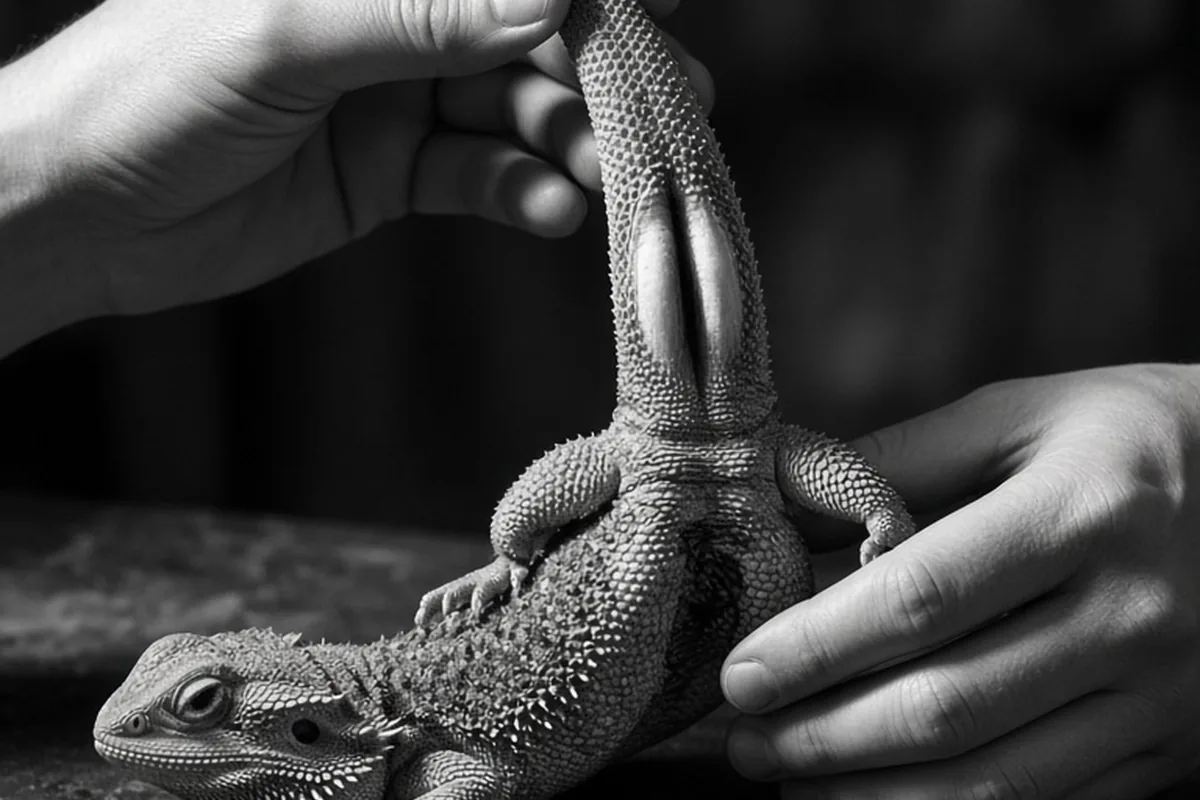
To tell a male bearded dragon from a female, gently lift the tail at a ninety-degree angle and inspect the underside above the vent. Males display two distinct vertical bulges along the outer edges of the tail base, separated by a central dip. Females have a single, centered bulge directly above the vent opening. You can also shine a flashlight through the top of the tail in a dark room to see these structures.
Accurately sexing a bearded dragon helps you provide appropriate habitat conditions, manage reproductive wellness, and prevent accidental breeding or territorial conflict. While young hatchlings look virtually identical, physical markers and behavioral traits become clearly distinguishable once a dragon approaches sub-adulthood.
The Tail-Lift Examination Method
The tail-lift method serves as the standard physical examination for determining a bearded dragon's sex. To perform this check safely, place your dragon on a flat, stable surface such as a table, your lap, or the floor of its enclosure. Allow the lizard to settle with its belly resting flat against the surface. Place your hand gently under the base of the tail and lift it upward toward the dragon's head at roughly a ninety-degree angle. Never bend the tail past ninety degrees or force the dragon into an uncomfortable posture, as excessive force can cause spinal strain or severe distress.
While holding the tail at this gentle angle, observe the underside of the tail base directly above the cloacal opening, also known as the vent. In a male bearded dragon, you will notice two raised, elongated vertical bumps running parallel on the left and right sides of the tail base, separated by a shallow valley in the center. These bulges house the hemipenes, the male reproductive organs. In contrast, a female bearded dragon exhibits a single, widened bump located right in the center above the vent line, without lateral side bulges. If the tail is not raised sufficiently, the skin may remain slack and obscure the bulges, so maintaining a steady, gentle upward lift is essential for clear visibility.
The Flashlight Candling Technique
When the visual tail-lift method yields ambiguous results, the flashlight candling technique provides a reliable, non-invasive alternative. This method relies on transillumination, where focused light passes through soft tissue to highlight internal anatomical structures. Choose a completely darkened room to maximize contrast, and use a small, high-powered LED flashlight or a smartphone torch. Resting your dragon securely on a flat surface or holding it in your palm, lift the tail gently to the standard ninety-degree angle.
Place the flashlight directly against the top, scaly side of the tail base, pointing the light beam downward toward the underside. Look directly at the illuminated underside of the tail. If your dragon is male, the light will reveal two distinct, elongated dark red shadows on either side of the tail base, representing the dense tissue of the hemipenal pockets. If your dragon is female, the area will either glow uniformly with an even pinkish-red hue or show a faint, single central shadow. Candling is particularly useful for younger dragons whose surface bulges have not fully developed, though you should ensure the light source does not emit excessive heat during the examination.
Femoral Pore Size and Secretion
Femoral pores offer another visible secondary sexual characteristic in mature bearded dragons. These pores consist of a distinct horizontal row of small, circular openings located on the underside of each hind thigh, extending from the knee toward the cloaca. Dragons use these specialized follicular glands to excrete a waxy, pheromone-rich substance that leaves chemical signals on rocks and wood as they move through their territory.
In sexually mature male bearded dragons, femoral pores appear significantly larger, darker, and more pronounced, often projecting slightly outward with visible waxy plugs. Female femoral pores, while present, remain much smaller, shallow, and faint, often looking like tiny, uniform dots that lie flush with the surrounding scales. While pronounced pores strongly suggest a male dragon, environmental factors such as humidity and substrate type can occasionally lead to clogged or enlarged pores in females. Consequently, pore size should serve as a secondary confirmation alongside the tail-lift or candling test rather than a sole diagnostic factor.
Head Shape, Beard Size, and Body Proportions
Adult male and female bearded dragons exhibit subtle morphological differences in overall body structure, shaped by sexual dimorphism. Mature males typically develop broader, more robust heads with a pronounced triangular silhouette when viewed from above. Their jaw muscles appear thicker, and the gular region—commonly called the beard—is substantially larger and covers a wider area beneath the chin and across the upper throat.
Females tend to display a more streamlined anatomy, featuring narrower, slender heads with softer contours and a comparatively smaller beard. Additionally, female bodies often have slightly wider abdomens to accommodate egg production, paired with a tail base that tapers evenly rather than widening immediately behind the vent. However, body shape alone carries significant limitations; variations in diet, genetics, growth rates, and specific morph lines can cause a robust female to resemble a male or a slender male to look feminine. Use head and body proportions purely as supplementary context.
Behavioral Differences and Seasonal Signals
Observing behavioral cues can provide helpful context regarding your dragon's sex, especially during active breeding seasons or when reacting to their environment. Mature males frequently engage in rapid, aggressive head bobbing to assert dominance or signal courtship readiness. This display is almost always accompanied by a jet-black beard that extends outward and sometimes spreads down to the chest and shoulders, occasionally paired with vigorous foot stamping.
Female bearded dragons display different classic behaviors, most notably slow, deliberate arm waving. This motion involves raising one front leg and rotating it in a circular, swimming motion to signal submission or acknowledge another dragon. During nesting periods, sexually mature females may also engage in frantic glass surfing, continuous pacing, and vigorous digging at the corners of their enclosure as they seek an appropriate site to deposit eggs. Keep in mind that behavioral boundaries are fluid; dominant females may occasionally head-bob, and subordinate males may arm-wave, so behaviors should always be weighed against physical checks.
Age, Timing, and When to Consult a Professional
Attempting to sex a bearded dragon too early is the most common cause of misidentification among reptile keepers. Hatchlings and young juveniles under four to six months of age—or under eight to ten inches in total length—possess underdeveloped reproductive organs that do not create distinct surface contours. Attempting to force a determination on a very young dragon often leads to inaccurate conclusions and unnecessary stress for the animal.
For optimal accuracy, wait until your bearded dragon reaches approximately six to eight months of age, when hormonal shifts make hemipenal bulges and femoral pores clearly evident. If you need confirmation sooner for cohabitation management, breeding plans, or medical evaluations, schedule an appointment with a qualified reptile veterinarian. A veterinarian can perform a gentle physical probe examination or use ultrasound imaging to confirm sex definitively without risking injury to delicate juvenile tissues.
Frequently asked questions
At what age can you accurately tell a bearded dragon's sex?
Most bearded dragons can be accurately sexed between six and eight months of age, once they reach roughly eight to ten inches in length. Attempting to sex dragons younger than six months often yields unreliable results because their reproductive structures have not fully developed.
Can a female bearded dragon lay eggs without a male present?
Yes, sexually mature female bearded dragons can produce and lay infertile egg clutches without ever mating with a male. If your female exhibits restless digging behavior and a rounded abdomen, provide a private lay box filled with moist soil and sand to prevent egg binding.
Is it safe to probe a bearded dragon's sex at home?
Probing should never be attempted at home by pet owners because improper tool insertion can easily rupture delicate internal tissues, tear the cloaca, or cause permanent injury. If visual and candling methods are inconclusive, have a licensed reptile veterinarian perform the procedure.
Your next step
Inspect your dragon's tail base on a flat surface using a gentle ninety-degree lift alongside a flashlight check to confirm the presence of dual male bulges or a single central female contour.